2 072 kr
Läs direkt efter köp
2 072 kr
Läs direkt efter köp
2 072 kr
Läs direkt efter köp
1 566 kr
Läs direkt efter köp
372 kr
Läs direkt efter köp
1 668 kr
Läs direkt efter köp
1 375 kr
Läs direkt efter köp
1 057 kr
Läs direkt efter köp
1 050 kr
Läs direkt efter köp
3 019 kr
Skickas inom 7-10 vardagar
1 733 kr
Skickas inom 3-6 vardagar
2 810 kr
Skickas inom 7-10 vardagar
1 371 kr
Skickas inom 7-10 vardagar
586 kr
Skickas inom 7-10 vardagar
1 206 kr
Skickas inom 7-10 vardagar
3 387 kr
Skickas inom 7-10 vardagar
585 kr
Skickas inom 7-10 vardagar
2 948 kr
Skickas inom 7-10 vardagar
2 088 kr
Skickas inom 3-6 vardagar
505 kr
Skickas inom 10-15 vardagar
1 838 kr
Skickas inom 10-15 vardagar
716 kr
Skickas inom 7-10 vardagar
1 872 kr
Skickas inom 7-10 vardagar
493 kr
Skickas inom 7-10 vardagar
589 kr
Läs direkt efter köp
Originally published in 1984, State Apparatus contributes to the debate on the theory of the state through posing questions regarding the state’s form, function, and apparatus.
The book begins by setting out the theoretical and methodological problems and reviewing the various Conservative, Liberal and Marxist theories in light of these. It discusses state activity, using specific case studies to clearly illustrate key points, such as the development of welfare systems in North America and Western Europe. It also explores the use of language under the state, the role of the legal apparatus within a capitalist system, and the "local state". The book concludes with a discussion of democracy and the crisis of legitimacy, and the issue of justice and the state.
State Apparatus is a detailed and comprehensive text, ideal for those with an interest in the history, theory, form, and function of the state.
585 kr
Läs direkt efter köp
Originally published in 1984, State Apparatus contributes to the debate on the theory of the state through posing questions regarding the state’s form, function, and apparatus.
The book begins by setting out the theoretical and methodological problems and reviewing the various Conservative, Liberal and Marxist theories in light of these. It discusses state activity, using specific case studies to clearly illustrate key points, such as the development of welfare systems in North America and Western Europe. It also explores the use of language under the state, the role of the legal apparatus within a capitalist system, and the "local state". The book concludes with a discussion of democracy and the crisis of legitimacy, and the issue of justice and the state.
State Apparatus is a detailed and comprehensive text, ideal for those with an interest in the history, theory, form, and function of the state.
2 114 kr
Skickas inom 10-15 vardagar
599 kr
Skickas inom 10-15 vardagar
690 kr
Läs direkt efter köp
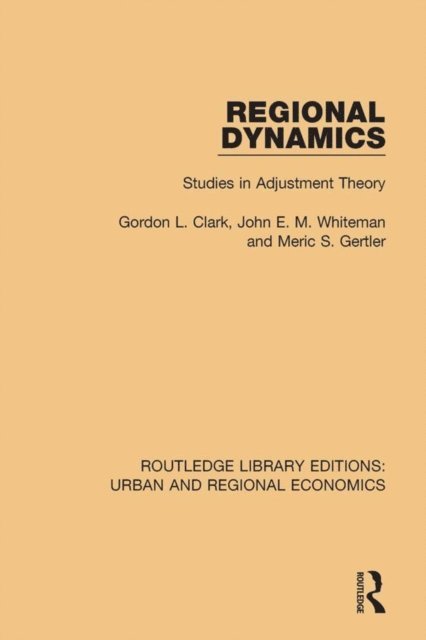
Originally published in 1986. This book is concerned with how regional economies adapt and respond to changing circumstances, and especially with the spatial system and processes of restructuring. Throughout the book there is a methodological commitment to adjustment theory - a unique analytical framework for the study of the dynamics of advanced capitalist economies. Instead of homogenising space in the manner of neoclassical economic theory, the authors focus on adjustment processes that produce and reproduce spatial differentiation.
The most important facets of regional economic structure are covered – employment, wages, prices, migration, and capital investment – in terms of their own dimensions and their connections with the larger theoretical framework. Each part of the book develops one particular dimension of regional adjustment, and each has an overview and summary. Within each part, there is a sequence of related studies focussing on the empirical aspects, theoretical logic, and distributive consequences of regional adjustment.
705 kr
Läs direkt efter köp
Originally published in 1986. This book is concerned with how regional economies adapt and respond to changing circumstances, and especially with the spatial system and processes of restructuring. Throughout the book there is a methodological commitment to adjustment theory - a unique analytical framework for the study of the dynamics of advanced capitalist economies. Instead of homogenising space in the manner of neoclassical economic theory, the authors focus on adjustment processes that produce and reproduce spatial differentiation.
The most important facets of regional economic structure are covered – employment, wages, prices, migration, and capital investment – in terms of their own dimensions and their connections with the larger theoretical framework. Each part of the book develops one particular dimension of regional adjustment, and each has an overview and summary. Within each part, there is a sequence of related studies focussing on the empirical aspects, theoretical logic, and distributive consequences of regional adjustment.
685 kr
Läs direkt efter köp
The worldwide rise of sovereign wealth funds is emblematic of the ongoing transformation of nation-state economic prospects. Sovereign Wealth Funds maps the global footprints of these financial institutions, examining their governance and investment management, and issues of domestic and international legitimacy. Through a variety of case studies--from the China Investment Corporation to the funds of several Gulf states--the authors show that the forces propelling the adoption and development of sovereign wealth funds vary by country. The authors also show that many of these investment institutions have identifiable commonalities of form and function that match the core institutions of Western financial markets. The authors suggest that the international legitimacy of sovereign wealth funds is based on the degree to which their design and governance match Western expectations about investment management. Undercutting commonplace assumptions about the emerging world of the twenty-first century, the authors demonstrate that even small countries with large and globally oriented sovereign wealth funds are likely to play a significant role in international relations. Sovereign Wealth Funds considers how such financial organizations have altered not only the face of finance, but also the international geopolitical landscape.