
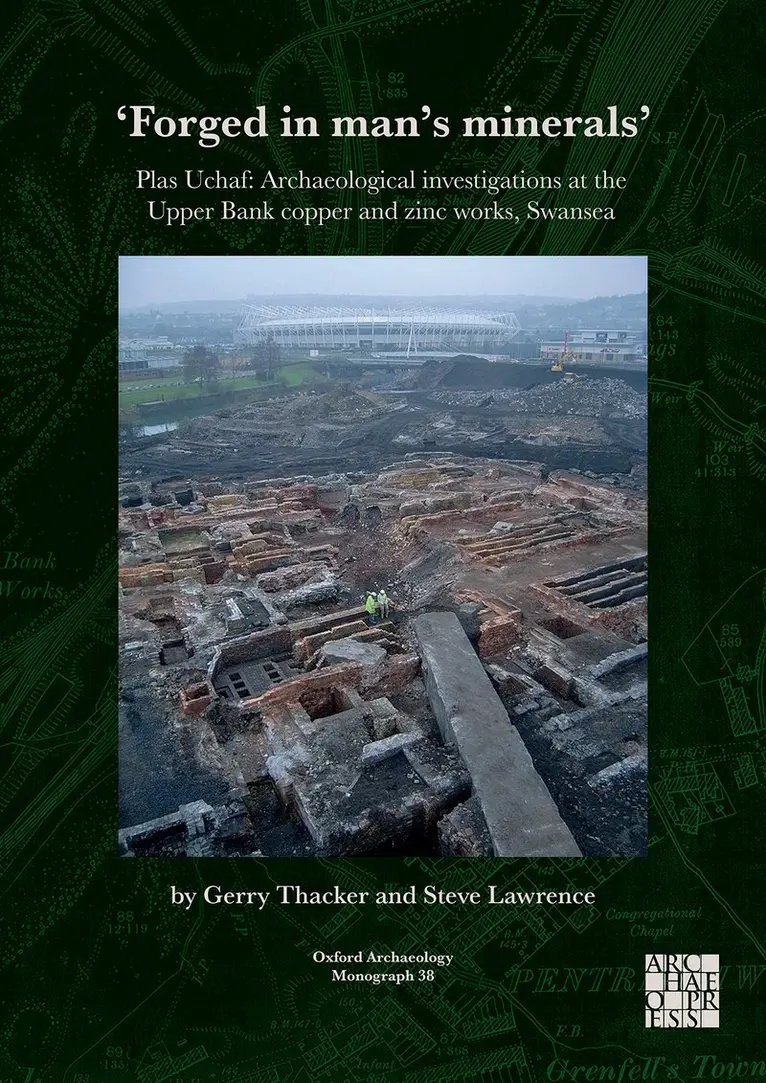
Del 38 - Oxford Archaeology Monograph
‘Forged in Man’s Minerals’: Plas Uchaf
Archaeological Investigations at the Upper Bank Copper and Zinc Works, Swansea
Häftad, Engelska, 2026
544 kr
Kommande
In its 19th century industrial heyday, Swansea in South Wales was the copper capital of the world, receiving ships laden with copper ore from South America, Australia, Europe and Africa and producing the majority of the world’s copper. This volume describes the results of excavations carried out by Oxford Archaeology at one of the industrial works in the area that became known as Copperopolis.The Upper Bank works on the east bank of the River Tawe was founded in 1757 for the smelting of lead and zinc. By 1782 it had turned to copper smelting, its operations using the technology known as the Welsh Process. The earliest structural remains belong to this key phase of activity. The works expanded during the early to mid-19th century, the industrial and structural evidence attributed to this period reflecting several phases of rebuilding and enlargement. The central area of the works was converted to zinc smelting in 1868, with much of the surviving structural remains associated with processes developed by Siemens. During World War II, part of the site was devoted to the production of munitions.The many artefacts recovered from the site provide insights into the use of the industrial installations, the supply and management of materials, and aspects of daily life, with evidence as varied as manufacturing waste, machine components, tools and fixings, crucibles, ingots and ingot moulds, ladles, rail track and barrow run plates, leather boots and soda bottles. The volume pieces together evidence from documentary and other archival sources, shining a light on key figures in the industry—Chauncey Townsend, Thomas Williams and Pascoe Grenfell among them—and placing the archaeological findings within their historical and social context.
