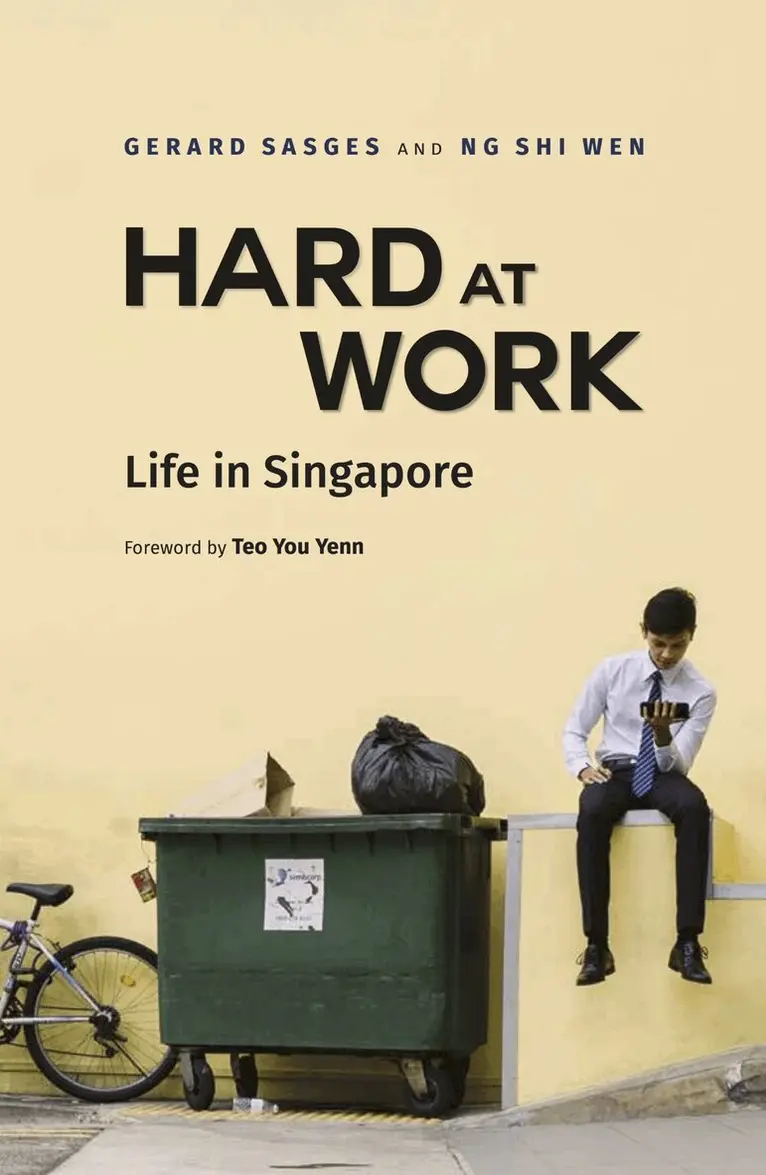
For most people in Singapore, having a job is just a fact of life. But that simple fact encompasses a wide range of experiences. Have you ever really considered what workers do on a daily basis and how they feel about their jobs?Have you ever walked past an ice cream uncle and wondered why he does that particular job and how he got it? Ever wondered what your barista is thinking of you as she takes your morning coffee order? Have you ever considered the tension that comes with being a gay volunteer police officer and being tasked with enforcing the law in a country where sex between consenting adult men is still a criminal act? What exactly does a funeral director do? And did you even know that jobs such as academic ghostwriter, temple flower seller and Thai disco girl agent exist?Hard at Work gives us access into the interior lives and experiences of more than fifty Singapore workers. It forms a snapshot of Singapore's working population that will fascinate contemporary and future readers.
For most of us, work is a basic daily fact of life. But that simple fact encompasses an incredibly wide range of experiences. Hard at Work takes readers into the day-to-day work experiences of more than fifty working people in Singapore who hold jobs that run from the ordinary to the unusual: from ice cream vendors, baristas, police officers and funeral directors to academic ghostwriters, temple flower sellers, and Thai disco girl agents. Through first-person narratives based on detailed interviews, vividly augmented with color photographs, Hard at Work reminds us of the everyday labor that continually goes on around us, and that every job can reveal something interesting if we just look closely enough. It shows us too the ways inequalities of status and income are felt and internalized in this highly globalized society.
This open access book provides fascinating insights into the incredible changes that Vietnam underwent in the long twentieth century as it transformed from an early modern kingdom to a European colony, to a divided land with opposing ideologies, and to a unified country in a globalized world. At each stage in this long century of changes, there were Vietnamese who sought to mold their society into some vision of “modernity.” The book looks at multiple, rather than one form of modernity, and links those forms with the different political moments that Vietnam experienced, in tandem with the outside interlocutors that were maintained during those periods. As such, this book provides a holistic view of the many forms of modernity and their global links that can be found in Vietnam over the course of the long twentieth century. These multiple modernities are documented in this book, and the authors do so by bringing together the strengths of “traditional” language-based area studies scholarship with the insights that an awareness of trans-national and global perspectives provides. Relevant to historians and researchers in the broader arena of Southeast Asian studies with a particular interest in Vietnam—its journey from past to present—this book is a must-read engagement with a country that has undergone and continues to experience, rapid transformation.
Through interviews and 70 photographs, It’s a Living reveals the energy and struggle of the world of work in Vietnam today. A goldfish peddler installing aquariums, a business school graduate selling shoes on the sidewalk, a college student running an extensive multi-level sales network, and a girl doing promotions but intent on moving into management are just a few of the people profiled.Based on frank and freewheeling interviews conducted by students, the book engages a broad range of Vietnamese on their feelings about work, life and getting ahead. By providing a ground-level view of the texture of daily working life in the midst of rapid and unsettling change, the book reveals Vietnam today as a place where ordinary people are leveraging whatever assets they have, not just to survive, but to make a better life for themselves, 24 hours a day, seven days a week.
Making liquor isn’t rocket science: some raw materials, a stove, and a few jury-rigged pots are all that’s really needed. So when the colonial regime in turn-of-the-century French Indochina banned homemade rice liquor, replacing it with heavily taxed, tasteless alcohol from French-owned factories, widespread clandestine distilling was the inevitable result. The state’s deeply unpopular alcohol monopoly required extensive systems of surveillance and interdiction and the creation of an unwieldy bureaucracy that consumed much of the revenue it was supposed to collect. Yet despite its heavy economic and political costs, this unproductive policy endured for more than four decades, leaving a lasting mark on Indochinese society, economy, and politics.The alcohol monopoly in Indochina was part of larger economic and political processes unfolding across the globe. New research on fermentation and improved still design drove the capitalization and concentration of the distilling industry worldwide, while modernizing states with increasing capacities to define, tax, and police engaged in a never-ending search for revenue. Indochina’s alcohol regime thus arose from the same convergence of industrial potential and state power that produced everything from Russian vodka to blended Scotch whisky. Yet with rice liquor part of everyday life for millions of Indochinese, young and old, men and women, villagers and city-folk alike, in Indochina these global developments would be indelibly shaped by the colony’s particular geographies, histories, and people.Imperial Intoxication provides a unique window on Indochina between 1860 and 1939. It illuminates the contradictory mix of modern and archaic, power and impotence, civil bureaucracy and military occupation that characterized colonial rule. It highlights the role Indochinese played in shaping the monopoly, whether as reformers or factory workers, illegal distillers or the agents sent to arrest them. And it links these long-ago stories to global processes that continue to play out today.