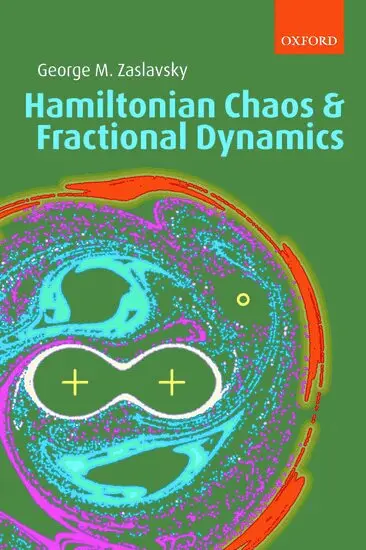
The dynamics of realistic Hamiltonian systems has unusual microscopic features that are direct consequences of its fractional space-time structure and its phase space topology. The book deals with the fractality of the chaotic dynamics and kinetics, and also includes material on non-ergodic and non-well-mixing Hamiltonian dynamics. The book does not follow the traditional scheme of most of today's literature on chaos. The intention of the author has been to put together some of the most complex and yet open problems on the general theory of chaotic systems. The importance of the discussed issues and an understanding of their origin should inspire students and researchers to touch upon some of the deepest aspects of nonlinear dynamics.The book considers the basic principles of the Hamiltonian theory of chaos and some applications including for example, the cooling of particles and signals, control and erasing of chaos, polynomial complexity, Maxwell's Demon, and others. It presents a new and realistic image of the origin of dynamical chaos and randomness. An understanding of the origin of randomness in dynamical systems, which cannot be of the same origin as chaos, provides new insights in the diverse fields of physics, biology, chemistry, and engineering.
This book aims to familiarize the reader with the essential properties of the chaotic dynamics of Hamiltonian systems by avoiding specialized mathematical tools, thus making it easily accessible to a broader audience of researchers and students. Unique material on the most intriguing and fascinating topics of unsolved and current problems in contemporary chaos theory is presented. The coverage includes: separatrix chaos; properties and a description of systems with non-ergodic dynamics; the distribution of Poincaré recurrences and their role in transport theory; dynamical models of the Maxwell's Demon, the occurrence of persistent fluctuations, and a detailed discussion of their role in the problem underlying the foundation of statistical physics; the emergence of stochastic webs in phase space and their link to space tiling with periodic (crystal type) and aperiodic (quasi-crystal type) symmetries.This second edition expands on pseudochaotic dynamics with weak mixing and the new phenomenon of fractional kinetics, which is crucial to the transport properties of chaotic motion.The book is ideally suited to all those who are actively working on the problems of dynamical chaos as well as to those looking for new inspiration in this area. It introduces the physicist to the world of Hamiltonian chaos and the mathematician to actual physical problems.The material can also be used by graduate students.
Over the last few years it has become apparent that fluid turbulence shares many common features with plasma turbulence, such as coherent structures and self-organization phenomena, passive scalar transport and anomalous diffusion. This book gathers very high level, current papers on these subjects. It is intended for scientists and researchers, lecturers and graduate students because of the review style of the papers.
P. Lévy's work on random walks with infinite moments, developed more than half a century ago, has now been fully appreciated as a foundation of probabilistic aspects of fractals and chaos as well as scale-invariant processes. This is the first book for physicists devoted to Lévy processes. It includes thorough review articles on applications in fluid and gas dynamics, in dynamical systems including anomalous diffusion and in statistical mechanics. Various articles approach mathematical problems and finally the volume addresses problems in theoretical biology. The book is introduced by a personal recollection of P. Lévy written by B. Mandelbrot.
Over the last few years it has become apparent that fluid turbulence shares many common features with plasma turbulence, such as coherent structures and self-organization phenomena, passive scalar transport and anomalous diffusion. This book gathers very high level, current papers on these subjects. It is intended for scientists and researchers, lecturers and graduate students because of the review style of the papers.