223 kr
Kommande
223 kr
Kommande
231 kr
Läs direkt efter köp
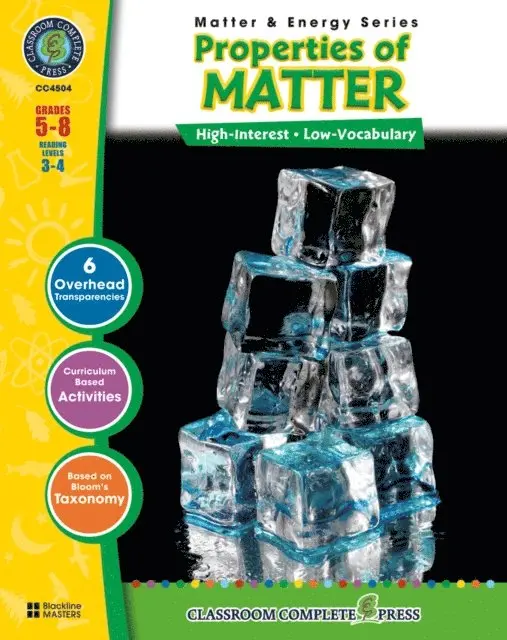
Discover what matter is and what it isn''t. Our resource breaks down the physical and chemical properties of matter to make it more accessible to students. Start off by identifying matter as atoms, particles and molecules. Then, explore the three states of matter: solid, liquid and gas. Determine whether something is transparent, opaque or translucent. List three physical changes and three chemical changes that could happen in the kitchen. Conduct an experiment to see chemical change in action. Describe the steps necessary when separating a mixture. Experiment with photosynthesis, an important chemical change. Aligned to the Next Generation Science Standards and written to Bloom''s Taxonomy and STEAM initiatives, additional hands-on experiments, crossword, word search, comprehension quiz and answer key are also included.
236 kr
Läs direkt efter köp
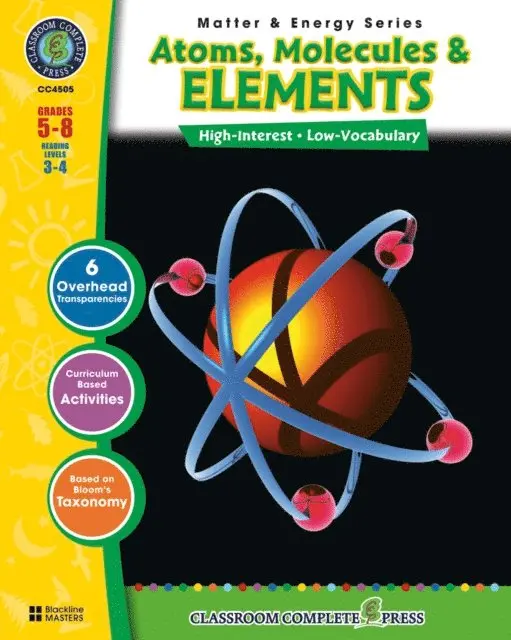
Young scientists will be thrilled to explore the invisible world of atoms, molecules and elements. Our resource makes the periodic table easier to understand. Begin by answering, what are atoms? See how the atomic model is made up of electrons, protons and neutrons. Find out what a molecule is, and how they differ from elements. Then, move on to compounds. Find the elements that make up different compounds. Get comfortable with the periodic table by recognizing each element as part of a group. Examine how patterns in the period table dictate how those elements react with others. Finally, explore the three important kinds of elements: metals, nonmetals and inert gases. Aligned to the Next Generation Science Standards and written to Bloom''s Taxonomy and STEAM initiatives, additional hands-on experiments, crossword, word search, comprehension quiz and answer key are also included.
236 kr
Läs direkt efter köp
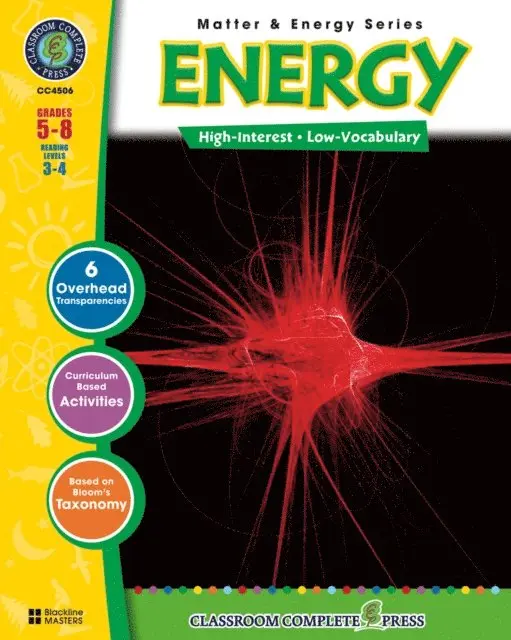
Unlock the mysteries of energy. Our resource demonstrates how energy is more than "the ability to do work". Learn about all the different kinds of energy. Dissect mechanical energy by identifying the different points on a roller coaster as using kinetic or potential energy. Find out how an object''s thermal energy is calculated from its kinetic energy. Understand that amplitude, wavelength and frequency are all part of sound waves, and use these terms to correctly label one. Take a look at the electromagnetic spectrum as you see all the colors of light energy. Explore other forms of potential energy from nonrenewable and renewable sources. Finally, measure the speed of sound in a group experiment. Aligned to the Next Generation Science Standards and written to Bloom''s Taxonomy and STEAM initiatives, additional hands-on experiments, crossword, word search, comprehension quiz and answer key are also included.
238 kr
Läs direkt efter köp
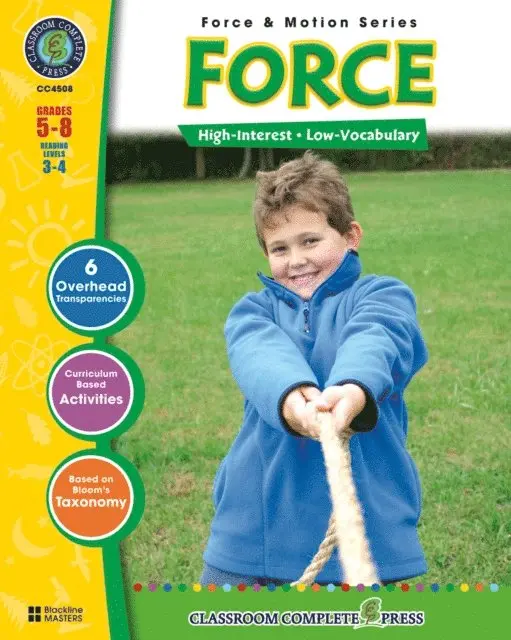
Forces are at work all around us. Our resource makes this invisible world easy to "see" and understand. Start by identifying what a force is before looking at different kinds of forces. Conduct several experiments on the force of friction and air resistance. Learn about net force and how more than one force acts on an object. Understand that acceleration and deceleration are examples of unbalanced forces. Explore how the force and mass of an arrow will affect its motion during flight. Explain how the force of gravity affects the weight of an object. Finally, take a look at magnetic and electrostatic forces as examples of forces that act without touching. Aligned to the Next Generation State Standards and written to Bloom''s Taxonomy and STEAM initiatives, additional hands-on experiments, crossword, word search, comprehension quiz and answer key are also included.
238 kr
Läs direkt efter köp
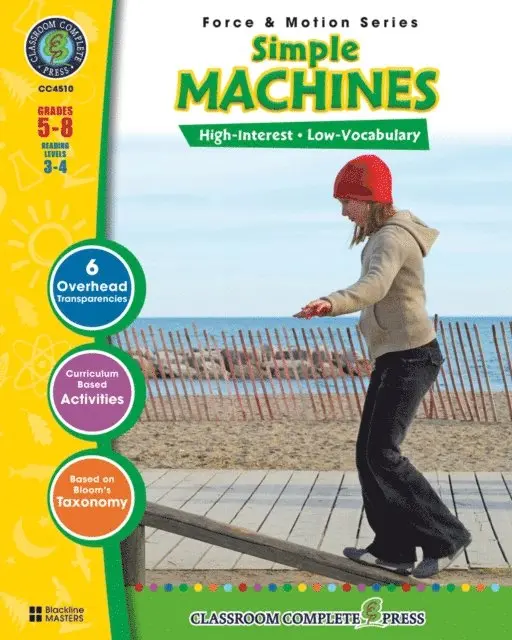
Just how simple are simple machines? Our resource makes these machines simple to teach and easy to learn. Understand that work is when a thing moves in the direction that a force is acting on it. Conduct an experiment with first-class levers to study distance and force. Explain how a wheel and axle can be used as a lever. Identify the three different kinds of pulleys. Find the resistance force when walking up an inclined plane. Figure out the direction of the effort force when using a wedge to split a log. Explain how a screw is a kind of inclined plane. Visit a hardware store to find as many simple and complex machines as possible. Aligned to the Next Generation State Standards and written to Bloom''s Taxonomy and STEAM initiatives, additional hands-on experiments, crossword, word search, comprehension quiz and answer key are also included.
439 kr
Läs direkt efter köp