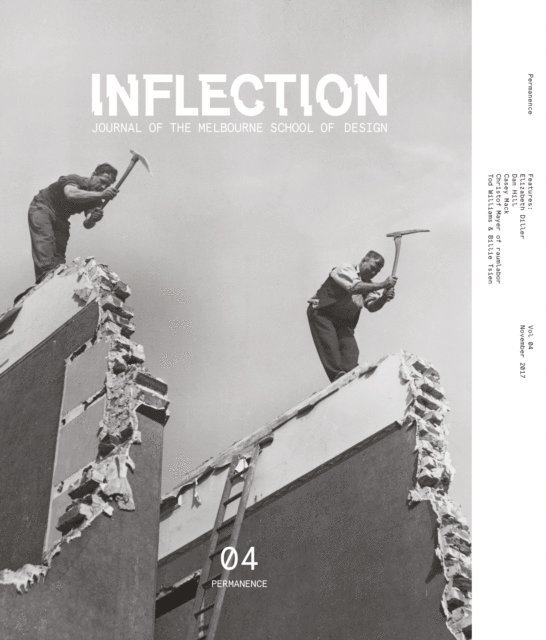
Permanence as an architectural concept is no longer restricted to the Vitruvian virtueof firmitas. To think about it in this sense today produces a schism: absolutism in aworld of relativism. The fourth volume of Inflection extrapolates the permanent andthe temporary not as opposing forces, but as a spectrum to be navigated at each stage of architecture''s unfolding narrative. Through each of the responses presented in this year''s edition, Permanence provides a critical voice as architecture and design continually seek an enduring foothold in an inherently evolving landscape, physical or otherwise.Inflection is a student-run design journal based at the Melbourne School of Design, University of Melbourne. Born from a desire to stimulate debate and generate ideas, it advocates the discursive voice of students, academics and practitioners. Founded in 2013, Inflection is a home for provocative writing—a place to share ideas and engage with contemporary discourse.
Permanence as an architectural concept is no longer restricted to the Vitruvian virtueof firmitas. To think about it in this sense today produces a schism: absolutism in aworld of relativism. The fourth volume of Inflection extrapolates the permanent andthe temporary not as opposing forces, but as a spectrum to be navigated at each stage of architecture''s unfolding narrative. Through each of the responses presented in this year''s edition, Permanence provides a critical voice as architecture and design continually seek an enduring foothold in an inherently evolving landscape, physical or otherwise.Inflection is a student-run design journal based at the Melbourne School of Design, University of Melbourne. Born from a desire to stimulate debate and generate ideas, it advocates the discursive voice of students, academics and practitioners. Founded in 2013, Inflection is a home for provocative writing—a place to share ideas and engage with contemporary discourse.
Aga Khan Award for Architecture 2019The Aga Khan Award for Architecture is one of the most prestigious and renowned awards for architecture worldwide. Since 1980 the Award has been given every three years to projects that combine social and ecological aspects and translate them into innovative and exemplary design. The Award seeks to identify and encourage building concepts that successfully address the needs and aspirations of societies across the world, in which Muslims have a significant presence.This publication presents the shortlist of the 2017–2019 award cycle. From a group of almost 400, 20 projects have been shortlisted by the Master Jury and evaluated by an expert group of technical reviewers. Some of these projects have been honoured with the Aga Khan Award. In addition to detailed descriptions of all projects, this book gathers a series of personal statements from the members of the Steering Committee and the Award’s Master Jury on key issues that were crucial in the discussions for the final selection and assignment of the award recipients. Assembled together, this book presents a selection of the outstanding examples of sustainable and socially relevant architecture in the world today and opens up fundamental perspectives for the planning of the future.