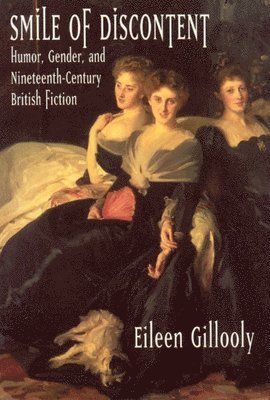
Like sex, Eileen Gillooly argues, humour has long been viewed as a repressed feature of 19th-century femininity. However, in the works of writers such as Jane Austen, George Eliot, Elizabeth Gaskell, Anthony Trollope, and Henry James, Gillooly finds an understated, wryly amusing perspective that differs subtly but significantly in rhetoric, affect, and politics from traditional forms of comic expression. Gillooly shows how such humour became, for mostly female writers at the time, an unobtrusive and prudent means of expressing discontent with a culture that was ideologically committed to restricting female agency and identity. If the aggression and emotional distance of irony and satire mark them as "masculine", then for Gillooly, the passivity, indirection, and sympathy of the humour she discusses render it "feminine." She goes on to disclose how the humorous tactics employed by writers from Burney to Wharton persist in the work of Barbara Pym, Anita Brookner, and Penelope Fitzgerald.
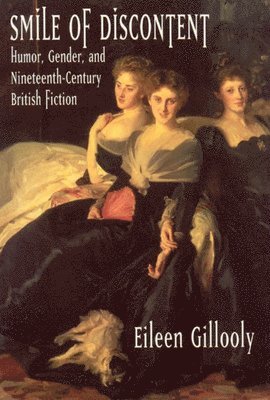
Like sex, Eileen Gillooly argues, humour has long been viewed as a repressed feature of 19th-century femininity. However, in the works of writers such as Jane Austen, George Eliot, Elizabeth Gaskell, Anthony Trollope, and Henry James, Gillooly finds an understated, wryly amusing perspective that differs subtly but significantly in rhetoric, affect, and politics from traditional forms of comic expression. Gillooly shows how such humour became, for mostly female writers at the time, an unobtrusive and prudent means of expressing discontent with a culture that was ideologically committed to restricting female agency and identity. If the aggression and emotional distance of irony and satire mark them as "masculine", then for Gillooly, the passivity, indirection, and sympathy of the humour she discusses render it "feminine." She goes on to disclose how the humorous tactics employed by writers from Burney to Wharton persist in the work of Barbara Pym, Anita Brookner, and Penelope Fitzgerald.
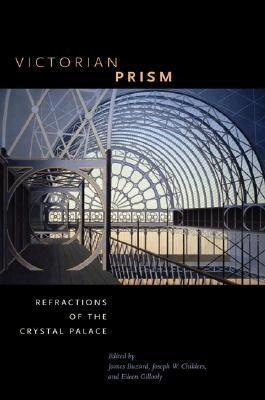
From the moment it opened on the first of May in the Crystal Palace in Hyde Park, London, the Great Exhibition of 1851 was one of the defining events of the Victorian period. It stood not only as a visible symbol of British industrial and technological progress but as a figure for modernity - a figure that has often been thought to convey one coherent message and vision of culture and society. This volume examines the place occupied both materially and discursively by the Crystal Palace and other nineteenth- and twentieth-century exhibitions in the struggle to understand what it means to be modern. Initiated in part by a number of conferences held in 2001 to commemorate the 150th anniversary of the Crystal Palace, ""Victorian Prism"" provides new perspectives to historians, literary critics, art historians, and others interested in how a large glass building in a London park could refract meaning from Caracas to Calcutta. In its investigations of the ways of knowing and shaping the world that emerged during the planning and execution of this first ""world's fair,"" ""Victorian Prism"" not only restores the multiplicity of experiences and other determining factors to our picture of the Great Exhibition; it makes reevaluation of the exhibition and its legacies the occasion for reevaluating modernity itself in its broadest sense - as the cultures, potentialities, and liabilities of the Enlightenment. With essays by a number of leading scholars in their fields, the collection as a whole focuses on how these exhibitions, in attempting to define the cultures of their day, incorporated a range of conflicting ideologies and agendas. In doing so, it offers a richer, more complex understanding of the experience of modernity than we have previously acknowledged. The volume also addresses the ways in which the cultural processes and tendencies brought together in these exhibitions have been refracted down to the present, thus informing and complicating our own relationship to both modernity and post-modernity.