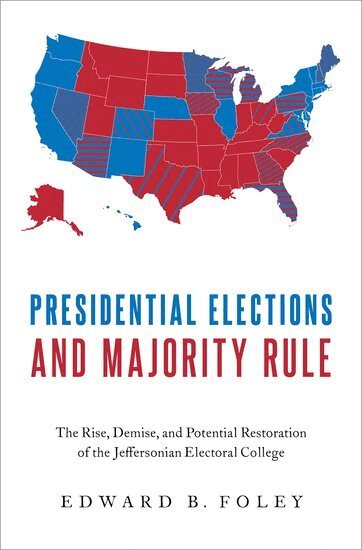
The Electoral College that governs America has been with us since 1804, when Thomas Jefferson's supporters redesigned it for his re-election. The Jeffersonians were motivated by the principle of majority rule. Gone were the days when a president would be elected by acclamation, as George Washington had been. Instead, given the emergence of intense two-party competition, the Jeffersonians wanted to make sure that the Electoral College awarded the presidency to the candidate of the majority, rather than minority, party. They also envisioned that a candidate would win by amassing a majority of Electoral College votes secured from states where the candidate's party was in the majority.For most of American history, this system has worked as intended, producing presidents who won Electoral College victories derived from state-based majorities. In the last quarter-century, however, there have been three significant aberrations from the Jeffersonian design: 1992, 2000, and 2016. In each of these years, the Electoral College victory depended on states where the winner received only a minority of votes. In this authoritative history of the American Electoral College system, Edward Foley analyzes the consequences of the unparalleled departure from the Jeffersonians' original intent and delineates what we can do about it. He explains how states, by simply changing their Electoral College procedures, could restore the original Jeffersonian commitment to majority rule. There are various ways to do this, all of which comply with the Constitution. If only a few states had done so before 2016, the outcome might have been different. Doing so before future elections can prevent another victory that, contrary to the original Jeffersonian intent, a majority of voters did not want.
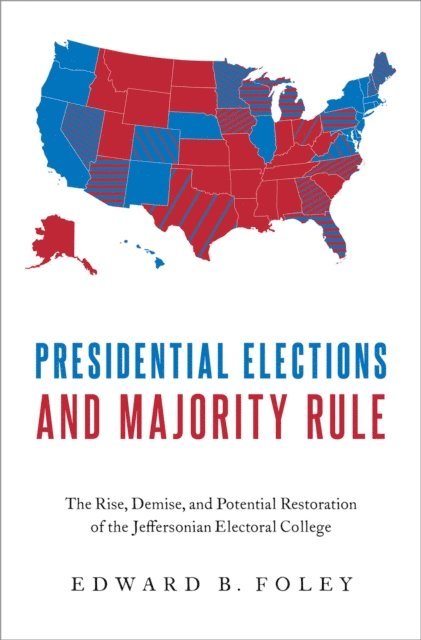
The Electoral College that governs America has been with us since 1804, when Thomas Jefferson''s supporters redesigned it for his re-election. The Jeffersonians were motivated by the principle of majority rule. Gone were the days when a president would be elected by acclamation, as George Washington had been. Instead, given the emergence of intense two-party competition, the Jeffersonians wanted to make sure that the Electoral College awarded the presidency to the candidate of the majority, rather than minority, party. They also envisioned that a candidate would win by amassing a majority of Electoral College votes secured from states where the candidate''s party was in the majority.For most of American history, this system has worked as intended, producing presidents who won Electoral College victories derived from state-based majorities. In the last quarter-century, however, there have been three significant aberrations from the Jeffersonian design: 1992, 2000, and 2016. In each of these years, the Electoral College victory depended on states where the winner received only a minority of votes. In this authoritative history of the American Electoral College system, Edward Foley analyzes the consequences of the unparalleled departure from the Jeffersonians'' original intent-and delineates what we can do about it. He explains how states, by simply changing their Electoral College procedures, could restore the original Jeffersonian commitment to majority rule. There are various ways to do this, all of which comply with the Constitution. If only a few states had done so before 2016, the outcome might have been different. Doing so before future elections can prevent another victory that, contrary to the original Jeffersonian intent, a majority of voters did not want.
A timely look into and argument for the Jeffersonian Electoral College.The Electoral College that governs America has been with us since 1804, when Thomas Jefferson's supporters redesigned it for his re-election. The Jeffersonians were motivated by the principle of majority rule. Gone were the days when a president would be elected by acclamation, as George Washington had been. Instead, given the emergence of intense two-party competition, the Jeffersonians wanted to make sure that the Electoral College awarded the presidency to the candidate of the majority, rather than minority, party. They also envisioned that a candidate would win by amassing a majority of Electoral College votes secured from states where the candidate's party was in the majority.For most of American history, this system has worked as intended, producing presidents who won Electoral College victories derived from state-based majorities. In the last quarter-century, however, there have been three significant aberrations from the Jeffersonian design: 1992, 2000, and 2016. In each of these years, the Electoral College victory depended on states where the winner received only a minority of votes. In this authoritative history of the American Electoral College system, Edward Foley analyzes the consequences of the unparalleled departure from the Jeffersonians' original intent-and delineates what we can do about it. He explains how states, by simply changing their Electoral College procedures, could restore the original Jeffersonian commitment to majority rule. There are various ways to do this, all of which comply with the Constitution. If only a few states had done so before 2016, the outcome might have been different. Doing so before future elections can prevent another victory that, contrary to the original Jeffersonian intent, a majority of voters did not want.
The 2000 presidential race resulted in the highest-profile ballot battle in over a century. But it is far from the only American election determined by a handful of votes and marred by claims of fraud. Since the founding of the nation, violence frequently erupted as the votes were being counted, and more than a few elections produced manifestly unfair results. Despite America's claim to be the world's greatest democracy, its adherence to the basic tenets of democratic elections-the ability to count ballots accurately and fairly even when the stakes are high-has always been shaky. A rigged gubernatorial election in New York in 1792 nearly ended in calls for another revolution, and an 1899 gubernatorial race even resulted in an assassination. Though acts of violence have decreased in frequency over the past century, fairness and accuracy in ballot counting nonetheless remains a basic problem in American political life. In Ballot Battles, Edward Foley presents a sweeping history of election controversies in the United States, tracing how their evolution generated legal precedents that ultimately transformed how we determine who wins and who loses. While weaving a narrative spanning over two centuries, Foley repeatedly returns to an originating event: because the Founding Fathers despised parties and never envisioned the emergence of a party system, they wrote a constitution that did not provide clear solutions for high-stakes and highly-contested elections in which two parties could pool resources against one another. Moreover, in the American political system that actually developed, politicians are beholden to the parties which they represent - and elected officials have typically had an outsized say in determining the outcomes of extremely close elections that involve recounts. This underlying structural problem, more than anything else, explains why intense ballot battles that leave one side feeling aggrieved will continue to occur for the foreseeable future. American democracy has improved dramatically over the last two centuries. But the same cannot be said for the ways in which we determine who wins the very close races. From the founding until today, there has been little progress toward fixing the problem. Indeed, supporters of John Jay in 1792 and opponents of Lyndon Johnson in the 1948 Texas Senate race would find it easy to commiserate with Al Gore after the 2000 election. Ballot Battles is not only the first full chronicle of contested elections in the US. It also provides a powerful explanation of why the American election system has been-and remains-so ineffective at deciding the tightest races in a way that all sides will agree is fair.
"This volume is a treasure trove of ideas about how to make our electoral system better—less polarized, more responsive to citizens. In it, big thinkers discuss big ideas. Their analyses are rich, detailed, and incisive. This might very well turn out to be the book that launches a thousand reforms." —Costas Panagopoulos, Northeastern University"At this time when distrust and partisanship are too often justifications for the status quo, the authors offer evidence-based, consensus-driven, achievable proposals to improve governance in the United States. Anyone interested in reforming US democracy should start here."—Derek T. Muller, Notre Dame Law School In the midst of the political ugliness that has become part of our everyday reality, are there steps that can be taken to counter polarization and extremism—practical steps that are acceptable across the political spectrum? To answer that question, starting from the premise that the way our political processes are designed inevitably creates incentives for certain styles of politics and candidates, the Task Force on American Electoral Reform spent two years exploring alternative ideas for reforming key aspects of the US electoral process. The results of their work are presented in this essential book.
St.-Denis is celebrated as the birthplace of Gothic architecture, the place of origin for the largest vernacular history project in the Middle Ages, the repository for one of the richest treasuries in medieval Europe and the most important royal necropolis in the history of France. This publication makes available a complete edition of the richest liturgical manuscript of St.-Denis in existence. Paris, Bibliothèque Mazarine 526 is the single most important resource for reconstructing worship at the royal abbey in the twelfth and thirteenth centuries. Reflecting the work of Abbot Suger ( d. 1151) this codex, written c. 1234, documents the state of worship in the hybrid Gothic-Carolingian church which existed until the late thirteenth century. Beginning with First Vespers of the First Sunday of Advent and continuing through the entire temporal cycle and eleven of twelve months of the sanctoral cycle, this manuscript details the places, ministers, texts, artifacts, bells, vesture, processions and other rubrics which allow this liturgy to be thoroughly examined. This edition is complemented by extensive inices which allow access to all of the almost 5000 liturgical texts contained in the manuscript. An accompanying study of the manuscript, introduced by an essey on the history of St.-Denis, analyzes three important aspects of this worship: the structure of the offices, the calendar of saints and anniversaries, and the spatial deployment of the worship.