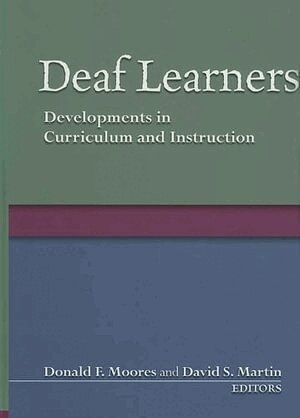
"Deaf Learners: Developments in Curriculum and Instruction", edited by Donald F. Moores and David S. Martin, presents an in-depth collection by 17 renowned international scholars that details a developmental framework to maximize academic success for deaf students from kindergarten through grade 12. Part One: The Context commences with an overview of the state of general education and that of deaf learners, followed by a state-of-the art philosophical position on the selection of curriculum. Part Two: The Content considers critical subjects for deaf learners and how to deliver them, including mathematics, print literacy, science, social studies, and physical education. This section also addresses the role of itinerant services, as well as how to teach Deaf culture, provide for students with multiple disabilities, and facilitate school-to-work transitions.Chapters in Part Three: Instructional Considerations across the Curriculum provides suggestions and guidelines for assessing and planning programs for deaf students using meaningful contexts; optimizing the academic performance of deaf students with emphasis on access and opportunities; implementing a cognitive strategy that encourages teaching for and about thinking as an overriding principle; establishing instructional and practical communication in the classroom, especially in relation to ASL and English-based signing; and solving old problems with new strategies, including web-based technologies, resources, and applications. The lessons of these assembled scholars coalesce in the Part Four: Summary as a general recommendation for ongoing adaptability, a fitting capstone to this extraordinary volume of work.
International perspectives about literacy and deaf students is an uncharted intellectual landscape. Much of the literacy research in deaf education is conducted in English-speaking countries—primarily the United States—but 90% of deaf children live outside the U.S. and learn various signed and spoken languages, as well as diverse writing systems. Many of these children face significant educational challenges. In order to improve the literacy outcomes of deaf students around the world, it is imperative to study how children are using their local signed and spoken languages along with Deaf culture to learn to read and write. This volume fills a void in the field by providing a global view of recent theoretical and applied research on literacy education for deaf learners.Literacy and Deaf Education: Toward a Global Understanding is organized by region and country, with the first part discussing writing systems that use alphabetic scripts, and the second part focusing on countries that use non-alphabetic scripts. Some examples of the wide spectrum of topics covered include communication methodologies, curriculum, bilingual education, reading interventions, script diversity, and sociocultural development, including Deaf cultural developments. The contributors provide the results from literacy projects in fifteen countries and regions.This volume aims to widen the knowledge base, familiarize others in the field with these initiatives, and improve global understandings and outcomes of literacy teaching and learning in deaf education from birth to high school.Signed chapter summaries are available on the Gallaudet University Press YouTube channel.