6 121 kr
Kommande
6 121 kr
Kommande
272 kr
Skickas inom 3-6 vardagar
390 kr
Skickas inom 10-15 vardagar
526 kr
Läs direkt efter köp
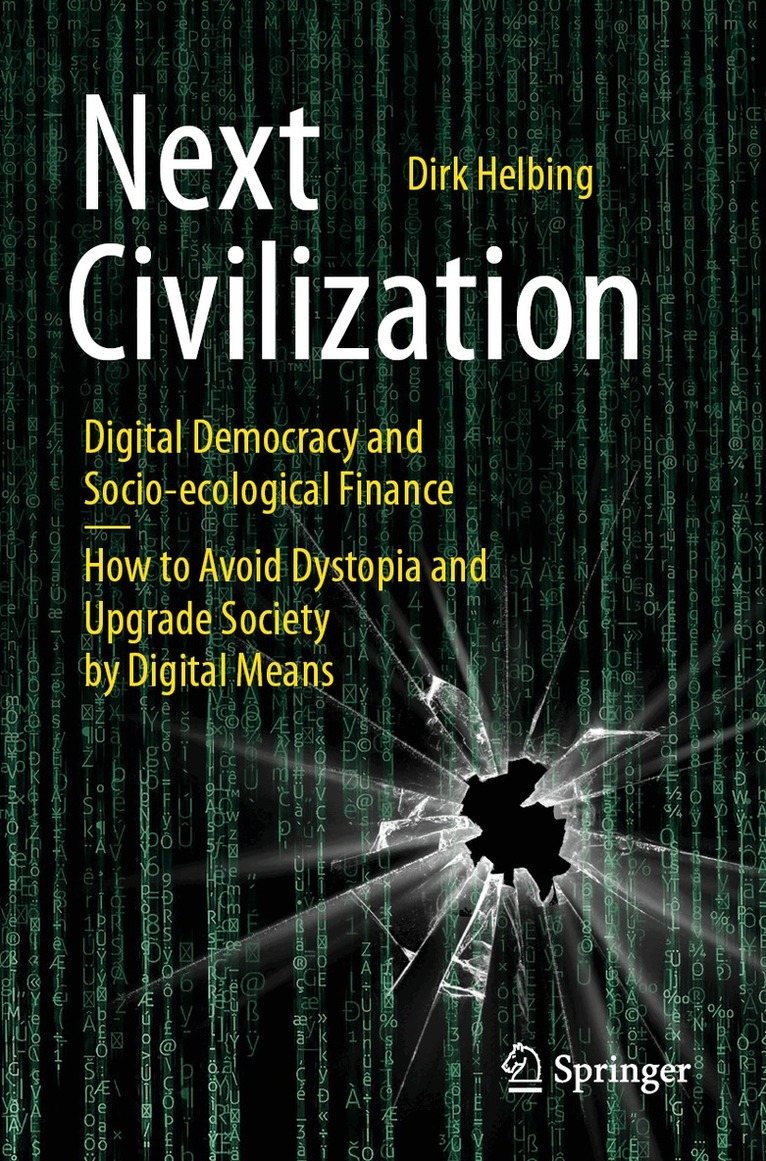
"Digital transformation" sounds harmless, given that the explosion in data volumes, processing power and Artificial Intelligence has driven humanity and the entire world to a point of no return. We will surely see a new civilization, but we are at a crossroads. The future needs to be re-invented, decisions must be taken.
After the automation of factories and the creation of self-driving cars, the automation of society is on its way. But there are two kinds of automation: a centralized top-down control of the world and a distributed control approach, supporting local self-organization. Using the power of today’s information systems, governments and big tech companies seem to engage in the first approach. Might they even build a „digital Crystal Ball“ that knows almost everything, including your personality, and a super-intelligent "digital God“ to control what we do?
We are much closer to such „science fiction scenarios“ than you probably think.
In this much expanded second edition of "The Automation of Society is Next: How to Survive the Digital Revolution" (2015), the author discusses lessons learned on digital democracy, aspects of transhumanism and far-reaching thoughts about life in the digital age and what it may mean to be human in the future.
460 kr
Skickas inom 10-15 vardagar
310 kr
Skickas inom 10-15 vardagar
437 kr
Läs direkt efter köp
The rapidly progressing digital revolution is now touching the foundations of the governance of societal structures. Humans are on the verge of evolving from consumers to prosumers, and old, entrenched theories – in particular sociological and economic ones – are falling prey to these rapid developments. The original assumptions on which they are based are being questioned. Each year we produce as much data as in the entire human history - can we possibly create a global crystal ball to predict our future and to optimally govern our world? Do we need wide-scale surveillance to understand and manage the increasingly complex systems we are constructing, or would bottom-up approaches such as self-regulating systems be a better solution to creating a more innovative, more successful, more resilient, and ultimately happier society? Working at the interface of complexity theory, quantitative sociology and Big Data-driven risk and knowledge management, the author advocates the establishment of new participatory systems in our digital society to enhance coordination, reduce conflict and, above all, reduce the “tragedies of the commons,” resulting from the methods now used in political, economic and management decision-making.
The author
Physicist Dirk Helbing is Professor of Computational Social Science at the Department of Humanities, Social and Political Sciences and an affiliate of the Computer Science Department at ETH Zurich, as well as co-founder of ETH’s Risk Center. He is internationally known for the scientific coordination of the FuturICT Initiative which focuses on using smart data to understand techno-socio-economic systems.
“Prof. Helbing has produced an insightful and important set of essays on the ways in which big data and complexity science are changing our understanding of ourselves and our society, and potentially allowing us to manage our societies much better than we are currently able to do. Of special note are the essays that touch on the promises of big data along with the dangers...this is material that we should all become familiar with!” Alex Pentland, MIT, author of Social Physics: How Good Ideas Spread - The Lessons From a New Science
"Dirk Helbing has established his reputation as one of the leading scientific thinkers on the dramatic impacts of the digital revolution on our society and economy. Thinking Ahead is a most stimulating and provocative set of essays which deserves a wide audience.” Paul Ormerod, economist, and author of Butterfly Economics and Why Most Things Fail.
"It is becoming increasingly clear that many of our institutions and social structures are in a bad way and urgently need fixing. Financial crises, international conflicts, civil wars and terrorism, inaction on climate change, problems of poverty, widening economic inequality, health epidemics, pollution and threats to digital privacy and identity are just some of the major challenges that we confront in the twenty-first century. These issues demand new and bold thinking, and that is what Dirk Helbing offers in this collection of essays. If even a fraction of these ideas pay off, the consequences for global governance could be significant. So this is a must-read book for anyone concerned about the future." Philip Ball, science writer and author of Critical Mass
“This collection of papers, brought together by Dirk Helbing, is both timely and topical. It raises concerns about Big Data, which are truly frightening and disconcerting, that we do need to be aware of; while at the same time offering some hope that the technology, which has created the previously unthought-of dangers to our privacy, safety and democracy can be the means to address these dangers by enabling social, economic and political participation and coordination, not possible in the past. It makes for compelling reading and I hope for timely action.”Eve Mitleton-Kelly, LSE, author of Corporate Governance and Complexity Theory and editor of Co-evolution of Intelligent Socio-technical Systems

359 kr
Skickas inom 10-15 vardagar
475 kr
Läs direkt efter köp
This new collection of essays follows in the footsteps of the successful volume Thinking Ahead - Essays on Big Data, Digital Revolution, and Participatory Market Society, published at a time when our societies were on a path to technological totalitarianism, as exemplified by mass surveillance reported by Edward Snowden and others.
Meanwhile the threats have diversified and tech companies have gathered enough data to create detailed profiles about almost everyone living in the modern world - profiles that can predict our behavior better than our friends, families, or even partners. This is not only used to manipulate peoples’ opinions and voting behaviors, but more generally to influence consumer behavior at all levels. It is becoming increasingly clear that we are rapidly heading towards a cybernetic society, in which algorithms and social bots aim to control both the societal dynamics and individual behaviors.
However there are also silver linings: most of the threats that have accumulated over the past years have been identified and regulations are on the way to being introduced. Furthermore, entirely novel approaches based on blockchain technology and other developments derived from complexity science offer the possibility of entirely redefining collective trust and building platforms to support our core societal values.
1 547 kr
Skickas inom 10-15 vardagar
1 140 kr
Skickas inom 10-15 vardagar
1 470 kr
Läs direkt efter köp
Each chapter in Managing Complexity focuses on analyzing real-world complex systems and transferring knowledge from the complex-systems sciences to applications in business, industry and society. The interdisciplinary contributions range from markets and production through logistics, traffic control, and critical infrastructures, up to network design, information systems, social conflicts and building consensus. They serve to raise readers'' awareness concerning the often counter-intuitive behavior of complex systems and to help them integrate insights gained in complexity research into everyday planning, decision making, strategic optimization, and policy.
Intended for a broad readership, the contributions have been kept largely non-technical and address a general, scientifically literate audience involved in corporate, academic, and public institutions.
1 139 kr
Skickas inom 10-15 vardagar
1 106 kr
Skickas inom 10-15 vardagar
1 427 kr
Läs direkt efter köp
1 657 kr
Skickas inom 10-15 vardagar
2 111 kr
Läs direkt efter köp
Cetraro, Italy 2009, Editors: Benedetto Piccoli, Michel Rascle
1 325 kr
Skickas inom 10-15 vardagar
1 785 kr
Läs direkt efter köp
1 107 kr
Skickas inom 10-15 vardagar
1 655 kr
Skickas inom 10-15 vardagar
1 277 kr
Läs direkt efter köp
1 444 kr
Skickas inom 10-15 vardagar