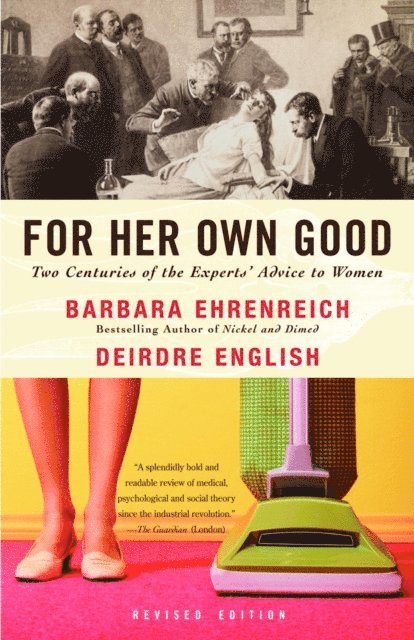
This women''s history classic brilliantly exposed the constraints imposed on women in the name of science and exposes the myths used to control them. Since the the nineteenth century, professionals have been invoking scientific expertise to prescribe what women should do for their own good. Among the experts’ diagnoses and remedies: menstruation was an illness requiring seclusion; pregnancy, a disabling condition; and higher education, a threat to long-term health of the uterus. From clitoridectomies to tame women’s behavior in the nineteenth century to the censure of a generation of mothers as castrators in the 1950s, doctors have not hesitated to intervene in women’s sexual, emotional, and maternal lives. Even domesticity, the most popular prescription for a safe environment for woman, spawned legions of “scientific” experts. Barbara Ehrenreich and Dierdre English has never lost faith in science itself, butinsist that we hold those who interpret it to higher standards. Women are entering the medical and scientific professions in greater numbers but as recent research shows, experts continue to use pseudoscience to tell women how to live. For Her Own Good provides today’s readers with an indispensable dose of informed skepticism.
The classic work on women''s health and how the medical establishment helped to justify sexism, by the authors of Witches, Midwives, and Nurses.From Barbara Ehrenrich, New York Times-bestselling author of Nickel and Dimed, Bright-Sided, and other titles, and Deirdre English, former editor of Mother Jones, this book delves into the history of how women have been diagnosed, defined, and often dismissed, by doctors, a problem that persists even today.From claiming scientific proof of female inferiority to prescribing the "rest cure" to labeling patients as "hysterical," the medical profession treated women as weak and pathological—and here, the authors of the "underground classic" Witches, Midwives, and Nurses (Kirkus Reviews) show how this biomedical rationale was used to justify sex discrimination throughout the culture, as well as how its vestiges are still evident in abortion policy and other reproductive rights struggles.