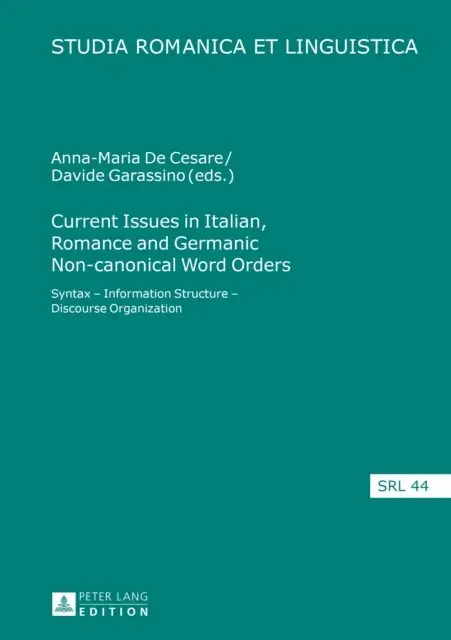
This volume aims at offering an up-to-date survey on non-canonical word orders and their interplay with information structure and discourse organization. The contributions analyze different non-canonical syntactic structures (fronting, inversion, dislocations, and cleft constructions), focusing on Italian alone or on Italian in a contrastive perspective with one or more Romance (French, Romanian, Portuguese, Spanish) and/or Germanic (English and German) languages. The authors tackle the main issue of the volume from a variety of perspectives and by relying on different theoretical frameworks. At the same time, they all offer a fine-grained description of the structures analyzed on the basis of a solid empirical foundation.
The present volume is centered on the notional domain of additivity. Many linguistic phenomena are based on additivity (i.e. are incremental) and additive relations are a mechanism that underlies a wide array of text types. Specifically, the present volume is centered on the class of function words which have been labeled, among many others, Additive Focusing Modifiers (FMs). The chapters gathered in this volume deal with the syntactic, prosodic and pragmatic properties of Additive FMs and new lines of research on these items are pursued, including (i) the historical development of Additive FMs and the use of these forms in older stages of the European languages; (ii) the pragmatic and sociolinguistic properties of Additive FMs, in particular of the functions they play in discourse and their distribution in different language varieties; (iii) the processing of Additive FMs by adults, in particular by relying on reading experiments involving eye tracking and self-paced reading; (iv) the use of Additive FMs in language contact situations and (v) the acquisition of Additive FMs by different learner groups.