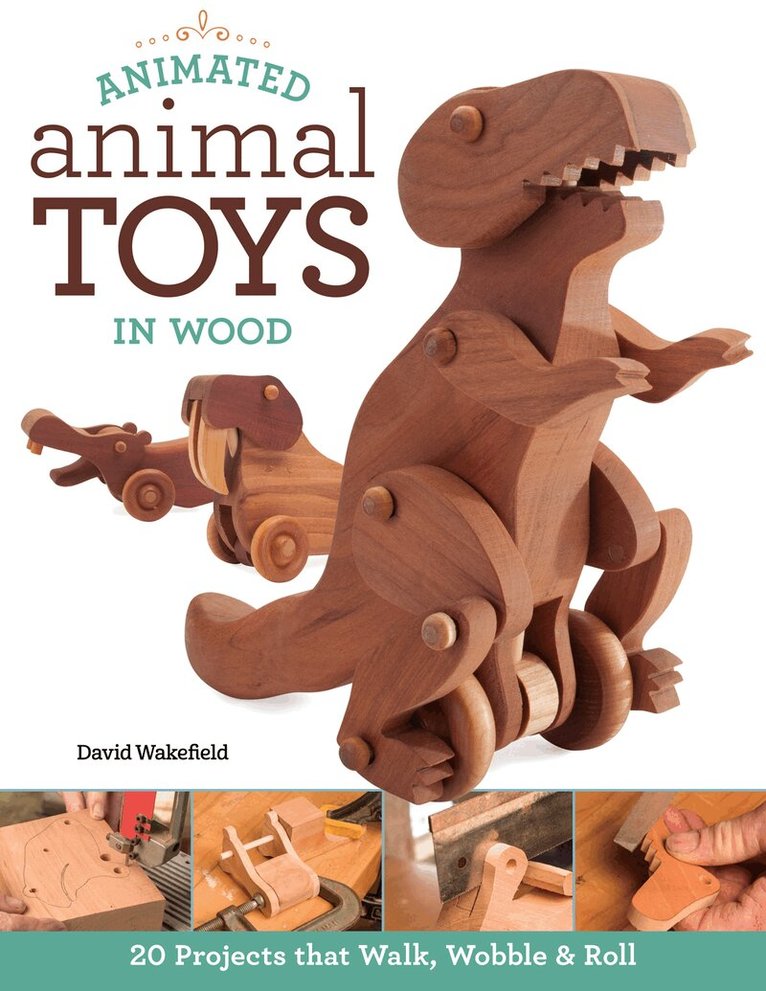
This book features 20 imaginative designs for classic wooden toys that walk, wiggle, waddle or whirl. It is a perennial favourite with woodworkers, these push-and-pull animals are timeless keepsakes. Detailed patterns, concise instructions and step-by-step colour photographs make this a suitable book for beginners. All children love animals, and all children love toys. Build plenty of good old-fashioned fun for any child with these clever designs for classic push-and-pull toys. Inside you'll discover 20 imaginative projects for making wild and wacky wooden animals that come alive with delightful lifelike motion. Create a chomping crocodile, waddling duck, jumping frog, timid turtle, howling wolf or terrifying T-Rex. Each animated marvel features an ingenious design to make it walk, wiggle, waddle or whirl. With detailed patterns, concise instructions, and step-by-step colour photographs, these charming projects are simple enough for even a beginner to complete in a weekend. Fun to build, fun to give and fun to play with, they'll provide hours of pleasure for woodworkers and children alike.
The division of household property in agricultural societies lies at the centre of the transmission of economic control from one generation to the next. In assembling a body of data concerned with fenjia (household division) in Qing and Republican China, this text investigates one of the central topics in understanding how Chinese society functioned and continues to function. In his presentation of case studies of household division, the author determines that equal division was the rule, yet living parents and single siblings had property rights as well. Variations in inheritance orientations had dramatic effects on landownership patterns, lineage property patterns, lineage strength, class formations and even on state efficiency and its influence on village society. The text explores social class, women and the nuclear family, family documents and law in order to weave the different traditions into a vision of how inheritance, family, lineage and state interacted over the course of Qing and Republican China.