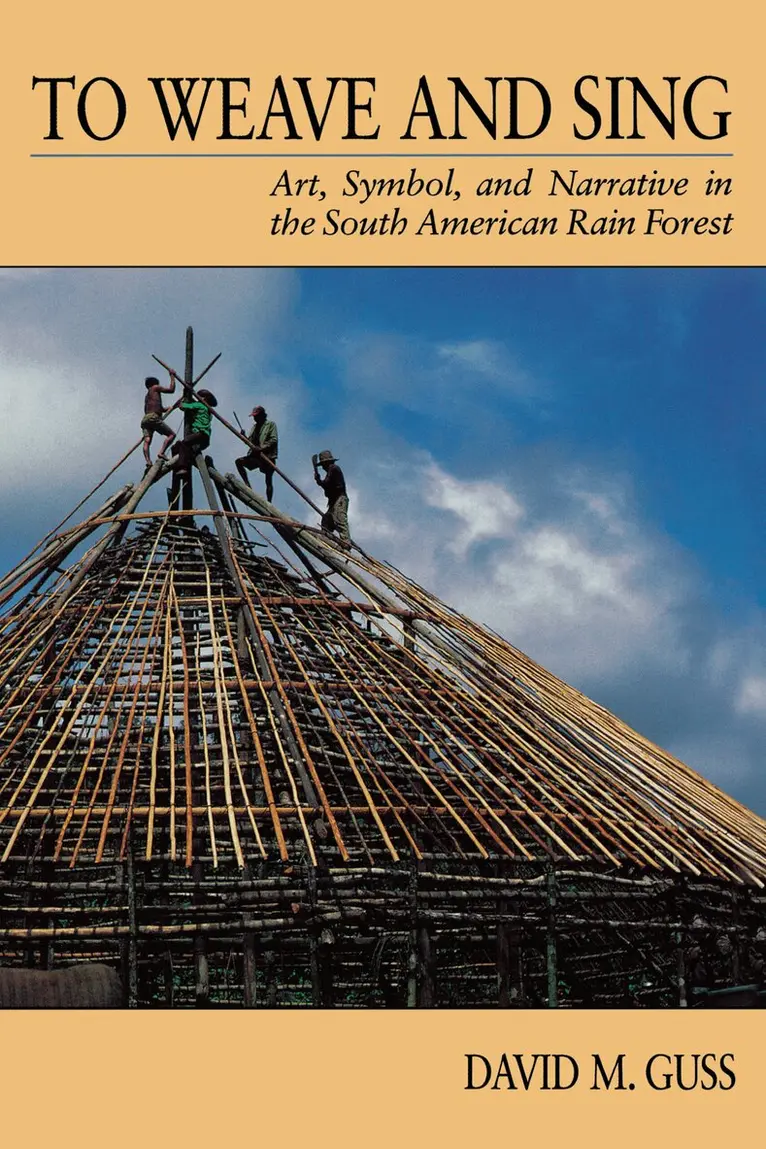
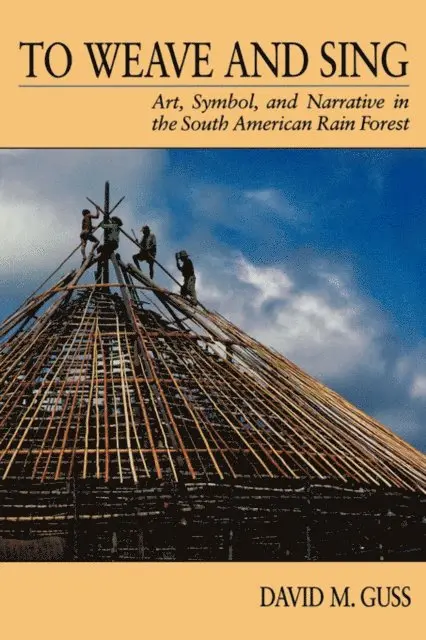
"To Weave and Sing" is the first in-depth analysis of the rich spiritual and artistic traditions of the Carib-speaking Yekuana Indians of Venezuela, who live in the dense rain forest of the upper Orinoco. Within their homeland of Ihuruna, the Yekuana have succeeded in maintaining the integrity and unity of their culture, resisting the devastating effects of acculturation that have befallen so many neighboring groups. Yet their success must be attributed to more than natural barriers of rapids and waterfalls, to more than lack of 'contact' with our 'modern' world. The ethnographic history recounted here includes not only the Spanish discovery of the Yekuana but detailed indigenous accounts of the entire history of Yekuana contact with Western culture, revealing an adaptive technique of mythopoesis by which the symbols of a new and hostile European ideology have been consistently defused through their incorporation into traditional indigenous structures.The author's initial point of departure is the Watunna, the Yekuana creation epic, but he finds his principal entrance into this mythic world through basketry, focusing on the elaborate kinetic designs of the round waja baskets and the stories told about them. Guss argues that the problem of understanding Yekuana basketry is the problem of understanding all traditional art forms within a tribal context, and critiques the cultural assumptions inherent in our systems of classification. He demonstrates that the symbols woven into the baskets function not in isolation but collectively, as a powerful system cutting across the entire culture. "To Weave and Sing" addresses all Yekuana material culture and the greater reality it both incorporates and masks, discerning a unifying configuration of symbols in chapters on architectural forms, the geography of the body, and the use of herbs, face paints, and chants. A narrow view of slash-and-burn gardens as places of mere subsistence is challenged by Guss' portrait of these exclusively female spaces as systematic inversions of the male world, 'the sacred turned on its head'.Throughout, a wealth of narrative and ritual materials provides us with the closest approximation we have to a native exegesis of these phenomena. What we are offered here is a new Poetics of Culture, ethnography not as a static given but as a series of shifting fields, wherein culture (and our image of it) is constantly recreated in all of its parts, by all of its members.
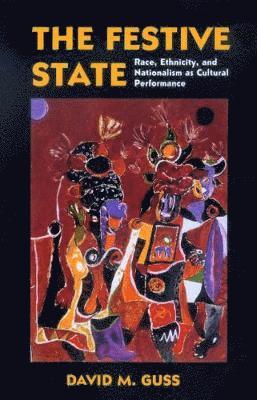
If, as David Guss argues, culture is a contested terrain with constantly changing contours, then festivals are its battlegrounds, where people come to fight and dispute in large acts of public display. Festive behavior, long seen by anthropologists and folklorists as the "uniform expression of a collective consciousness, is contentious and often subversive," and The Festive State is an eye-opening guide to its workings. Guss investigates "the ideology of tradition," combining four case studies in a radical multisite ethnography to demonstrate how in each instance concepts of race, ethnicity, history, gender, and nationhood are challenged and redefined. In a narrative as colorful as the events themselves, Guss presents the Afro-Venezuelan celebration of San Juan, the "neo-Indian" Day of the Monkey, the mestizo ritual of Tamunangue, and the cultural policies and products of a British multinational tobacco corporation. All these illustrate the remarkable fluidity of festive behavior as well as its importance in articulating different cultural interests.
To Weave and Sing is the first in-depth analysis of the rich spiritual and artistic traditions of the Carib-speaking Yekuana Indians of Venezuela, who live in the dense rain forest of the upper Orinoco. Within their homeland of Ihuruna, the Yekuana have succeeded in maintaining the integrity and unity of their culture, resisting the devastating effects of acculturation that have befallen so many neighboring groups. Yet their success must be attributed to more than natural barriers of rapids and waterfalls, to more than lack of "contact" with our "modern" world. The ethnographic history recounted here includes not only the Spanish discovery of the Yekuana but detailed indigenous accounts of the entire history of Yekuana contact with Western culture, revealing an adaptive technique of mythopoesis by which the symbols of a new and hostile European ideology have been consistently defused through their incorporation into traditional indigenous structures.The author''s initial point of departure is the Watunna, the Yekuana creation epic, but he finds his principal entrance into this mythic world through basketry, focusing on the eleborate kinetic designs of the round waja baskets and the stories told about them. Guss argues that the problem of understanding Yekuana basketry is the problem of understanding all traditional art forms within a tribal context, and critiques the cultural assumptions inherent in our systems of classification. He demonstrates that the symbols woven into the baskets function not in isolation but collectively, as a powerful system cutting across the entire culture.To Weave and Sing addresses all Yekuana material culture and the greater reality it both incorporates and masks, discerning a unifying configuration of symbols in chapters on architectural forms, the geography of the body, and the use of herbs, face paints, and chants. A narrow view of slash-and-burn gardens as places of mere subsistence is challenged by Guss''s portrait of these exclusively female spaces as systematic inversions of the male world, "the sacred turned on its head." Throughout, a wealth of narrative and ritual materials provides us with the closest approximation we have to a native exegesis of these phenomena. What we are offered here is a new Poetics of Culture, ethnography not as a static given but as a series of shifting fields, wherein culture (and our image of it) is constantly recreated in all of its parts, by all of its members.
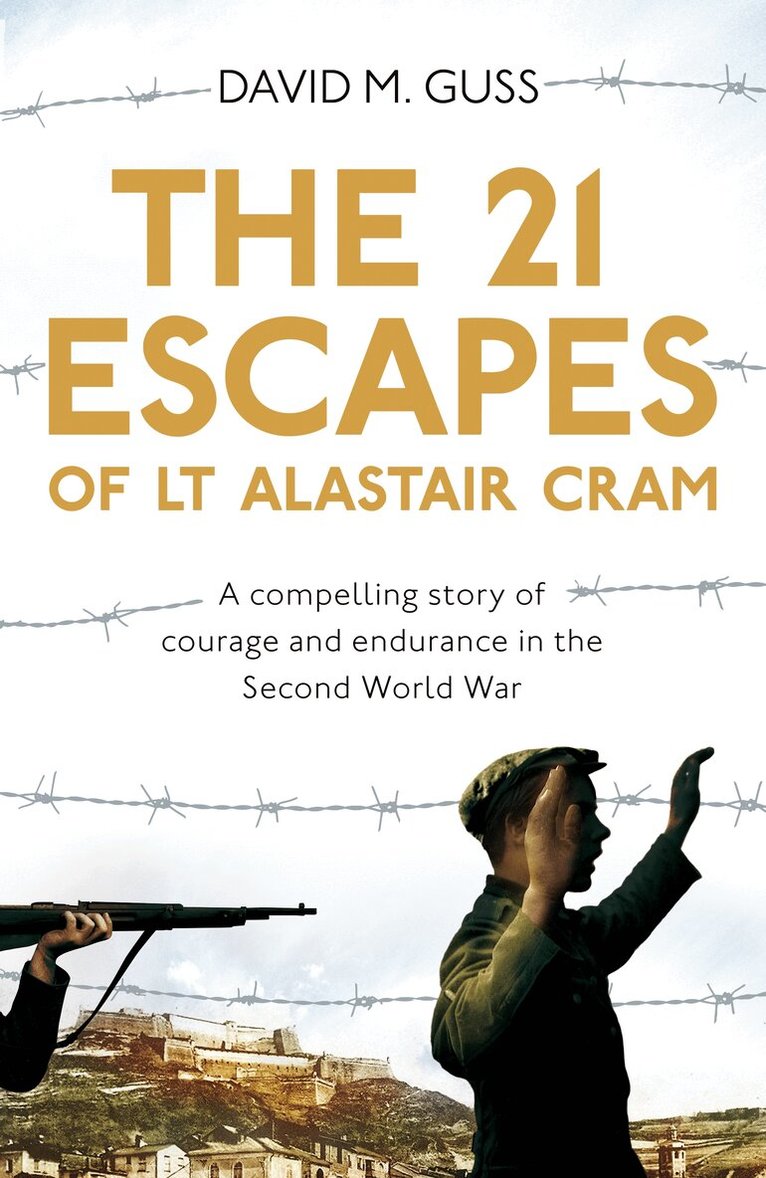
'Endlessly fascinating. Cram's story sizzles with adventure.' Giles Milton, Sunday TimesA genuinely new Second World War story, The 21 Escapes of Lt Alastair Cram is a riveting account of the wartime exploits of Alastair Cram, brilliantly told by the American author, David Guss. Cram was taken prisoner in North Africa in November 1941, which began a long odyssey through twelve different POW camps, three Gestapo prisons and one asylum. He became a serial escapee – fleeing his captors no fewer than twenty-one times, including his final, and finally successful, escape from a POW column in April 1945. Perhaps the most dramatic of his attempts was from Gavi, the ‘Italian Colditz’. Gavi was a maximum-security prison near Genoa for the pericolosi, the ‘most dangerous’ inmates because of their perpetual hunger to escape. It was here that Alastair met David Stirling, the legendary founder of the SAS, and cooked up the plan for what would become the ‘Cistern Tunnel’ escape, one of the most audacious but hitherto little-known mass escape attempts of the entire war. A story of courage in the face of extraordinary odds, it is a testament to one man's dogged determination never to give up.
A genuinely new Second World War story, The 21 Escapes of Lt Alastair Cram by David M. Guss is the gripping narrative of an intrepid Scottish soldier's audacious defiance and resilience in the face of overwhelming odds.'An extraordinary and humbling account' Damien Lewis, The Scotsman'Endlessly fascinating. Cram's story sizzles with adventure' – Giles Milton, Sunday TimesIn November 1941 Lt Alastair Cram was taken prisoner in North Africa as a devastating tank battle unfolded as Operation Crusader struggled to relieve Tobruk. His capture began a four year-long odyssey as he passed through twelve different POW camps, three Gestapo prisons and one asylum. Determined to regain his freedom, he became a serial escapee fleeing his captors no fewer than twenty-one times.In a saga of relentless determination, Cram, along the legendary founder of the SAS, David Stirling, masterminded the audacious 'Cistern Tunnel' escape from the Italian fortress Gavi - a thousand-year-old stronghold housing the most 'dangerous' escape risk prisoners. It became one of the most audacious – but little-known – mass escape attempts of the entire war. Thrillingly told, this is a record of stamina and courage against unfathomable adversity.'Fascinating' – Daily Express'An enthralling portrait of true courage' – Sunday Express S Magazine
This book is the only major collection of the great Chilean writer Vicente Huidobro’s poetry to appear in English. Drawn from his works published from 1917 to 1948 and presented bilingually, the translations are principally by David Guss supplemented with renderings by Stephen Fredman, Carlos Hagen, W. S. Merwi,. Geoffrey O’Brien, David Ossman, Michael Palmer, Jerome Rothenberg, Eliot Weinberger, and Geoffrey Young. Huidobro’s masterpiece Alrazor appears almost entire.Huidobro (1893-1948) left Santiago for Paris in 1916. There he co-founded the influential Cubist magazine Nord-Su with Guillaume Apollinaire and Pierre Reverdy. He then launched his own poetic movement, Creationism, and wrote as well for a score of avant-garde journals. Author of over forty books—plays. political tracts, novels, manifestos, poetry—he worked with Edgard Varése, Hans Arp, Robert Delauney, Jorge Luis Borges, and other important writers.Besides his translations, editor Guss has provided a biographical essay, “Poetry ls a Heavenly Crime," a lucid and helpful introductory overview of Huidobro and his work.