606 kr
Skickas inom 5-8 vardagar
606 kr
Skickas inom 5-8 vardagar
668 kr
Läs direkt efter köp
1 166 kr
Skickas inom 10-15 vardagar
584 kr
Läs direkt efter köp
518 kr
Läs direkt efter köp
522 kr
Läs direkt efter köp
1 155 kr
Läs direkt efter köp
1 147 kr
Läs direkt efter köp
577 kr
Skickas inom 7-10 vardagar
1 243 kr
Skickas inom 7-10 vardagar
1 072 kr
Skickas inom 3-6 vardagar
658 kr
Skickas inom 7-10 vardagar
1 390 kr
Skickas inom 7-10 vardagar
1 883 kr
Skickas inom 7-10 vardagar
1 309 kr
Skickas inom 7-10 vardagar
3 110 kr
Skickas inom 7-10 vardagar
2 303 kr
Skickas inom 7-10 vardagar
840 kr
Skickas inom 7-10 vardagar
803 kr
Läs direkt efter köp
2 728 kr
Skickas inom 10-15 vardagar
919 kr
Skickas inom 10-15 vardagar
2 497 kr
Skickas inom 10-15 vardagar
1 034 kr
Skickas inom 7-10 vardagar
1 617 kr
Skickas inom 7-10 vardagar
553 kr
Skickas inom 7-10 vardagar
927 kr
Skickas inom 7-10 vardagar
518 kr
Skickas inom 10-15 vardagar
1 422 kr
Skickas inom 10-15 vardagar
375 kr
Skickas inom 10-15 vardagar
447 kr
Skickas inom 3-6 vardagar
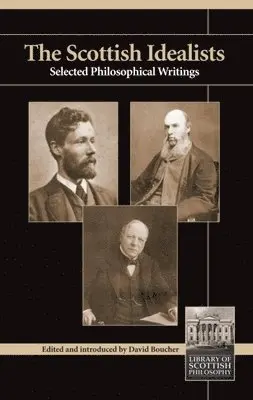
The extent to which British Idealism was heavily influenced by Scots has been little noticed, yet not only were they at the forefront of introducing Hegel into Britain in the work of Ferrier, Carlyle, Hutcheson, Stirling and Edward Caird, but they were also distinctive in locating themselves in relation to the Scottish philosophical tradition they sought to extend. The Scottish Idealists, among them Edward Caird, David George Ritchie, Andrew Seth Pringle Pattison, William Mitchell, John Watson, and the Welshman Henry Jones who found his spiritual home in Glasgow, comprised a formidable force and dominated the philosophical professoriate in Britain, Australia and Canada from the late nineteenth century to the years leading up to the First World War. Its main centres were St. Andrews, Glasgow and Edinburgh in Scotland, Cardiff in Wales, and Oxford in England. This collection of readings, the first of its kind, has been chosen with a view to displaying the variety, richness and strength of the Scottish Idealist tradition, beginning with an essay from the famous Essays in Philosophical Criticism (1883), a book that set-out the future direction of enquiry for this group of thinkers who shared a 'common purpose or tendency'. Scottish Idealism was immensely spiritual in character and recognized no hard and fast distinctions between philosophy, religion, poetry and science. It was a formidable force in social and educational reform. .