

Häftad, Engelska, 2008
281 kr
Skickas inom 3-6 vardagar
281 kr
Skickas inom 3-6 vardagar
175 kr
Skickas
329 kr
Skickas inom 7-10 vardagar

WW Norton & Co
1 282 kr
Skickas inom 7-10 vardagar

569 kr
Skickas inom 3-6 vardagar

413 kr
Läs direkt efter köp

413 kr
Läs direkt efter köp
97 kr
Läs direkt efter köp
97 kr
Läs direkt efter köp

2 031 kr
Skickas inom 7-10 vardagar
746 kr
Skickas inom 7-10 vardagar
510 kr
Läs direkt efter köp
506 kr
Läs direkt efter köp

2 328 kr
Skickas inom 7-10 vardagar

340 kr
Läs direkt efter köp
638 kr
Skickas inom 7-10 vardagar
120 kr
Skickas
98 kr
Läs direkt efter köp
98 kr
Läs direkt efter köp

1 345 kr
Skickas inom 11-20 vardagar

WW Norton & Co
1 901 kr
Skickas inom 7-10 vardagar

WW Norton & Co
1 901 kr
Skickas inom 7-10 vardagar
213 kr
Skickas inom 3-6 vardagar

3 483 kr
Skickas inom 7-10 vardagar
Not Stated
264 kr
Skickas
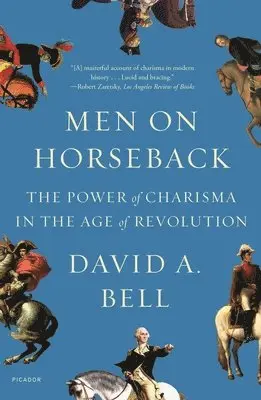
"In his lucid and bracing history, [David] Bell helps us better understand how [a] charismatic grifter came to occupy the most powerful office in the world . . . Bell’s description of our predicament makes for essential reading." —Robert Zaretsky, Los Angeles Review of BooksAn immersive examination of why the age of democratic revolutions was also a time of hero worship and strongmenIn Men on Horseback, the Princeton University historian David A. Bell offers a dramatic new interpretation of modern politics, arguing that the history of democracy is inextricable from the history of charisma, its shadow self. Bell begins with Corsica’s Pasquale Paoli, an icon of republican virtue whose exploits were once renowned throughout the Atlantic World. Paoli would become a signal influence in both George Washington’s America and Napoleon Bonaparte’s France. In turn, Bonaparte would exalt Washington even as he fashioned an entirely different form of leadership. In the same period, Toussaint Louverture sought to make French Revolutionary ideals of freedom and equality a reality for the formerly enslaved people of what would become Haiti, only to be betrayed by Napoleon himself. Simon Bolivar witnessed the coronation of Napoleon and later sought refuge in newly independent Haiti as he fought to liberate Latin America from Spanish rule. Tracing these stories and their interconnections, Bell weaves a spellbinding tale of power and its ability to mesmerize. Ultimately, Bell tells the crucial and neglected story of how political leadership was reinvented for a revolutionary world that wanted to do without kings and queens. If leaders no longer rule by divine right, what underlies their authority? Military valor? The consent of the people? Their own Godlike qualities? Bell’s subjects all struggled with this question, learning from each other’s example as they did so. They were men on horseback who sought to be men of the people—as Bell shows, modern democracy, militarism, and the cult of the strongman all emerged together. Today, with democracy’s appeal and durability under threat around the world, Bell’s account of its dark twin is timely and revelatory. For all its dangers, charisma cannot be dispensed with; in the end, Bell offers a stirring injunction to reimagine it as an animating force for good in the politics of our time.

1 538 kr
Läs direkt efter köp

223 kr
Skickas inom 7-10 vardagar
383 kr
Skickas inom 7-10 vardagar

1 550 kr
Skickas inom 10-15 vardagar

1 912 kr
Läs direkt efter köp
Historians have long used biography and life narratives as a means of understanding the French Revolution, as classic studies on major figures such as Robespierre and Napoleon attest. At the current moment, however, many of the most creative such studies are focusing on relatively minor revolutionary figures. Such work, which combines the techniques of classic biography and microhistory, reveals how the great political, social, cultural and religious transformations of the revolutionary era were refracted through the prism of individual experience. This work often links to research and writing taking place in adjacent disciplines, notably around the ideas and practices of life-writing. These studies, themselves often grounded in the history of emotions, resist the ''biographical illusion'' that an individual’s essence can be inferred unproblematically from their words and actions, and they also transcend the tendency to see those words and actions as merely symptoms of broader political processes. By focusing on individual life stories in their own right and insisting on the slipperiness of individual identity, this book explores emergent forms of subjectivity.