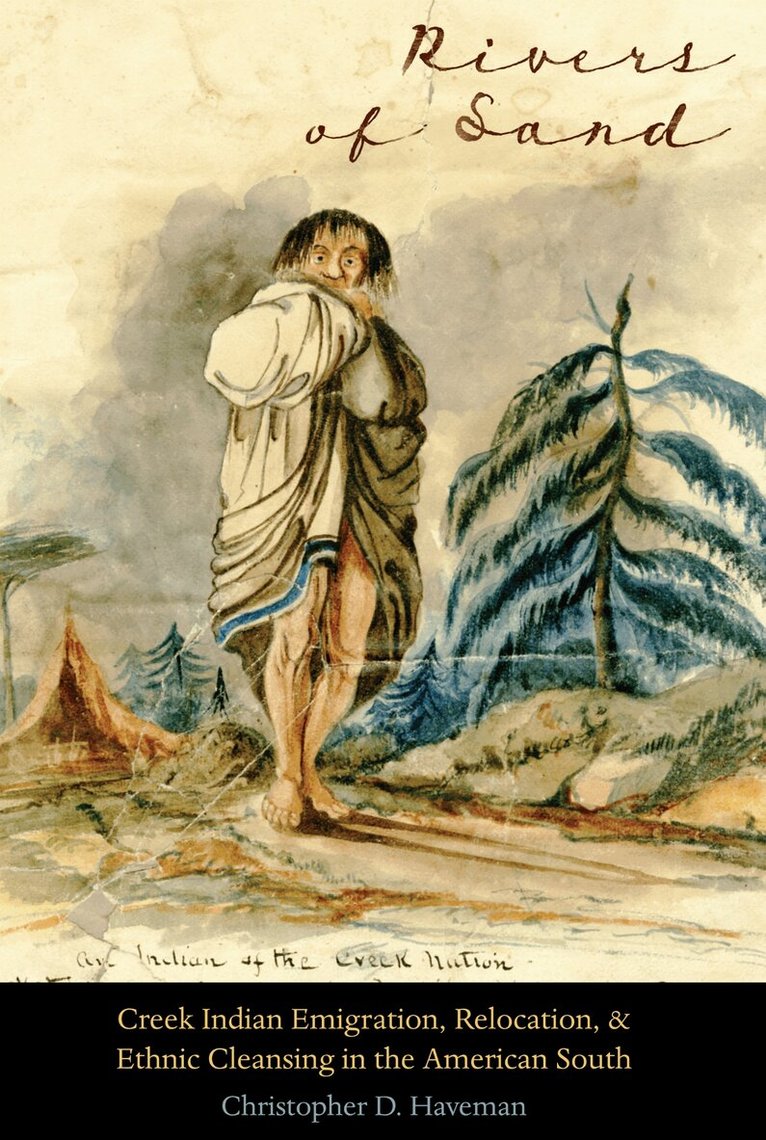
At its height the Creek Nation comprised a collection of multiethnic towns and villages with a domain stretching across large parts of Alabama, Georgia, and Florida. By the 1830s, however, the Creeks had lost almost all this territory through treaties and by the unchecked intrusion of white settlers who illegally expropriated Native soil. With the Jackson administration unwilling to aid the Creeks, while at the same time demanding their emigration to Indian territory, the Creek people suffered from dispossession, starvation, and indebtedness.Between the 1825 Treaty of Indian Springs and the arrival of detachment six in the West in late 1837, nearly twenty-three thousand Creek Indians were moved-voluntarily or involuntarily-to Indian territory. Rivers of Sand fills a substantial gap in scholarship by capturing the full breadth and depth of the Creeks’ collective tragedy during the marches westward, on the Creek home front, and during the first years of resettlement.Unlike the Cherokee Trail of Tears, which was conducted largely at the end of a bayonet, most Creeks were relocated through a combination of coercion and negotiation. Hopelessly outnumbered military personnel were forced to make concessions in order to gain the compliance of the headmen and their people. Christopher D. Haveman’s meticulous study uses previously unexamined documents to weave narratives of resistance and survival, making Rivers of Sand an essential addition to the ethnohistory of American Indian removal.

2018 Choice Outstanding Academic Title2019 Dwight L. Smith (ABC-CLIO) Award from the Western History AssociationBetween 1827 and 1837 approximately twenty-three thousand Creek Indians were transported across the Mississippi River, exiting their homeland under extreme duress and complex pressures. During the physically and emotionally exhausting journey, hundreds of Creeks died, dozens were born, and almost no one escaped without emotional scars caused by leaving the land of their ancestors.Bending Their Way Onward is an extensive collection of letters and journals describing the travels of the Creeks as they moved from Alabama to present-day Oklahoma. This volume includes documents related to the “voluntary” emigrations that took place beginning in 1827 as well as the official conductor journals and other materials documenting the forced removals of 1836 and the coerced relocations of 1836 and 1837.This volume also provides a comprehensive list of muster rolls from the voluntary emigrations that show the names of Creek families and the number of slaves who moved west. The rolls include many prominent Indian countrymen (such as white men married to Creek women) and Creeks of mixed parentage. Additional biographical data for these Creek families is included whenever possible. Bending Their Way Onward is the most exhaustive collection to date of previously unpublished documents related to this pivotal historical event.
At its height the Creek Nation comprised a collection of multiethnic towns and villages with a domain stretching across large parts of Alabama, Georgia, and Florida. By the 1830s, however, the Creeks had lost almost all this territory through treaties and by the unchecked intrusion of white settlers who illegally expropriated Native soil. With the Jackson administration unwilling to aid the Creeks, while at the same time demanding their emigration to Indian territory, the Creek people suffered from dispossession, starvation, and indebtedness.Between the 1825 Treaty of Indian Springs and the arrival of detachment six in the West in late 1837, nearly twenty-three thousand Creek Indians were moved-voluntarily or involuntarily-to Indian territory. Rivers of Sand fills a substantial gap in scholarship by capturing the full breadth and depth of the Creeks’ collective tragedy during the marches westward, on the Creek home front, and during the first years of resettlement.Unlike the Cherokee Trail of Tears, which was conducted largely at the end of a bayonet, most Creeks were relocated through a combination of coercion and negotiation. Hopelessly outnumbered military personnel were forced to make concessions in order to gain the compliance of the headmen and their people. Christopher D. Haveman’s meticulous study uses previously unexamined documents to weave narratives of resistance and survival, making Rivers of Sand an essential addition to the ethnohistory of American Indian removal.
Challenging myths about the Indian Removal era, this book explores how false narratives like "forced removal" and "empty western lands" became widespread, using primary sources to reveal the true story of land theft, Native resistance, and government betrayal.Exploring ten widely held misconceptions about American Indian Removal, this book examines how these misconceptions—such as the belief that all Native Americans were forcibly removed or that removal began with the 1830 Indian Removal Act—became popular and have been perpetuated over time. Using primary documents, the book delves into the actual events and realities that have been obscured by these false narratives, shedding light on the government’s role in land theft, the complexities of Native resistance, and the experiences of Native communities during this turbulent period.Challenging simplistic portrayals of American Indian Removal, each chapter carefully deconstructs one of the myths, revealing the full scope of the era’s impact on Indigenous peoples. The book demonstrates that American Indian Removal was not only a forced migration but also a calculated land grab and that resistance took many forms, both public and hidden. By reassessing these myths, this book offers a more nuanced understanding of this dark chapter in American history, amplifying the voices and experiences of those who lived through it.