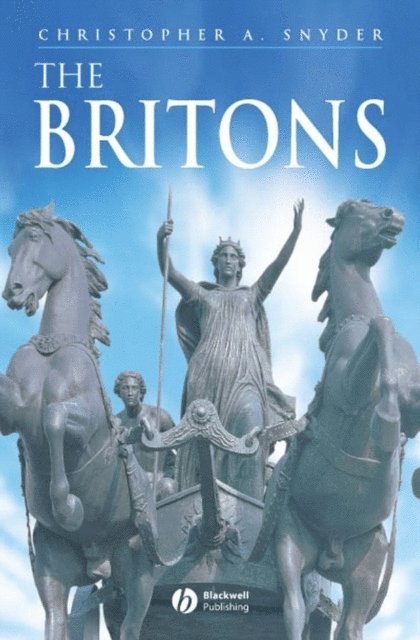
This book provides a fascinating and unique history of the Britons from the late Iron Age to the late Middle Ages. It also discusses the revivals of interest in British culture and myth over the centuries, from Renaissance antiquarians to modern day Druids. A fascinating and unique history of the Britons from the late Iron Age to the late Middle Ages. Describes the life, language and culture of the Britons before, during and after Roman rule. Examines the figures of King Arthur and Merlin and the evolution of a powerful national mythology. Proposes a new theory on the Anglo-Saxon settlement of Britain and the establishment of separate Brittonic kingdoms. Discusses revivals of interest in British culture and myth, from Renaissance antiquarians to modern day Druids.
This book provides a fascinating and unique history of the Britons from the late Iron Age to the late Middle Ages. It also discusses the revivals of interest in British culture and myth over the centuries, from Renaissance antiquarians to modern day Druids. A fascinating and unique history of the Britons from the late Iron Age to the late Middle Ages. Describes the life, language and culture of the Britons before, during and after Roman rule. Examines the figures of King Arthur and Merlin and the evolution of a powerful national mythology. Proposes a new theory on the Anglo-Saxon settlement of Britain and the establishment of separate Brittonic kingdoms. Discusses revivals of interest in British culture and myth, from Renaissance antiquarians to modern day Druids.
A blueprint for the rejuvenation of American undergraduate educationAmerican universities face enormous challenges as they struggle to balance teaching and research, curricular independence, and the unpredictability of state and federal support. Along the way, Christopher Snyder argues, US higher education has lost touch with its roots. With The Oxbridge Solution, Snyder—a historian of the ancient and medieval worlds and a seasoned college administrator—shows us how to repair these valuable institutions.American colleges and universities built their foundations on principles established at Oxford and Cambridge—especially their residential colleges—but also imported elements of the German research university, resulting in frictions between educational models. Snyder offers concrete solutions, charting a return to holistic education through the application of his own modified Oxbridge Model, a student-centric approach that emphasizes civic engagement. He also examines four educational theorists—Hugh of St. Victor, John Henry Newman, Maria Montessori, and Dorothy Sayers—who each have something to offer as American higher education struggles to define a common good. Snyder argues, ultimately, for a return to careful construction and support of intellectual communities dedicated first and foremost to educating the whole student.