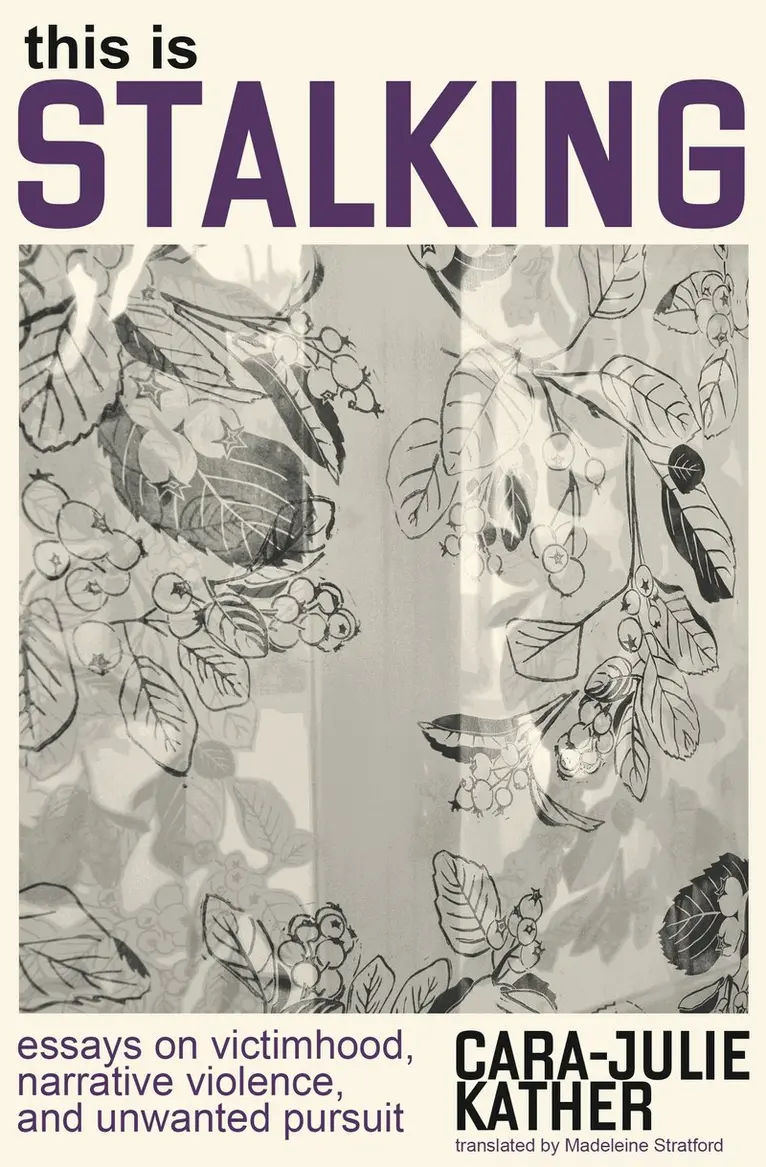
Stalked by a neighbour who emailed her an explicit fantasy of his obsession, Cara-Julie Kather urgently sought a way out of her lease and an escape from the creep next door. The landlord company saw it from the stalker’s perspective: they wouldn’t agree to terminate the lease, as this was all a misunderstanding of a man’s benign, if awkward, expression of love.Navigating a hostile legal and housing landscape, Kather began to recognize the narratives that framed stalking as nothing more than an expression of love that could be humoured, endured, or ignored, but not defied, let alone defined.In This Is Stalking, Kather retells her experience of being stalked and her efforts to find safety from the neighbour on the other side of the paper-thin walls. Through a series of poignant essays rooted in feminist inquiry, Kather describes the social and cultural ideas about stalking that perpetuate narrative violence: the violence embedded in the ways stories are told and who gets to tell them under which circumstances. Kather shows that the pernicious social narratives about stalking have real, material consequences for victims’ lives, but that naming, understanding, and theorizing these narratives is an important site of contestation in the struggle for feminist justice.An elegant and erudite translation by Madeleine Stratford captures a courageous testimony and deft assessment of patriarchal violence and the role of naming and storytelling in survival.
The practice of philosophy has led to both emancipation and exclusion in society. Questions around how philosophy should be practiced, who should engage in it, and with which issues philosophy should deal are subject to debate and controversy. This volume is dedicated to the special role of epistemic injustice and violence in philosophy. By shedding light on the inherent unjust structures of academic philosophy, the contributors to this volume help to better understand this powerful tool that impacts the academic landscape as well as individual and collective ways of being. From graphic novel to philosophical essay, they design a concept of transformative philosophy and offer various entry points to the conversation.
What does it mean to know something? What does it mean to prove something? And how are the two connected? Cara-Julie Kather explores Mathematics as a way of thinking and being in the world. She investigates Mathematics in its conceptual relation to Western understandings of the Rational and the Human, and proposes possibilities of subverting Western Mathematics and of forming different mathematical practices. To engage in decolonial-feminist re-writings of the Rational and the Human requires to re-write mathematical practice too. This study seeks to inspire such practices of re-writing thinking and being – in the realm of the mathematical and beyond.