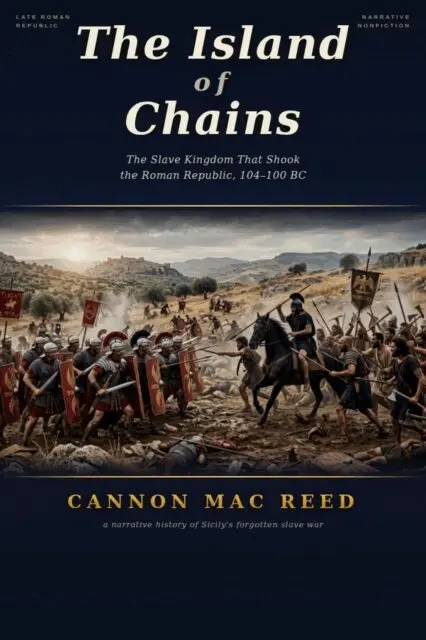
In 104 BC, a Roman provincial governor dissolved a tribunal, pocketed his bribes, and triggered the most sophisticated slave rebellion the ancient world had ever seen. What followed was not a rampage but a revolution. Over four years, the enslaved people of Sicily built a functioning state in the island's western highlands — complete with a king, a senate, a treasury, a cavalry, and the institutional architecture of a genuine political community. They defeated three successive Roman commanders. They governed agricultural territory, managed supply chains, and proclaimed laws. They nearly broke Rome's grain supply and bent the Republic's political calendar around their survival.The Island of Chains reconstructs the Second Servile War of 104–100 BC in full, drawing on the fragmentary but revealing ancient sources to recover the rebellion's military, political, and economic dimensions. At its center are two extraordinary men: Salvius-Tryphon, the political visionary who synthesized Hellenistic monarchy with Roman civic forms to create a state that demanded legitimacy; and Athenion of Cilicia, the pastoral commander whose logistical genius and tactical brilliance made that state impossible to destroy. Together they built something that Rome required its best available army to reduce to rubble.This is the story the ancient sources tried to bury. It deserves to be told.
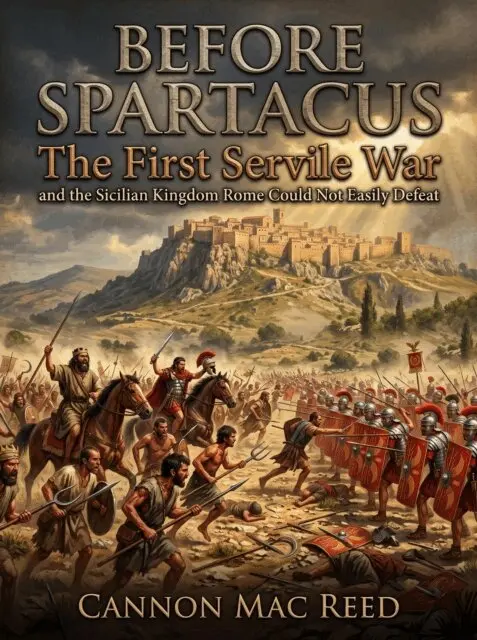
In 135 BC, on a Sicilian estate whose owner had grown rich from the grain that fed Rome, a Syrian prophet named Eunus announced himself king. Within weeks, the island's enslaved pastoral workers had followed him into open revolt. What they built in the years that followed was not a rebellion — it was a state. Complete with coinage, a royal court organized on Hellenistic lines, a functioning administrative apparatus, and a military force that defeated three Roman armies before the Senate finally committed its full consular power to the suppression, the rebel kingdom of King Antiochus stood for four years at the center of the island Rome depended on to eat.The First Servile War is the full story of Rome's most significant internal military crisis before Spartacus: the four-year struggle between a self-organized enslaved population and the most powerful republic in the ancient world. It traces the life of Eunus from Syrian prophet to Sicilian king; the military genius of Cleon, the Cilician herdsman who built the rebel army; the paralysis of Roman provincial governance that allowed the revolt to ignite; and the methodical campaigns of the consuls Piso and Rupilius who finally, at enormous cost, put it down.Drawing on Diodorus Siculus, Posidonius, the archaeological record, and a century of modern scholarship, Cannon Mac Reed recovers the full scale of what was achieved — and what was lost — on the plateau of Enna in the second century BC.