With all appropriate modesties and heresies, Bruno Gulli and Richard Gilman-Opalsky think together in the ways of other kindred spirits like Gilles Deleuze and Felix Guattari, bell hooks and Cornel West, Michael Hardt and Antonio Negri, and Stefano Harney and Fred Moten. Gulli and Gilman- Opalsky undertake a philosophical and political inquiry into capitalist forms of life and communist ontologies. From a deep, dialectical study of each other's work, they aim at a new synthesis of theory about possible and desirable beings-in-the-world. Rejecting capitalist conceptions of labor, politics, sovereignty, economy, (neo)liberalism, community, the individual, art, revolution, social change, and even the human person, Gulli and Gilman-Opalsky propose new ways of thinking and being antagonistic to the existing world (such as it is). They consider the prospects for new forms of life realized by way of the emancipatory dreams and struggles of everyday people.
In Singularities at the Threshold: The Ontology of Unrest, Bruno Gullì calls into question the concept of the independent and sovereign individual of the liberal (and neoliberal) tradition from the standpoint of the ontology of singularity, that is, the plural constitution of what appears to be an individual. Singularity is not the result of a process of individuation, but the process itself. He argues that the process of individuation—whereby at each stage everything appears to be individuated as such, to be an individual thing—is in reality always already plural, a process of transindividuation, or better, trans-dividuation. Gullì further examines why singularity is usually confused with individuality; what comes after the sovereign and independent individual, after the subject; and what the role of subversive and liberated singularities is in bringing about a new ethos and a better world.
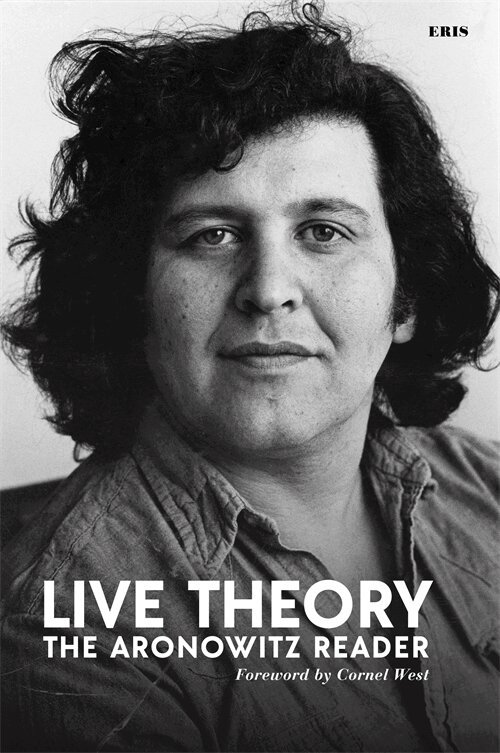
Stanley Aronowitz was a towering figure on the American Left for over sixty years. Both a tireless organizer and a militant social and political theorist, Aronowitz was a highly perceptive analyst of class power. He was dedicated throughout his career to the development and circulation of conceptual weapons for the working class and for all those who faced oppression within American society.Live Theory: The Stanley Aronowitz Reader brings together in thirteen seminal essays Aronowitz’s theoretical contributions to fundamental questions regarding science, class, culture, and education, alongside his pioneering interventions on labor, contract unionism, and the ongoing struggle for radical democracy. It is a crucial introduction to an indispensable thinker.
Distinguishes between work for money (productive labour) and work for pleasure or to release the creative spirit (living labour), and reveals a new layer of potency to the sociology and philosophy of labour
A fierce critique of productivity and sovereignty in the world of labor and everyday life, Bruno Gulli's "Earthly Plenitudes" asks, Can labor exist without sovereignty and without capitalism? He introduces the concept of dignity of individuation to prompt a rethinking of categories of political ontology. Dignity of individuation stresses the notion that the dignity of each and any individual being lies in its being individuated as such; dignity is the irreducible and most essential character of any being. Singularity is a more universal quality. Gulli first reviews approaches to sovereignty by philosophers as varied as Gottfried Leibniz and Georges Bataille, and then looks at concrete examples where the alliance of sovereignty and capital cracks under the potency of living labor. He examines contingent academic labor as an example of the super-exploitation of labor, which has become a global phenomenon, and as such, a clear threat to the sovereign logic of capital.Gulli also looks at disability to assert that a new measure of humanity can only be found outside the schemes of sovereignty, productivity, efficiency, and independence, through care and caring for others, in solidarity and interdependence.