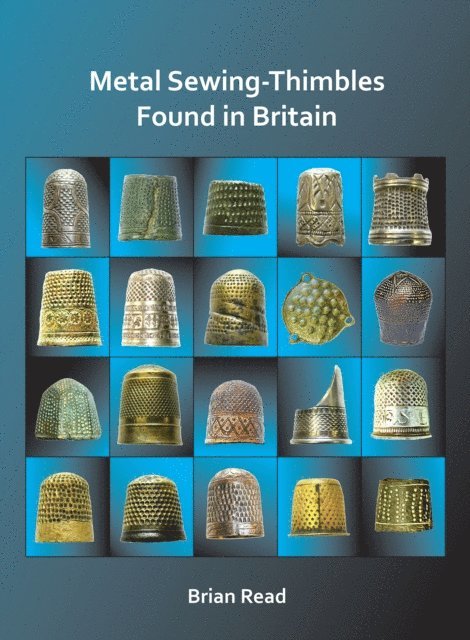
This is the first reference book that deals specifically with all types of sewing-thimble made from copper-alloy or silver, or either of these metals combined with iron or steel, and found in Britain: also included is a seemingly rare gold specimen. Domed, ring-type and open-top (here the latter classed as a new type) sewing-thimbles are described, among them unusual examples and others previously absent from the known record. From Britain the earliest reliable dating for these humble yet fascinating tools is between c.1270 – c.1350, and continues through the medieval and early post-medieval period and into the 18th and 19th centuries. Dating from at least the 17th century, subjected to detailed attention is the largely neglected sailmakers’ and sailors’ palm-iron, a heavy-duty tool made from either iron, steel or copper alloy. Also described are the two known types of silver or copper-alloy finger guard, an 18th – 19th century tool used in conjunction with finer sewing-thimbles. The majority of sewing-thimbles and other sewing-tools catalogued here are credited to metal-detectorists or members of The Society of Thames Mudlarks, who also use metal-detectors. To show constructional detail, each object is archaeologically drawn. This information is essential for metal-detectorists, archaeologists, museum curators, sewing-tool collectors and dealers, or anyone with an interest, seeking to gauge the type or age of any particular sewing-thimble or palm-iron.
The ever-expanding growth of Information Technology continues to place fresh demands on the management of data. Database researchers must respond to new challenges, particularly to the opportunities offered by the Internet for access to distributed, semi-structured and multimedia data sources. th This volume contains the proceedings of the 18 British National Conference on Databases (BNCOD 2001), held at the Rutherford Appleton Laboratory in July 2001. In recent years, interest in this conference series has extended well beyond the UK. In selecting just eleven of the submitted papers for presentation, the programme committee has included contributors from The Netherlands, Germany, Sweden, Canada and USA. In addition, two specially invited speakers address subjects of topical interest. Our first invited speaker is Professor Dr. Rudi Studer from the University of Karlsruhe. At AIFB, the Institute for Applied Informatics and Formal Description Methods, he and his colleagues are in the forefront of work on the Semantic Web. This aims to make information accessible to human and software agents on a semantic basis. The paper discusses the role that semantic structures, based on ontologies, play in establishing communication between different agents. The AIFB web site has been developed as a semantic portal to serve as a case study.
The ever-expanding growth of Information Technology continues to place fresh demands on the management of data. Database researchers must respond to new challenges, particularly to the opportunities offered by the Internet for access to distributed, semi-structured and multimedia data sources. th This volume contains the proceedings of the 18 British National Conference on Databases (BNCOD 2001), held at the Rutherford Appleton Laboratory in July 2001. In recent years, interest in this conference series has extended well beyond the UK. In selecting just eleven of the submitted papers for presentation, the programme committee has included contributors from The Netherlands, Germany, Sweden, Canada and USA. In addition, two specially invited speakers address subjects of topical interest. Our first invited speaker is Professor Dr. Rudi Studer from the University of Karlsruhe. At AIFB, the Institute for Applied Informatics and Formal Description Methods, he and his colleagues are in the forefront of work on the Semantic Web. This aims to make information accessible to human and software agents on a semantic basis. The paper discusses the role that semantic structures, based on ontologies, play in establishing communication between different agents. The AIFB web site has been developed as a semantic portal to serve as a case study.