1 811 kr
Läs direkt efter köp
1 811 kr
Läs direkt efter köp
1 820 kr
Läs direkt efter köp
Introducing the tools of statistics and probability from the ground up
An understanding of statistical tools is essential for engineers and scientists who often need to deal with data analysis over the course of their work. Statistics and Probability with Applications for Engineers and Scientists walks readers through a wide range of popular statistical techniques, explaining step-by-step how to generate, analyze, and interpret data for diverse applications in engineering and the natural sciences.
Unique among books of this kind, Statistics and Probability with Applications for Engineers and Scientists covers descriptive statistics first, then goes on to discuss the fundamentals of probability theory. Along with case studies, examples, and real-world data sets, the book incorporates clear instructions on how to use the statistical packages Minitab® and Microsoft® Office Excel® to analyze various data sets. The book also features:
• Detailed discussions on sampling distributions, statistical estimation of population parameters, hypothesis testing, reliability theory, statistical quality control including Phase I and Phase II control charts, and process capability indices • A clear presentation of nonparametric methods and simple and multiple linear regression methods, as well as a brief discussion on logistic regression method • Comprehensive guidance on the design of experiments, including randomized block designs, one- and two-way layout designs, Latin square designs, random effects and mixed effects models, factorial and fractional factorial designs, and response surface methodology • A companion website containing data sets for Minitab and Microsoft Office Excel, as well as JMP ® routines and results
Assuming no background in probability and statistics, Statistics and Probability with Applications for Engineers and Scientists features a unique, yet tried-and-true, approach that is ideal for all undergraduate students as well as statistical practitioners who analyze and illustrate real-world data in engineering and the natural sciences.
1 815 kr
Läs direkt efter köp
Introducing the tools of statistics and probability from the ground up
An understanding of statistical tools is essential for engineers and scientists who often need to deal with data analysis over the course of their work. Statistics and Probability with Applications for Engineers and Scientists walks readers through a wide range of popular statistical techniques, explaining step-by-step how to generate, analyze, and interpret data for diverse applications in engineering and the natural sciences.
Unique among books of this kind, Statistics and Probability with Applications for Engineers and Scientists covers descriptive statistics first, then goes on to discuss the fundamentals of probability theory. Along with case studies, examples, and real-world data sets, the book incorporates clear instructions on how to use the statistical packages Minitab® and Microsoft® Office Excel® to analyze various data sets. The book also features:
• Detailed discussions on sampling distributions, statistical estimation of population parameters, hypothesis testing, reliability theory, statistical quality control including Phase I and Phase II control charts, and process capability indices • A clear presentation of nonparametric methods and simple and multiple linear regression methods, as well as a brief discussion on logistic regression method • Comprehensive guidance on the design of experiments, including randomized block designs, one- and two-way layout designs, Latin square designs, random effects and mixed effects models, factorial and fractional factorial designs, and response surface methodology • A companion website containing data sets for Minitab and Microsoft Office Excel, as well as JMP ® routines and results
Assuming no background in probability and statistics, Statistics and Probability with Applications for Engineers and Scientists features a unique, yet tried-and-true, approach that is ideal for all undergraduate students as well as statistical practitioners who analyze and illustrate real-world data in engineering and the natural sciences.
477 kr
Skickas inom 11-20 vardagar
534 kr
Läs direkt efter köp
A solutions manual to accompany Statistics and Probability with Applications for Engineers and Scientists Unique among books of this kind, Statistics and Probability with Applications for Engineers and Scientists covers descriptive statistics first, then goes on to discuss the fundamentals of probability theory. Along with case studies, examples, and real-world data sets, the book incorporates clear instructions on how to use the statistical packages Minitab® and Microsoft® Office Excel® to analyze various data sets. The book also features:
Detailed discussions on sampling distributions, statistical estimation of population parameters, hypothesis testing, reliability theory, statistical quality control including Phase I and Phase II control charts, and process capability indices A clear presentation of nonparametric methods and simple and multiple linear regression methods, as well as a brief discussion on logistic regression method Comprehensive guidance on the design of experiments, including randomized block designs, one- and two-way layout designs, Latin square designs, random effects and mixed effects models, factorial and fractional factorial designs, and response surface methodology A companion website containing data sets for Minitab and Microsoft Office Excel, as well as JMP ® routines and resultsAssuming no background in probability and statistics, Statistics and Probability with Applications for Engineers and Scientists features a unique, yet tried-and-true, approach that is ideal for all undergraduate students as well as statistical practitioners who analyze and illustrate real-world data in engineering and the natural sciences.
1 817 kr
Läs direkt efter köp
Introduces basic concepts in probability and statistics to data science students, as well as engineers and scientists
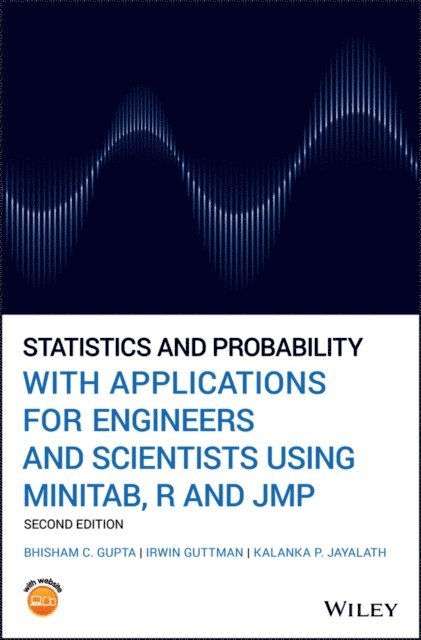
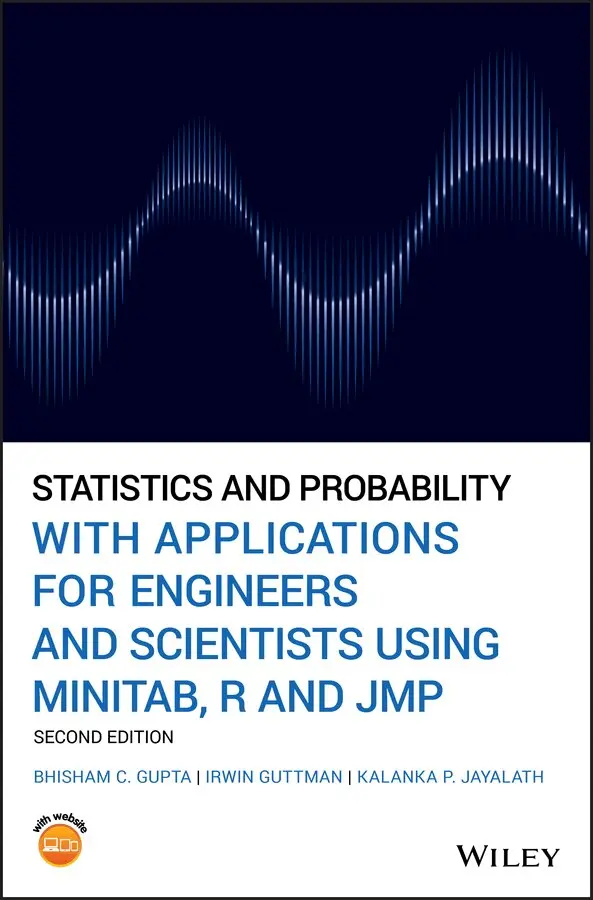
Aimed at undergraduate/graduate-level engineering and natural science students, this timely, fully updated edition of a popular book on statistics and probability shows how real-world problems can be solved using statistical concepts. It removes Excel exhibits and replaces them with R software throughout, and updates both MINITAB and JMP software instructions and content. A new chapter discussing data mining—including big data, classification, machine learning, and visualization—is featured. Another new chapter covers cluster analysis methodologies in hierarchical, nonhierarchical, and model based clustering. The book also offers a chapter on Response Surfaces that previously appeared on the book’s companion website.
Statistics and Probability with Applications for Engineers and Scientists using MINITAB, R and JMP, Second Edition is broken into two parts. Part I covers topics such as: describing data graphically and numerically, elements of probability, discrete and continuous random variables and their probability distributions, distribution functions of random variables, sampling distributions, estimation of population parameters and hypothesis testing. Part II covers: elements of reliability theory, data mining, cluster analysis, analysis of categorical data, nonparametric tests, simple and multiple linear regression analysis, analysis of variance, factorial designs, response surfaces, and statistical quality control (SQC) including phase I and phase II control charts. The appendices contain statistical tables and charts and answers to selected problems.
Features two new chapters—one on Data Mining and another on Cluster Analysis Now contains R exhibits including code, graphical display, and some results MINITAB and JMP have been updated to their latest versions Emphasizes the p-value approach and includes related practical interpretations Offers a more applied statistical focus, and features modified examples to better exhibit statistical concepts Supplemented with an Instructor''s-only solutions manual on a book’s companion websiteStatistics and Probability with Applications for Engineers and Scientists using MINITAB, R and JMP is an excellent text for graduate level data science students, and engineers and scientists. It is also an ideal introduction to applied statistics and probability for undergraduate students in engineering and the natural sciences.

1 616 kr
Skickas inom 7-10 vardagar
1 817 kr
Läs direkt efter köp
Introduces basic concepts in probability and statistics to data science students, as well as engineers and scientists
Aimed at undergraduate/graduate-level engineering and natural science students, this timely, fully updated edition of a popular book on statistics and probability shows how real-world problems can be solved using statistical concepts. It removes Excel exhibits and replaces them with R software throughout, and updates both MINITAB and JMP software instructions and content. A new chapter discussing data mining—including big data, classification, machine learning, and visualization—is featured. Another new chapter covers cluster analysis methodologies in hierarchical, nonhierarchical, and model based clustering. The book also offers a chapter on Response Surfaces that previously appeared on the book’s companion website.
Statistics and Probability with Applications for Engineers and Scientists using MINITAB, R and JMP, Second Edition is broken into two parts. Part I covers topics such as: describing data graphically and numerically, elements of probability, discrete and continuous random variables and their probability distributions, distribution functions of random variables, sampling distributions, estimation of population parameters and hypothesis testing. Part II covers: elements of reliability theory, data mining, cluster analysis, analysis of categorical data, nonparametric tests, simple and multiple linear regression analysis, analysis of variance, factorial designs, response surfaces, and statistical quality control (SQC) including phase I and phase II control charts. The appendices contain statistical tables and charts and answers to selected problems.
Features two new chapters—one on Data Mining and another on Cluster Analysis Now contains R exhibits including code, graphical display, and some results MINITAB and JMP have been updated to their latest versions Emphasizes the p-value approach and includes related practical interpretations Offers a more applied statistical focus, and features modified examples to better exhibit statistical concepts Supplemented with an Instructor''s-only solutions manual on a book’s companion websiteStatistics and Probability with Applications for Engineers and Scientists using MINITAB, R and JMP is an excellent text for graduate level data science students, and engineers and scientists. It is also an ideal introduction to applied statistics and probability for undergraduate students in engineering and the natural sciences.
1 404 kr
Skickas inom 7-10 vardagar
1 613 kr
Läs direkt efter köp
Provides a basic understanding of statistical quality control (SQC) and demonstrates how to apply the techniques of SQC to improve the quality of products in various sectors
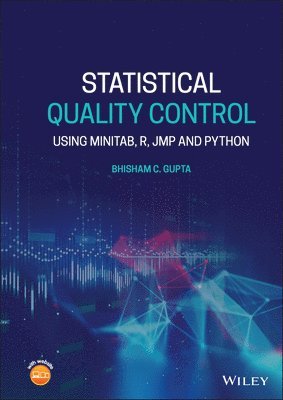
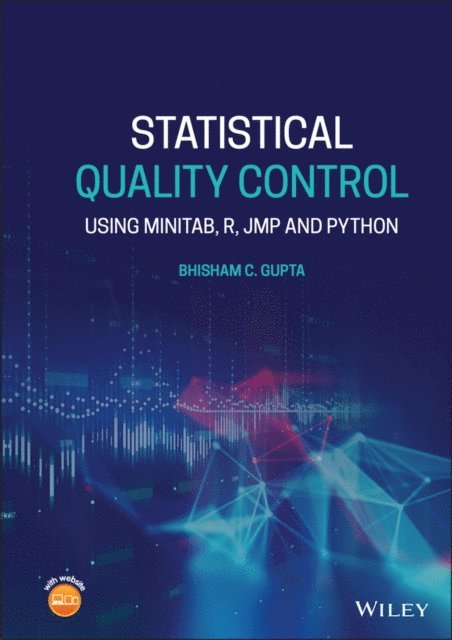
This book introduces Statistical Quality Control and the elements of Six Sigma Methodology, illustrating the widespread applications that both have for a multitude of areas, including manufacturing, finance, transportation, and more. It places emphasis on both the theory and application of various SQC techniques and offers a large number of examples using data encountered in real life situations to support each theoretical concept.
Statistical Quality Control: Using MINITAB, R, JMP and Python begins with a brief discussion of the different types of data encountered in various fields of statistical applications and introduces graphical and numerical tools needed to conduct preliminary analysis of the data. It then discusses the basic concept of statistical quality control (SQC) and Six Sigma Methodology and examines the different types of sampling methods encountered when sampling schemes are used to study certain populations. The book also covers Phase 1 Control Charts for variables and attributes; Phase II Control Charts to detect small shifts; the various types of Process Capability Indices (CPI); certain aspects of Measurement System Analysis (MSA); various aspects of PRE-control; and more. This helpful guide also
Focuses on the learning and understanding of statistical quality control for second and third year undergraduates and practitioners in the fieldDiscusses aspects of Six Sigma MethodologyTeaches readers to use MINITAB, R, JMP and Python to create and analyze chartsRequires no previous knowledge of statistical theoryIs supplemented by an instructor-only book companion site featuring data sets and a solutions manual to all problems, as well as a student book companion site that includes data sets and a solutions manual to all odd-numbered problemsStatistical Quality Control: Using MINITAB, R, JMP and Python is an excellent book for students studying engineering, statistics, management studies, and other related fields and who are interested in learning various techniques of statistical quality control. It also serves as a desk reference for practitioners who work to improve quality in various sectors, such as manufacturing, service, transportation, medical, oil, and financial institutions. It‘s also useful for those who use Six Sigma techniques to improve the quality of products in such areas.
John Wiley and Sons Ltd
1 906 kr
Tillfälligt slut