
E-bok
PDF, Engelska, 2004755 kr
Läs direkt efter köp
755 kr
Läs direkt efter köp
1 492 kr
Läs direkt efter köp
2 925 kr
Läs direkt efter köp
718 kr
Läs direkt efter köp
This book honours the outstanding contributions of Vladimir Vapnik, a rare example of a scientist for whom the following statements hold true simultaneously: his work led to the inception of a new field of research, the theory of statistical learning and empirical inference; he has lived to see the field blossom; and he is still as active as ever. He started analyzing learning algorithms in the 1960s and he invented the first version of the generalized portrait algorithm. He later developed one of the most successful methods in machine learning, the support vector machine (SVM) – more than just an algorithm, this was a new approach to learning problems, pioneering the use of functional analysis and convex optimization in machine learning.
Part I of this book contains three chapters describing and witnessing some of Vladimir Vapnik''s contributions to science. In the first chapter, Léon Bottou discusses the seminal paper published in 1968 by Vapnik and Chervonenkis that lay the foundations of statistical learning theory, and the second chapter is an English-language translation of that original paper. In the third chapter, Alexey Chervonenkis presents a first-hand account of the early history of SVMs and valuable insights into the first steps in the development of the SVM in the framework of the generalised portrait method.
The remaining chapters, by leading scientists in domains such as statistics, theoretical computer science, and mathematics, address substantial topics in the theory and practice of statistical learning theory, including SVMs and other kernel-based methods, boosting, PAC-Bayesian theory, online and transductive learning, loss functions, learnable function classes, notions of complexity for function classes, multitask learning, and hypothesis selection.These contributions include historical and context notes, short surveys, and comments on future research directions.
This book will be of interest to researchers, engineers, and graduate students engaged with all aspects of statistical learning.
3 013 kr
Läs direkt efter köp
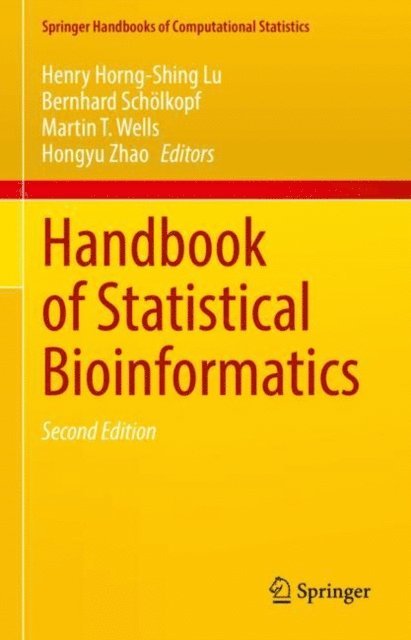
Now in its second edition, this handbook collects authoritative contributions on modern methods and tools in statistical bioinformatics with a focus on the interface between computational statistics and cutting-edge developments in computational biology. The three parts of the book cover statistical methods for single-cell analysis, network analysis, and systems biology, with contributions by leading experts addressing key topics in probabilistic and statistical modeling and the analysis of massive data sets generated by modern biotechnology. This handbook will serve as a useful reference source for students, researchers and practitioners in statistics, computer science and biological and biomedical research, who are interested in the latest developments in computational statistics as applied to computational biology.