199 kr
Läs direkt efter köp
199 kr
Läs direkt efter köp
180 kr
Läs direkt efter köp
199 kr
Läs direkt efter köp
199 kr
Läs direkt efter köp
193 kr
Läs direkt efter köp
193 kr
Läs direkt efter köp
437 kr
Lyssna direkt efter köp
The Age of Louis XIV is the biography of a period (1648–1715) that Spengler considered the apex of modern European civilization. "Some centuries hence," Frederick the Great correctly predicted to Voltaire, "they will translate the good authors of the age of Pericles and Augustus." Those authors are lovingly treated here: Pascal, Racine, and Boileau, Madame de S├®vign├®, Madame de la Fayette, and above all the philosopher-dramatist Moli├¿re, who so memorably exposed the vices and hypocrisies of the age.
Central to the book is the "Sun King" himself, Louis XIV. Louis XIV ruled France for over seventy years, longer than almost any European ruler in history. He is the subject of a character study that runs through seven chapters, revealing the flesh and blood beneath the purple and the crown. He is seen at his worst in his struggle with Jansenists and Huguenots, at his best in his patronage of literature and art, and at his most human in his love affairs with Henrietta Anne of Orl├®ans, Louise de La Valli├¿re, Madame de Montespan, and Madame de Maintenon.
From France the narrative passes to the Netherlands, and after pausing to examine the domestic idylls of Vermeer, shows the Dutch opening their dikes to save their land from Louis XIV and sending William of Orange to become king of England and a leader of the European alliance against Louis'' hegemony.
In England we contemplate the heyday of virtue under the Puritans and study the strange character of Cromwell. We see Milton''s passionate career as part of the vain effort to prevent the Stuart Restoration. We find Charles II, the "Merry Monarch," with more manners than morals, attend boisterous Restoration plays; we skim the diaries of Evelyn and Pepys; and we follow Jonathan Swift from genius to insanity.
Crossing the North Sea we trace the tragic heroism of Charles XII of Sweden and the attempt of Peter the Great to lead Russia from barbarism to civilization. We accompany the noble Sobieski of Poland as he rescues Vienna from the Turks. We visit Italy and Spain. We see the Jews proscribed and impoverished in Europe but rising to riches in Amsterdam and following Sabbatai Zevi in a desperate hope of regaining Palestine and freedom.
All this forms the background for the "intellectual adventure" of the European mind in its passage from superstition, mythology, and intolerance to education, science, and philosophy, for this was the age when Newton and Leibniz gave simultaneous birth to calculus, when Newton bound the planets and the stars with a chain of universal gravitation. Toward the end of the volume the authors revert to their favorite subject, philosophy, and devote a full chapter, with love and care, to Spinoza.
The book ends with the sunset of Le Roi Soleil: Louis punished for his aggressions by a swarm of enemies gathering around him; fighting till his people are destitute and disillusioned, till his treasury and his heart are empty; dying defeated and repentant, begging his grandson and successor not to imitate his taste for splendor and war; and followed in his funeral by the insults of the crowd.

447 kr
Lyssna direkt efter köp
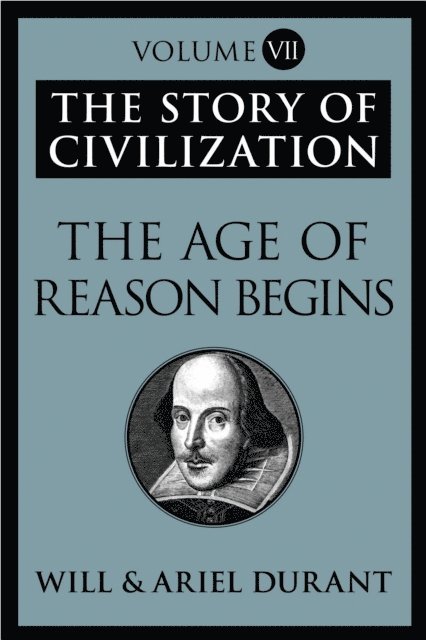
This seventh volume of Will and Ariel Durant''s renowned Story of Civilization chronicles the history of European civilization from 1558 to 1648.
The Age of Reason Begins brings together a fascinating network of stories in the discussion of the bumpy road toward the Enlightenment. This is the age of great monarchs and greater artists—on the one hand, Elizabeth I of England, Philip II of Spain, and Henry IV of France; on the other, Shakespeare, Cervantes, Montaigne, and Rembrandt. It also encompasses the heyday of Francis Bacon, Galileo, Giordano Bruno, and Descartes, the fathers of modern science and philosophy. But it is equally an age of extreme violence, a moment in which all Europe was embroiled in the horrible Thirty Years'' War—in some respects, the real first world war. This chapter in cultural history is one that can''t be missed.
426 kr
Lyssna direkt efter köp
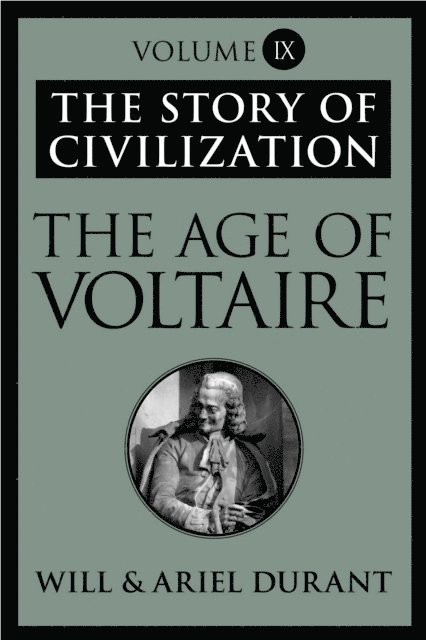
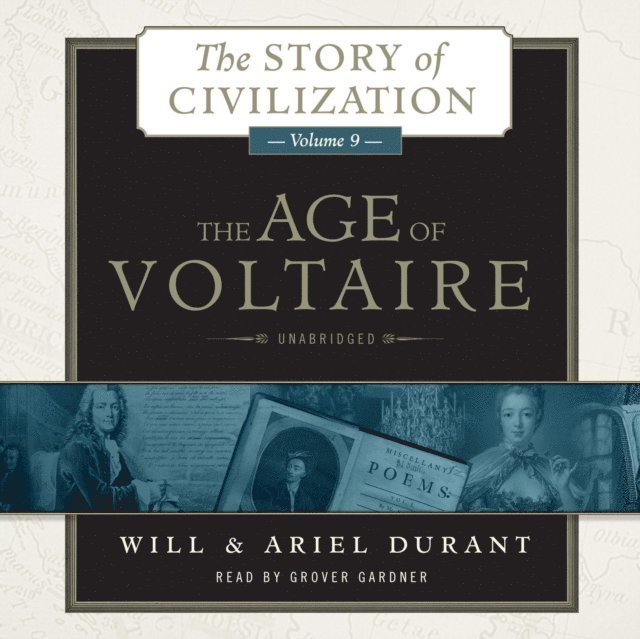
The Age of Voltaire, the ninth volume of the Story of Civilization, is an in-depth examination of France and England in the first half of the eighteenth century. In this masterful work, listeners will encounter
the English ideas that inspired the Enlightenment in France—skepticism, scientific experiment, constitutional government, "natural rights," and individual liberty; the salons of Paris, where the wits and thinkers of all Europe gathered to exchange ideas; the philosophes—intellectuals, playwrights, and poets who consulted and consorted with kings and queens; Voltaire himself—the incarnation of the Enlightenment and a devotee of reason who still defended religious faith; Mme. Pompadour, patron of the philosophes, who seduced King Louis XV and through him influenced French policy; the Augustan Age in English literature—Alexander Pope''s poetry, Jonathan Swift''s satires, and the novels of Samuel Richardson and Henry Fielding; and the growing parasitism of the aristocracy and rising power of the commercial class.440 kr
Lyssna direkt efter köp
The Pulitzer Prize–winning volume on European civilization by acclaimed historians Will and Ariel Durant
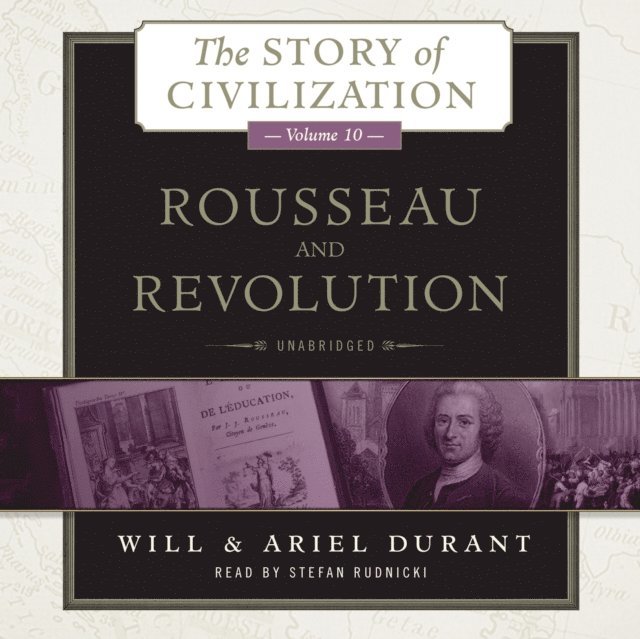
Rousseau and Revolution, the tenth volume of the Story of Civilization, ranges over a Europe in ferment, but centers on the passionate rebel—philosopher Jean-Jacques Rousseau, the great exponent of the romantic impulse toward self-exploration and social revolt, who contended with the great rationalist Voltaire for the mind of Europe. Rousseau condemned civilization as a disease, glorified the noble savage, proclaimed to the world with equal intensity his own love affairs and the natural rights of man, and became the patron saint of the revolution and the worldwide social upheavals of two centuries.
1 465 kr
Lyssna direkt efter köp
An engrossing volume on European civilization by Pulitzer Prize–winning historians Will and Ariel Durant
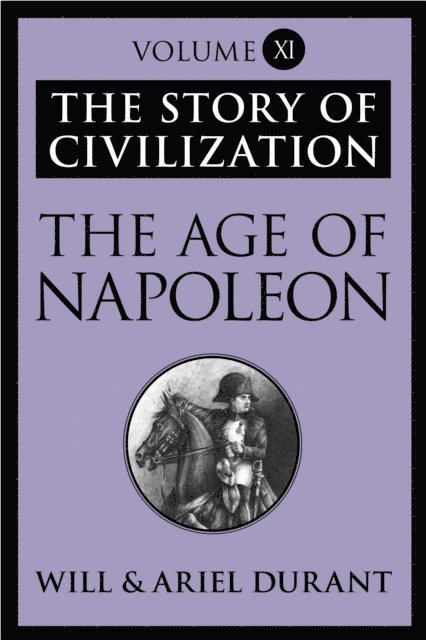
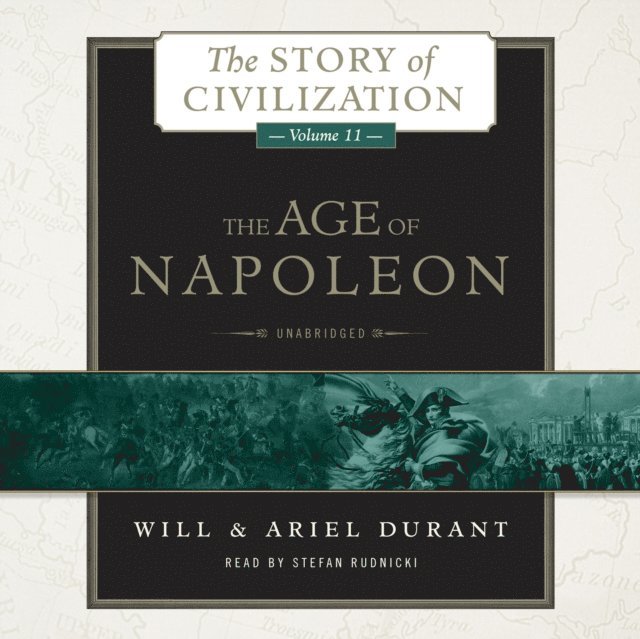
The Age of Napoleon, the eleventh and final volume of the Story of Civilization, surveys the amazing chain of events that wrenched Europe out of the Enlightenment and into the age of democracy. In this masterful work, listeners will encounter
the French Revolution—from the storming of the Bastille to the guillotining of the king; the revolution''s leaders Danton, Desmoulins, Robespierre, Saint-Just—all cut down by the reign of terror they inaugurated; Napoleon''s meteoric rise—from provincial Corsican military student to emperor and commander of the largest army in history; Napoleon''s fall—his army''s destruction in the snows of Russia, his exile to Elba, his escape and reconquest of the throne, and his ultimate defeat at Waterloo by the combined forces of Europe; the birth of Romanticism and the dawning of a new age of active democracy and a rising middle class, laying the foundation for a new era.440 kr
Lyssna direkt efter köp
An engrossing volume on European civilization by Pulitzer Prize–winning historians Will and Ariel Durant
The Age of Napoleon, the eleventh and final volume of the Story of Civilization, surveys the amazing chain of events that wrenched Europe out of the Enlightenment and into the age of democracy. In this masterful work, listeners will encounter
the French Revolution—from the storming of the Bastille to the guillotining of the king; the revolution''s leaders Danton, Desmoulins, Robespierre, Saint-Just—all cut down by the reign of terror they inaugurated; Napoleon''s meteoric rise—from provincial Corsican military student to emperor and commander of the largest army in history; Napoleon''s fall—his army''s destruction in the snows of Russia, his exile to Elba, his escape and reconquest of the throne, and his ultimate defeat at Waterloo by the combined forces of Europe; the birth of Romanticism and the dawning of a new age of active democracy and a rising middle class, laying the foundation for a new era.136 kr
Läs direkt efter köp