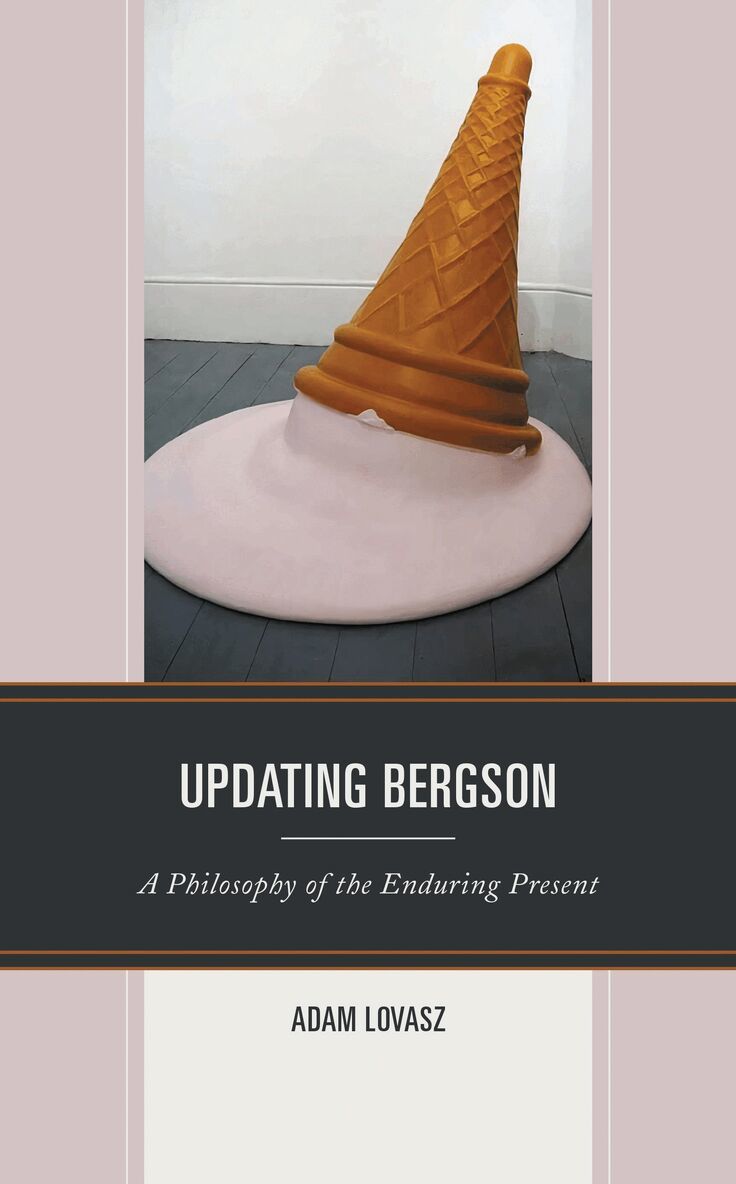
Over the past few decades, there has been a renewal of scholarly interest in the work of Henri Bergson (1859–1941). At once a commentary and a stark re-evaluation of Bergson’s philosophy, Updating Bergson: A Philosophy of the Enduring Present argues that time should be thought of as a hierarchy of simultaneous durations, the shifting reality of which can be revealed by the philosophical method of intuition. A duration is a perpetually dynamic flow situated in the now. Put simply, for Bergson, change is the substance of things. Nothing exists apart from alteration. Adam Lovasz analyzes Bergson’s philosophy of time, encompassing the three basic types of duration—material, organic, and subjective—and also touches on themes such as relativity, evolution, the problem of materialism and idealism, and the topic of free will. Lovasz connects key questions addressed by Bergson to contemporary scientific debates and paradigms. Shedding new light on the various aspects of Bergson's philosophy, this book is both a provocation and an invitation to think in terms of the enduring present, rather than committing ourselves to a dead past or an absent future.
The present book is the first monograph detailing the intriguing connections between H. P. Lovecraft's weird fiction and posthumanism. More than a retrospective reinterpretation, H. P. Lovecraft and Posthumanism enacts a productive dialogue between Lovecraft's "cosmic indifferentist" philosophy and contemporary post-anthropocentrism. In more ways than one, Lovecraft's literary and philosophical output alike presaged our contemporary era, one in which the primacy of the human is becoming open to question. The crisis-ridden darkness we face today is revealed as signalling the advent of the posthuman "strange aeon," the Age of Lovecraft.
Working with thinkers within and outside the Western philosophical canon, Márk Horváth and Ádám Lovász elaborate a novel philosophy of nature that strives to resituate humans within a more-than-human world, while also accounting for the alterity and uncontrollability of nature. The challenges of the twenty-first century, the Anthropocene polycrisis in particular, necessitate revisiting the ancient problem of physis versus nomos, that is, a fundamental rethinking of what the natural and artificial mean. Revisiting various non-dualist Western philosophies of nature, from the Stoics through Johannes Goethe, Friedrich Schelling, Alfred North Whitehead, John Dewey to Bruno Latour and Donna J. Haraway, the authors bring this subset of the philosophical tradition into dialogue with perspectives from beyond what is traditionally thought of as the Western philosophical canon. Drawing additionally upon the works of cultural anthropologists and Indigenous thinkers, they argue that transcending the Great Divide necessitates drawing upon a range of cultures and perspectives on the ontological status of the human within an inherently hybrid naturecultural world.