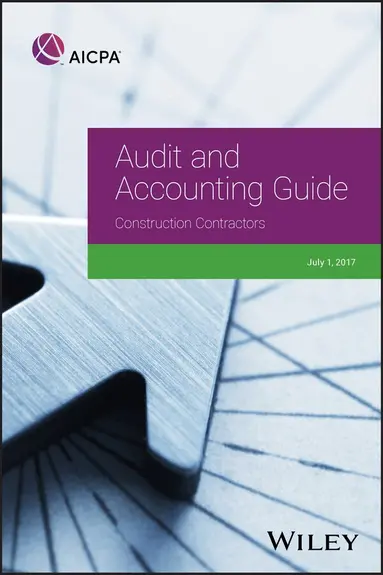
Audit and Accounting Guide
Construction Contractors, 2019
1 461 kr
Tillfälligt slut. Bevaka för att få ett mejl när produkten kan beställas.
Fler format och utgåvor
Beskrivning
Produktinformation
- Utgivningsdatum:2019-10-18
- Språk:Engelska
- ISBN:9781119679295
- Förlag:John Wiley & Sons Inc
- Serie:AICPA Audit and Accounting Guide
- Dimensioner:150 x 250 x 150 mm
Utforska kategorier
Mer om författaren
The American Institute of CPAs (AICPA) is the world's largest member association representing the CPA profession, with more than 429,000 members in the United States and worldwide, and a history of serving the public interest since 1887. AICPA members represent many areas of practice, including business and industry, public practice, government, education, and consulting. The AICPA sets ethical standards for its members and U.S. auditing standards for private companies, nonprofit organizations, federal, state and local governments. It develops and grades the Uniform CPA examination, offers specialized credentials, builds the pipeline of future talent and drives professional competency development to advance the vitality, relevance and quality of the procession.
Innehållsförteckning
- 1 Industry Background .01-.52Nature and Significance of the Industry .02-.05Features of the Business Environment .06-.37Characteristics Common to Contractors .07-.08Types of Contracts .09-.10Contract Modifications and Changes .11-.12Bonding and the Surety Underwriting Process .13-.19Project Ownership and Rights of Lien .20-.21Financing Considerations .22-.30Joint Ventures .31-.34Reporting for Financial and Income Tax Purposes .35-.37Typical Industry Operations .38-.50Preparing Cost Estimates and Bids .39-.45Entering Into the Contract .46Planning and Initiating the Project .47-.50Variations in Size and Methods of Operation .51Project Management .522 Accounting for Revenue From Contracts With Customers .01-.148Application of the Five-Step Model of FASB ASC 606 .03-.87Step 1: Identify the Contract With a Customer .03-.11Step 2: Identify the Performance Obligations in the Contract .12-.28Step 3: Determine the Transaction Price .29-.49Step 5: Recognize Revenue When (or as) the Entity Satisfies a Performance Obligation .50-.87Other Related Topics .88-.148Disclosures and Presentation .88-.123Contract Costs .124-.1483 Accounting for and Reporting Investments in Construction Joint Ventures .01-.44Joint Venture Accounting .03-.39Accounting Methods .03-.07Capital Contributions to Joint Ventures and Initial Measurement of Investments in Joint Ventures .08-.15Sales to a Venture .16-.19Subsequent Measurement and Presentation of Investments in Joint Ventures .20-.39Determining Venturers’ Percentage Ownership .40Conforming the Accounting Principles of the Venture .41Losses in Excess of a Venturer’s Investment, Loans, and Advances .42Disclosures in a Venturer’s Financial Statements .43-.444 Financial Reporting by Affiliated Entities .01-.11Combined Financial Statements .04-.06Presentation of Separate Financial Statements of Members of an Affiliated Group .07-.10Presentation of Separate Financial Statements of Members of an Affiliated Group That Constitute an Economic Unit .115 Other Accounting Considerations .01-.141Definition of a Public Business Entity .01Fair Value Measurements .02-.50Definition of Fair Value .05-.12Valuation Techniques .13-.15Present Value Techniques .16-.18The Fair Value Hierarchy .19-.22Application of Fair Value Measurements .23-.31Additional Guidance for Fair Value Measurement in Special Circumstances .32-.36Disclosures .37-.46Fair Value Option .47-.50Accounting for Certain Receive-Variable, Pay-Fixed Interest Rate Swaps .51-.55Disclosure .55Service Concession Arrangements .56-.61Discontinued Operations .62-.70Disposal Group Classified as Held for Sale .66-.68Disclosure .69-.70Impairment of Long-Lived Assets .71-.104Property, Plant, and Equipment .71-.76Intangibles — Goodwill .77-.86Accounting Alternative .87-.101Intangibles — Other .102-.104Accounting for Identifiable Intangible Assets in a Business Combination .105-.109Accounting Alternative .105-.109Business Combinations — Pushdown Accounting .110-.115Asset Retirement Obligations .116-.122Mandatorily Redeemable Stock .123-.124Presentation of an Unrecognized Tax Benefit When a Tax Carryforward Exists .125-.126Differences Between Financial Accounting and Income Tax Accounting .127-.137Cash Method .135-.136Accrual Method .137Provisions for Anticipated Losses on Contracts .138Costs of Equipment and Small Tools .139-.1416 Financial Statement Presentation .01-.48Balance Sheet Classification .01-.02Guidelines for Classified Balance Sheets .03-.15General Guidance .04-.08Retentions Receivable and Payable .09-.11Investments in Construction Joint Ventures .12Equipment .13Liabilities .14Deferred Income Taxes .15Fixed-Price Contract Terminations .16Disclosures in Financial Statements .17-.34Significant Accounting Policies .18Revised Estimates .19Backlog — Remaining Performance Obligations .20Receivables .21Receivables — Related Parties .22-.23Going Concern .24-.34Disclosures of Certain Significant Risks and Uncertainties .35-.36Accounting for Weather Derivatives .37Disclosures of Multiemployer Pension Plans .38-.48Multiemployer Plans That Provide Pension Benefits .39-.46Multiemployer Plans That Provide Postretirement Benefits Other Than Pensions .47Sample Disclosure for Plans That Provide Pension Benefits .487 Auditing Within the Construction Industry .01-.08Audit Focus .02-.07Scope of Auditing Guidance Included in This Guide .088 Controls in the Construction Industry .01-.28Estimating and Bidding .04-.07Project Administration and Contract Evaluation .08-.10Job Site Accounting and Controls .11-.14Billing Procedures .15-.18Contract Costs .19-.21Contract Revenues .22-.23Construction Equipment .24-.25Joint Ventures .26Internal Audit Function .27-.289 Planning the Audit, Assessing and Responding to Audit Risk, and Additional Auditing Considerations .01-.103Scope of This Chapter .01-.02Planning and Other Auditing Considerations .03-.34Planning the Audit .04-.06Auditor’s Communication With Those Charged With Governance .07-.21Audit Risk .22-.26Materiality .27-.34Use of Assertions in Obtaining Audit Evidence .35-.36Understanding the Entity, Its Environment, and Its Internal Control .37-.62Risk Assessment Procedures .40-.41Discussion Among the Audit Team .42Understanding the Entity and Its Environment .43-.45Understanding of Internal Control .46-.62Assessment of Risks of Material Misstatement and the Design of Further Audit Procedures .63-.85Assessing the Risks of Material Misstatement .64-.69Designing and Performing Further Audit Procedures .70-.85Evaluating Misstatements .86-.88Audit Documentation .89-.98Identifying and Evaluating Control Deficiencies .99-.10310 Major Auditing Procedures for Contractors .01-.50Job Site Visits and Interim Audit Procedures .02-.07Accounts Receivable .08-.26Contract Assets .12Retentions .13-.14Unapproved Change Orders, Extras, Claims, and Back Charges .15-.18Contract Scope Changes .19Contract Guarantees and Cancellation or Postponement Provisions .20-.24Collectibility .25-.26Liabilities Related to Contracts .27-.31Contract Costs .32-.38Costs Incurred to Date .35Estimated Cost to Complete .36-.38Income Recognition .39-.43Evaluating the Acceptability of Income Recognition Methods .41Combining Contracts .42Review of Earned Revenue .43Analysis of Gross Profit Margins .44-.45Review of Remaining Performance Obligations .46-.49Management Representations .5011 Other Audit Considerations .01-.50Affiliated Entities .02-.11Participation in Joint Ventures .03-.09Auditing Affiliated Entities and Related Party Transactions .10-.11Participation in a Group Audit .12-.14Capitalization and Cash Flow .15-.17Types of Auditor’s Reports on Financial Statements .18Going Concern Considerations .19-.27Supplementary Information in Relation to the Financial Statements as a Whole .28-.38Additional Considerations .37-.38Auditor’s Communications Related to Internal Control Matters .39Legal and Regulatory Considerations .40-.50State Statutes Affecting Construction Contractors .40The Auditor’s Consideration of Compliance With Laws and Regulations .41-.43Reporting of Identified or Suspected Noncompliance .44-.47Governmental Prequalification Reporting .48-.5012 Consideration of Fraud in a Financial Statement .01-.36The Importance of Exercising Professional Skepticism .03Discussion Among Engagement Personnel Regarding the Risks of Material Misstatement Due to Fraud .04-.09Obtaining the Information Needed to Identify the Risks of Material Misstatement Due to Fraud .10-.13Considering Fraud Risk Factors .12-.13Identifying Risks That May Result in a Material Misstatement Due to Fraud .14-.21A Presumption That Improper Revenue Recognition is a Fraud Risk .16-.20Key Estimates .21Assessing the Identified Risks After Taking Into Account an Evaluation of the Entity’s Programs and Controls That Address the Risks .22Responding to the Results of the Assessment .23-.26Evaluating Audit Evidence .27-.28Responding to Misstatements That May Be the Result of Fraud .29-.32Communicating About Possible Fraud to Management, Those Charged With Governance, and Others .33Documenting the Auditor’s Consideration of Fraud .34-.36AppendixA The New Leases Standard: FASB ASC 842B New Auditing Standards to Change the Auditor’s ReportC Overview of Statements on Quality Control StandardsD The Auditor’s ReportE Reporting on Supplementary Information in Relation to the Financial Statements as a WholeF Information SourcesG Schedule of Changes Made to the Text From the Previous EditionGlossaryIndex of Pronouncements and Other Technical GuidanceSubject Index
Mer från samma författare
Alert: Developments in Preparation, Compilation, and Review Engagements, 2017/18
AICPA
624 kr