69 kr
Lyssna direkt efter köp
69 kr
Lyssna direkt efter köp
69 kr
Lyssna direkt efter köp
Silas Marner is a novel George Eliot first published in 1861.
Reputed as Eliot’s favourite novel Silas Marner is set in the early years of the 19th century. Marner, a weaver, is a member of a small congregation in Lantern Yard.
Betrayed by a beloved friend and accused of a crime he didn’t commit, awkward Silas Marner is expelled from his beloved religious community - the only community he has ever known.
He exiles himself in the remote village of Raveloe. Friendless and without family, set apart from the villagers by their superstition and fear of him, he plies his weaving trade day after day, storing up gold which becomes his idol.
Unabridged, full text version. Totalt running time (TRT): 6 hours, 40 min.
Mary Anne Evans (1819-1880), better known by her pen name George Eliot, was an English novelist, journalist and translator, and one of the leading writers of the Victorian era. She is the author of seven novels, including Adam Bede (1859), The Mill on the Floss (1860), Silas Marner (1861), Middlemarch (1871-72), and Daniel Deronda (1876), most of them set in provincial England and known for their realism and psychological insight.
In December 2015, BBC Culture polled book critics outside the UK, to give an outsider’s perspective on the best in British literature. Out of 100 listed novels, Middlemarch listed as #1 and Daniel Deronda listed as #70.
69 kr
Lyssna direkt efter köp
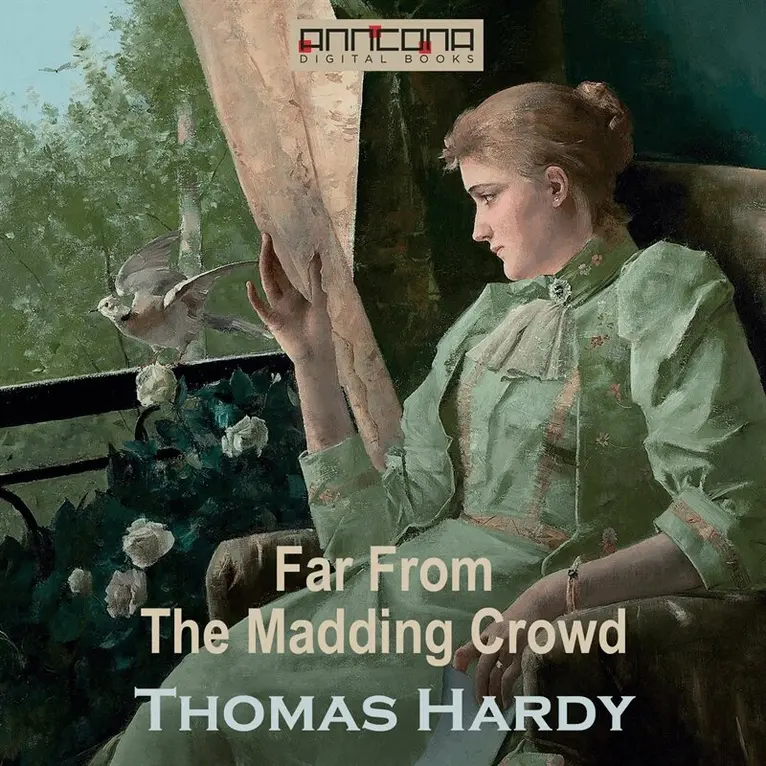
Far From The Madding Crowd (1874) is English writer Thomas Hardy's fourth novel.
The novel is the first to be set in Hardy's fictional county of Wessex in rural south west England. It deals in themes of love, honour and betrayal, against a backdrop of the seemingly idyllic, but often harsh, realities of a farming community in Victorian England. It describes the farmer Bathsheba Everdene, her life and relationships - especially with her lonely neighbour William Boldwood, the faithful shepherd Gabriel Oak, and the thriftless soldier Sergeant Troy.
Hardy's growing taste for tragedy is also evident in the novel. According to Virginia Woolf, "The subject was right; the method was right; the poet and the countryman, the sensual man, the sombre reflective man, the man of learning, all enlisted to produce a book which . . . must hold its place among the great English novels."
The book is often regarded as an early piece of feminist literature, since it features an independent woman with the courage to defy convention by running a farm herself. Although Bathsheba's passionate nature leads her into serious errors of judgment, Hardy endows her with sufficient resilience, intelligence, and good luck to overcome her youthful folly.
The novel was listed at number 48 on the BBC's survey The Big Read in 2003. The book finished 10th on the Guardian's list of greatest love stories of all time in 2007. The novel has been dramatised several times, notably in an Oscar-nominated 1967 film directed by John Schlesinger.
On publication, critical notices were plentiful and mostly positive. Hardy revised the text extensively for the 1895 (this) edition.
Total Running Time (TRT): 14h, 10 min.
Thomas Hardy (1840-1928) was an English novelist and poet. A Victorian realist, in the tradition of George Eliot, he was also influenced both in his novels and poetry by Romanticism, especially by William Wordsworth.
Charles Dickens is another important influence on Thomas Hardy. Like Dickens, he was also highly critical of much in Victorian society, though Hardy focused more on a declining rural society.
Initially he gained fame as the author of such novels as Far from the Madding Crowd (1874), The Mayor of Casterbridge (1886), Tess of the d'Urbervilles (1891), and Jude the Obscure (1895). However, since the 1950s Hardy has been recognized as a major poet, and had a significant influence on The Movement poets of the 1950s and 1960s, including Phillip Larkin.
The bulk of his fictional works, initially published as serials in magazines, were set in the semi-fictional region of Wessex and explored tragic characters struggling against their passions and social circumstances. Hardy's Wessex is based on the medieval Anglo-Saxon kingdom and eventually came to include the counties of Dorset, Wiltshire, Somerset, Devon, Hampshire, and much of Berkshire, in south west England.
69 kr
Lyssna direkt efter köp
Jude the Obscure is the last completed of English writer Thomas Hardy's novels, began as a magazine serial in December 1894 and was first published in book form in 1895.
Eleven-year-old Jude Fawley, inspired by his teacher Mr. Phillotson, who leaves Marygreen for Christminster to take a university degree, decides to adopt the same course for himself. Raised by his great-aunt, he studies hard with the aid of some old Latin and Greek books sent to him by Phillotson.
He trains as a stonemason in order to enable him to support himself when at the university. However when he finally arrives in Christminster he soon finds that a university education is not easily come by for one of his social standing. Meeting and falling in love with his cousin Sue Bridehead his future becomes a series of challenges to his moral, religious and social beliefs.
The novel caused quite a stir in late Victorian England due in part to it’s depiction of marriage and the role religion played in it. Savagely criticised on publication it led to Hardy turning from novel writing and concentrating for the rest of his career on poetry alone. It’s now considered one of Hardy’s finest works and is held up as an example of English novel writing at it’s best.
Total Running Time (TRT): 14h, 12 min.
Thomas Hardy (1840-1928) was an English novelist and poet. A Victorian realist, in the tradition of George Eliot, he was also influenced both in his novels and poetry by Romanticism, especially by William Wordsworth.
Charles Dickens is another important influence on Thomas Hardy. Like Dickens, he was also highly critical of much in Victorian society, though Hardy focused more on a declining rural society.
Initially he gained fame as the author of such novels as Far from the Madding Crowd (1874), The Mayor of Casterbridge (1886), Tess of the d'Urbervilles (1891), and Jude the Obscure (1895). However, since the 1950s Hardy has been recognized as a major poet, and had a significant influence on The Movement poets of the 1950s and 1960s, including Phillip Larkin.
The bulk of his fictional works, initially published as serials in magazines, were set in the semi-fictional region of Wessex and explored tragic characters struggling against their passions and social circumstances. Hardy's Wessex is based on the medieval Anglo-Saxon kingdom and eventually came to include the counties of Dorset, Wiltshire, Somerset, Devon, Hampshire, and much of Berkshire, in south west England.69 kr
Lyssna direkt efter köp
A Pair of Blue Eyes is a novel by English author Thomas Hardy, published in 1873, first serialised between September 1872 and July 1873. It was Hardy's third novel, but the first to bear his name on publication.
The book describes the love triangle between a young woman, Elfride Swancourt, and her two suitors from very different backgrounds. Stephen Smith is a socially inferior but ambitious young man who adores her and with whom she shares a country background. Henry Knight is the respectable, established, older man who represents London society.
Elfride finds herself caught in a battle between her heart, her mind and the expectations of those around her – her parents and society.
Total Running Time (TRT): 13h, 29 min.
Thomas Hardy (1840-1928) was an English novelist and poet. A Victorian realist, in the tradition of George Eliot, he was also influenced both in his novels and poetry by Romanticism, especially by William Wordsworth.
Charles Dickens is another important influence on Thomas Hardy. Like Dickens, he was also highly critical of much in Victorian society, though Hardy focused more on a declining rural society.
Initially he gained fame as the author of such novels as Far from the Madding Crowd (1874), The Mayor of Casterbridge (1886), Tess of the d'Urbervilles (1891), and Jude the Obscure (1895). However, since the 1950s Hardy has been recognized as a major poet, and had a significant influence on The Movement poets of the 1950s and 1960s, including Phillip Larkin.
The bulk of his fictional works, initially published as serials in magazines, were set in the semi-fictional region of Wessex and explored tragic characters struggling against their passions and social circumstances. Hardy's Wessex is based on the medieval Anglo-Saxon kingdom and eventually came to include the counties of Dorset, Wiltshire, Somerset, Devon, Hampshire, and much of Berkshire, in south west England.
69 kr
Lyssna direkt efter köp
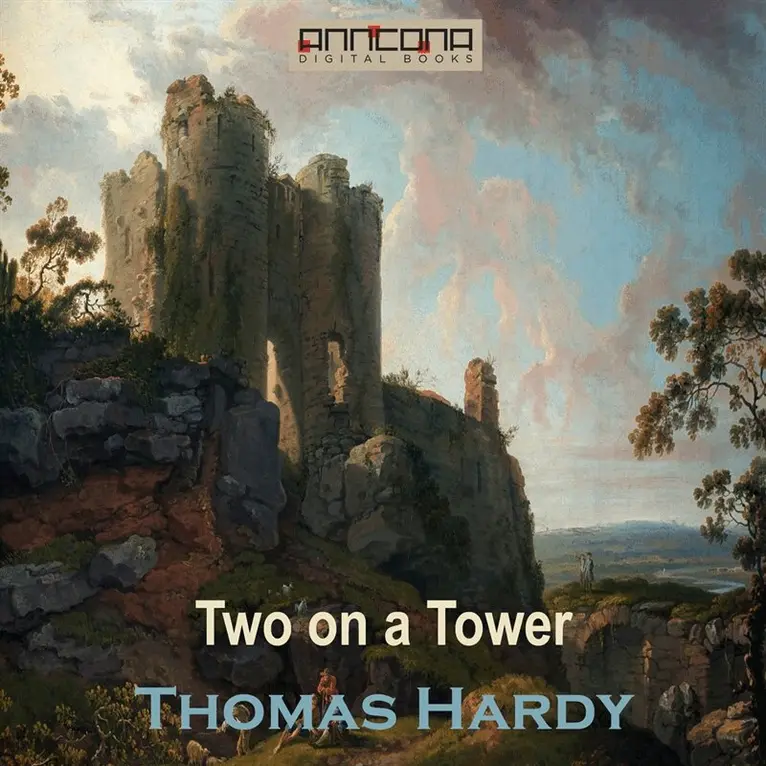
Two on a Tower (1882) is a novel by English author Thomas Hardy, classified by him as a romance and fantasy and now regarded as one of his minor works. The book is one of Hardy's Wessex novels, set in a parallel version of late Victorian Dorset.
The plot concerns two – literally starcrossed – lovers: Swithin St. Cleeve, a very young amateur astronomer, and Viviette Constantine, an unhappily married and abandoned woman 10 years his senior.
Each night Swithin climbs the old tower of the title, in the grounds of the Constantine estate. Lady Constantine, whose husband has been absent some years on an extended hunting and exploring journey to Africa, joins the young man in his stargazing, and supports his astronomical ambitions by buying him equipment, though his dreams of scientific renown are disappointed. Their relationship then deepens and takes several twists and turns.
This is Hardy's most complete treatment of the theme of love across the class and age divide and the fullest expression of his fascination with science and astronomy.
Because the book defied the social norms of the day, upon release the book was called shocking, repulsive, and one critic called it Hardy's "worst yet."
Hardy wrote in a letter to Edmund Gosse on 10 Dec 1882, “I get most extraordinary criticisms of T. on a T. Eminent critics write & tell me in private that it is the most original thing I have done...while other eminent critics (I wonder if they are the same) print the most cutting rebukes you can conceive—show me (to my amazement) that I am quite an immoral person...”
Total Running Time (TRT): 9h, 15 min.
Thomas Hardy (1840-1928) was an English novelist and poet. A Victorian realist, in the tradition of George Eliot, he was also influenced both in his novels and poetry by Romanticism, especially by William Wordsworth.
Charles Dickens is another important influence on Thomas Hardy. Like Dickens, he was also highly critical of much in Victorian society, though Hardy focused more on a declining rural society.
Initially he gained fame as the author of such novels as Far from the Madding Crowd (1874), The Mayor of Casterbridge (1886), Tess of the d'Urbervilles (1891), and Jude the Obscure (1895). However, since the 1950s Hardy has been recognized as a major poet, and had a significant influence on The Movement poets of the 1950s and 1960s, including Phillip Larkin.
The bulk of his fictional works, initially published as serials in magazines, were set in the semi-fictional region of Wessex and explored tragic characters struggling against their passions and social circumstances. Hardy's Wessex is based on the medieval Anglo-Saxon kingdom and eventually came to include the counties of Dorset, Wiltshire, Somerset, Devon, Hampshire, and much of Berkshire, in south west England.
69 kr
Lyssna direkt efter köp
The Woodlanders is a novel by English author Thomas Hardy. It was serialised 1886-87 in Macmillan's Magazine and published in three volumes in 1887. It is one of his series of Wessex novels.
The Woodlanders is one of Hardy's later novels, although he originally intended it as a successor to Far From The Madding Crowd.
It concerns the life and loves of Giles Winterborne, Grace Melbury, Edred Fitzpiers, Felice Charmond and Marty South. The topics of class, fidelity and loyalty are dealt with in Hardy's exquisite style and set in the beautiful woodlands of Hintock.
The novel was later classified by Hardy for the Wessex Edition of his works in the primary group of "Novels of Character and Environment". Yet despite it being regarded as one of Hardy's major novels, the novel is 'something of an anomaly', in comparison with the tragic depth of both its predecessor The Mayor of Casterbridge and its successor Tess of the D'Urbervilles.
The Woodlanders was widely praised. It was declared by the Saturday Review in April 1887 to be, "the best [novel] that Hardy has written", by Sir Arthur Quiller-Couch, "his loveliest if not his finest book", by William Lyon Phelps, "the most beautiful and most noble of Hardy's novels", and by A. Edward Newton, "one of the best novels of the last half century".
The novel remained a personal favourite of Hardy's. Newman Flower recounted that Hardy named it to him as his "favourite novel", and 25 years after its publication, Hardy wrote that, "On taking up The Woodlanders and reading it after many years, I like it as a story best of all."
Total Running Time (TRT): 13h, 26 min.
Thomas Hardy (1840-1928) was an English novelist and poet. A Victorian realist, in the tradition of George Eliot, he was also influenced both in his novels and poetry by Romanticism, especially by William Wordsworth.
Charles Dickens is another important influence on Thomas Hardy. Like Dickens, he was also highly critical of much in Victorian society, though Hardy focused more on a declining rural society.
Initially he gained fame as the author of such novels as Far from the Madding Crowd (1874), The Mayor of Casterbridge (1886), Tess of the d'Urbervilles (1891), and Jude the Obscure (1895). However, since the 1950s Hardy has been recognized as a major poet, and had a significant influence on The Movement poets of the 1950s and 1960s, including Phillip Larkin.
The bulk of his fictional works, initially published as serials in magazines, were set in the semi-fictional region of Wessex and explored tragic characters struggling against their passions and social circumstances. Hardy's Wessex is based on the medieval Anglo-Saxon kingdom and eventually came to include the counties of Dorset, Wiltshire, Somerset, Devon, Hampshire, and much of Berkshire, in south west England.