79 kr
Lyssna direkt efter köp
79 kr
Lyssna direkt efter köp
223 kr
Lyssna direkt efter köp
80 kr
Lyssna direkt efter köp
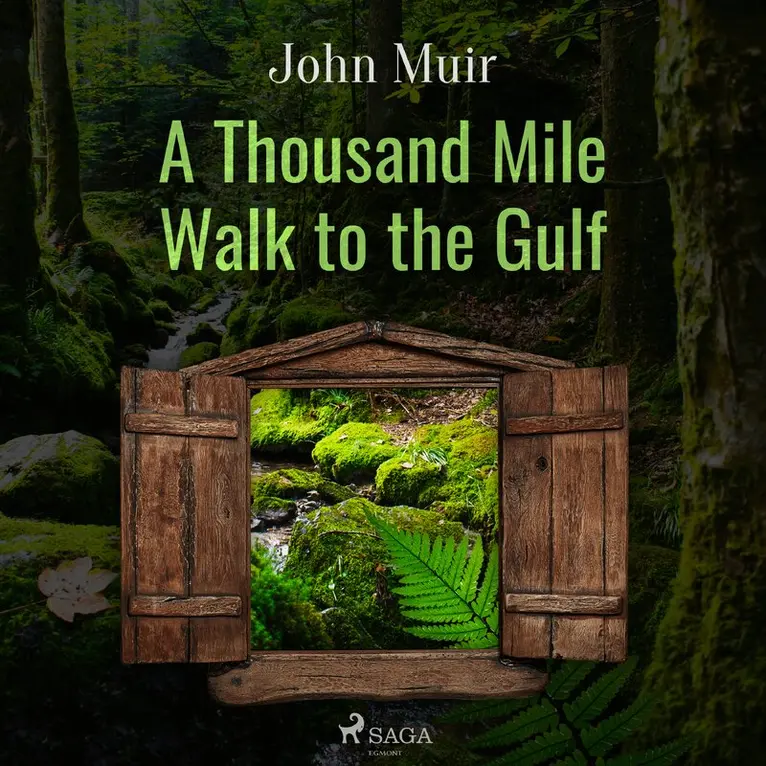
In early March 1867, Muir was injured while working at a wagon wheels factory: a tool he was using slipped and struck him in the eye. This accident changed the course of his life. He was confined to a darkened room for six weeks, worried he’d lost his sight forever. When he did recover, the world looked completely different and life had taken on a new meaning for him. Muir later said, "This affliction has driven me to the sweet fields. God has to nearly kill us sometimes, to teach us lessons." From that point on, he determined to "be true to myself" and follow his dream of exploring and studying plants.
A Thousand Mile Walk to the Gulf recounts Muir's walk of approximately 1,000 miles (1,600 km) from Indiana to Florida. He did not follow a specific route, only going by the "wildest, leafiest, and least trodden way I could find." This journal is the earliest of Muir's writings and autobiographically bridges the period between “The Story of my Boyhood and Youth” and “My First Summer in the Sierra.”John Muir (1838-1914) was a Scottish-American author and naturalist, who is traditionally considered to be the “Father of the National Parks”. Born in Dunbar (East Lothian), he spent his childhood exploring the area, and that is where his love of nature first bloomed. In 1849, his family emigrated to Portage, Wisconsin for religious reasons. At 22, he joined the University of Wisconsin-Madison, from which he never graduated, as he preferred to take a multitude of different classes in the variety of subjects he was interested him, such as chemistry, botany and geology. In 1866, whilst working at an Indianapolis wagon wheel factory, he got into a serious accident and almost lost his sight. When he recovered, he decided to follow his dreams and explore nature. In September 1867, he walked from Kentucky to Florida, later describing the trip in his “A Thousand-Mile Walk to the Gulf.” In 1868, he boarded a ship to Cuba, then later on sailed to New York City, from whence he travelled to California. From there, he decided to visit Yosemite, which he had long read about. He was one of the first to infer that the landscape there must have been formed by glaciers, a widely disputed theory at the time. Muir wrote countless essays, books and letters recounting his adventures out in nature, especially in the Sierra Nevada, which have been read by millions. He played a vital role in the preservation of natural areas, and the creations of Yosemite and Sequoia National Park, amongst many others.

69 kr
Lyssna direkt efter köp
69 kr
Lyssna direkt efter köp
Eyes Like the Sea is a novel by Hungarian writer Mór Jókai, first published in English in 1894. Eyes Like the Sea won the Hungarian Academy of Sciences prize for literature in 1890.
He was a painter, a poet, a novelist. He lived during the Hungarian revolution and his love of freedom meant his life was often in peril. She was his first love, this girl with the eyes like the sea. She was at heart noble, good and loving.
What an excellent lady might have been made out of this woman, if she had only met with a husband who, in the most ordinary acceptance of the word, had been a good fellow, as is really the case with about nine men out of every ten. But she always managed to draw the unlucky tenth out of the urn of destiny.
And so she spurned his true love in favor of a high-flying dandy. He went on to pursue a life of politics and she to follow her capricious heart. But yet, throughout her life, she kept returning to him and to the end, of all men, she loved him perhaps best of all.
Mór Jókai (1825-1904), outside Hungary also known as Maurus Jokai, was a Hungarian dramatist and novelist. Jókai was a romantic with an imagination and humour that has proved timeless. Imagine a combination of Walter Scott, William Beckford, Alexandre Dumas (père), and Charles Dickens, together with a strong hint of Hungarian touch, one can get an idea of the character of his work.
69 kr
Lyssna direkt efter köp
North and South is a social novel by English writer Elizabeth Gaskell first published in 1855. Along with Wives and Daughters (1865) and Cranford (1853), it is one of her best known novels.
Set in Victorian England, North and South is the story of Margaret Hale, a young woman whose life is turned upside down when her family relocates to northern England. As an outsider from the agricultural south, Margaret is initially shocked by the aggressive northerners of the dirty, smoky industrial town of Milton. But as she adapts to her new home, she defies social conventions with her ready sympathy and defense of the working poor.
Her passionate advocacy leads her to repeatedly clash with charismatic mill owner John Thornton over his treatment of his workers. While Margaret denies her growing attraction to him, Thornton agonizes over his foolish passion for her, in spite of their heated disagreements. As tensions mount between them, a violent unionization strike explodes in Milton, leaving everyone to deal with the aftermath in the town and in their personal lives.
Elizabeth Gaskell serialized North and South between September 1854 and January 1855 in Charles Dickens’s magazine Household Words. Upon its publication, Gaskell established herself as a novelist capable of serious discourse on social responsibility and advocacy for change in defiance of established authority.
North and South has been adapted for television twice, in 1975 and 2004. The latter version renewed interest in the novel and gained it a wider audience.
Elizabeth Cleghorn Gaskell, (1810-1865), was an English novelist and short story writer during the Victorian era. Her novels offer a detailed portrait of the lives of many strata of society, including the very poor, and are of interest to social historians as well as lovers of literature. Mrs. Gaskell, as she was often referred to, is considered one of the greatest British novelists of the Victorian era.