157 kr
Skickas
157 kr
Skickas
200 kr
Skickas inom 7-10 vardagar
Toward a Poetics for the Anthropocene
189 kr
Skickas
We have been told that we are living in the Anthropocene, a geological era shaped by humans rather than by nature. In Enlivenment, German philosopher Andreas Weber presents an alternative understanding of our relationship with nature, arguing not that humans control nature but that humans and nature exist in a commons of mutual transformation. There is no nature–human dualism, he contends, because the fundamental dimension of existence is shared in what he calls "aliveness." All subjectivity is intersubjectivity. Self is self-through-other. Seeing all beings in a common household of matter, desire, and imagination, an economy of metabolic and economic transformation, is “enlivenment.” This perspective allows us to move beyond Enlightenment-style thinking that strips material reality of any subjectivity.
To take this step, Weber argues, we need to supplant the concept of techné with the concept of poiesis as the element that brings forth reality. In a world not divided into things and ideas, culture and nature, reality arises from the creation of relationships and continuous fertile transformations; any thinking in terms of relationships comes about as a poetics. The self is always a function of the whole; the whole is equally a function of the individual. Only this integrated freedom allows humanity to reconcile with the natural world.
This first English edition of Enlivenment has been expanded and updated from the German edition.
255 kr
Skickas inom 3-6 vardagar
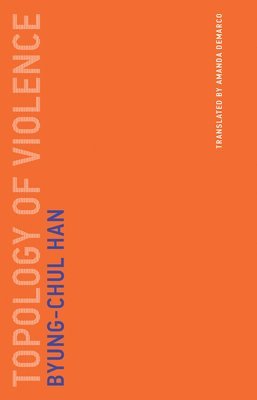
Some things never disappear—violence, for example. Violence is ubiquitous and incessant but protean, varying its outward form according to the social constellation at hand. In Topology of Violence, the philosopher Byung-Chul Han considers the shift in violence from the visible to the invisible, from the frontal to the viral to the self-inflicted, from brute force to mediated force, from the real to the virtual. Violence, Han tells us, has gone from the negative—explosive, massive, and martial—to the positive, wielded without enmity or domination. This, he says, creates the false impression that violence has disappeared. Anonymized, desubjectified, systemic, violence conceals itself because it has become one with society.
Han first investigates the macro-physical manifestations of violence, which take the form of negativity—developing from the tension between self and other, interior and exterior, friend and enemy. These manifestations include the archaic violence of sacrifice and blood, the mythical violence of jealous and vengeful gods, the deadly violence of the sovereign, the merciless violence of torture, the bloodless violence of the gas chamber, the viral violence of terrorism, and the verbal violence of hurtful language. He then examines the violence of positivity—the expression of an excess of positivity—which manifests itself as over-achievement, over-production, over-communication, hyper-attention, and hyperactivity. The violence of positivity, Han warns, could be even more disastrous than that of negativity. Infection, invasion, and infiltration have given way to infarction.
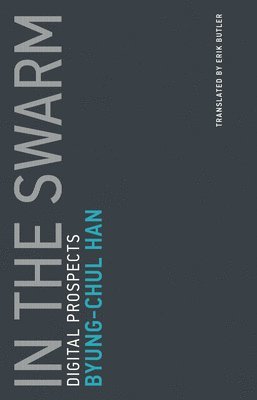
Digital Prospects
177 kr
Skickas
369 kr
Skickas inom 7-10 vardagar
305 kr
Skickas inom 7-10 vardagar
316 kr
Skickas inom 7-10 vardagar
213 kr
Skickas
A Dialogue
384 kr
Skickas inom 7-10 vardagar
259 kr
Skickas inom 7-10 vardagar
458 kr
Skickas inom 7-10 vardagar
180 kr
Skickas
In Good Entertainment, Byung-Chul Han examines the notion of entertainment—its contemporary ubiquity, and its philosophical genealogy. Entertainment today, in all its totalizing variety, has an apparently infinite capacity for incorporation: infotainment, edutainment, servotainment, confrontainment. Entertainment is held up as a new paradigm, even a new credo for being—and yet, in the West, it has had inescapably negative connotations. Han traces Western ideas of entertainment, considering, among other things, the scandal that arose from the first performance of Bach's Saint Matthew's Passion (deemed too beautiful, not serious enough); Kant's idea of morality as duty and the entertainment value of moralistic literature; Heidegger's idea of the thinker as a man of pain; Kafka's hunger artist and the art of negativity, which takes pleasure in annihilation; and Robert Rauschenberg's refusal of the transcendent.
The history of the West, Han tells us, is a passion narrative, and passion appears as a killjoy. Achievement is the new formula for passion, and play is subordinated to production, gamified. And yet, he argues, at their core, passion and entertainment are not entirely different. The pure meaninglessness of entertainment is adjacent to the pure meaning of passion. The fool's smile resembles the pain-racked visage of Homo doloris. In Good Entertainment, Han explores this paradox.
148 kr
Tillfälligt slut
148 kr
Tillfälligt slut
148 kr
Tillfälligt slut
186 kr
Tillfälligt slut