Del 14 - Sternberg Press / Critical Spatial Practice
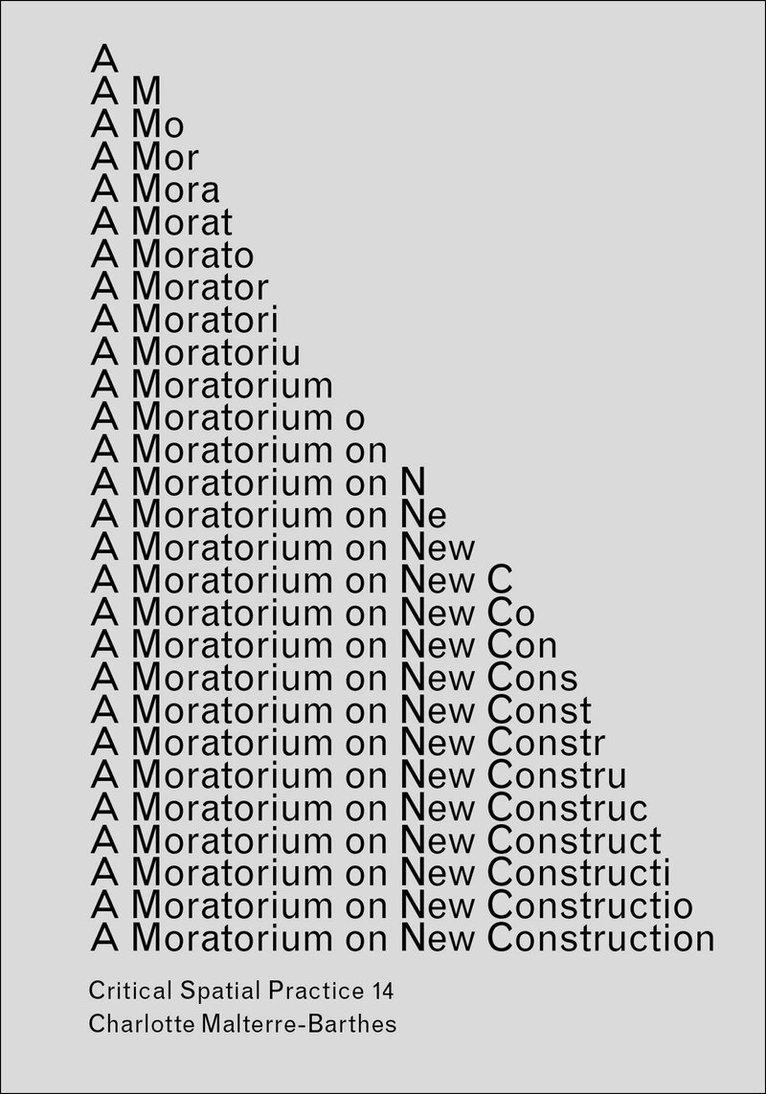
A Moratorium on New Construction
Häftad, Engelska, 2025
284 kr
Skickas inom 3-6 vardagar
A massive value shift for existing buildings, infrastructure, materials, unbuilt land, earth, and the labor that holds our world together.To build is to destroy, writes Charlotte Malterre-Barthes. From steel bolts to concrete blocks to wood flooring to polyester insulation panels, every single component of the built environment is the product of extractive processes. Driven by greedy economies, the global enterprise of space production expands, impacting climate, earth, water, humans, and non-humans everywhere. However housing is both a human right and the mandate of design disciplines: How to navigate the need for housing versus the destructive practice of construction? To pause new construction—even if momentarily, creates a radical thinking framework for alternatives to the current regime of space production and its suspect growth imperative. Engaging with unsettling questions, A Moratorium on New Construction envisions a massive value shift for our existing stock. From housing redistribution to reinviting value generation, from anti-extractive measures to profound structural changes, from curricula reforms to purging the exploitative culture of the office, an entire rewiring of design processes and construction lays ahead. Somewhere between a thought experiment and a call for action, A Moratorium on New Construction is a leap of faith to envision a less extractive future, made of what we have: Not demolishing, not building new, but building less, building with what exists, inhabiting it differently, and caring for it.