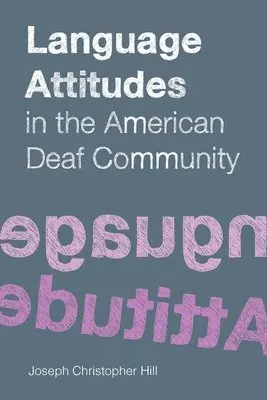
Conventional wisdom dictates that individuals who learn American Sign Language (ASL) at a young age possess a higher level of proficiency than those who acquire ASL later, but Joseph Christopher Hall shows how diversity in the deaf community belies such generalization. Hall dissects affective, cognitive, and behavioral responses to ASL, Signed English, and contact signing across variables of generation, race, and age of language acquisition to identify differing conceptions of a signing standard that, in turn, results in differing perceptions of language proficiency.
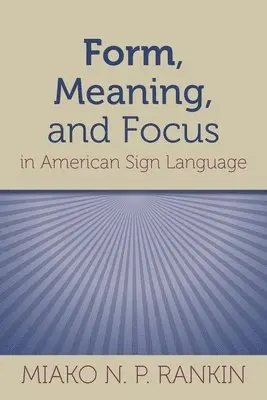
The meaning of any linguistic expression resides not only in the words, but in the way those words are conveyed. Miako N. P. Rankin explores this crucial interrelatedness of form and meaning in the context of American Sign Language, specifically in relation to the concept of non-agent focus - the ASL equivalent of the passive voice in English. Rankin has determined that the pattern of form-meaning correlation characteristic of non-agent focus is used prolifically in day-to-day language and that the recognition of the frequency of this pattern has wide implications for the acquisition of ASL, the development of curricula for teaching ASL, and the analysis of ASL discourse in effective interpretation.