180 kr
Skickas
180 kr
Skickas
179 kr
Skickas
“Death has become the most profitable business in existence.”—from Gore Capitalism
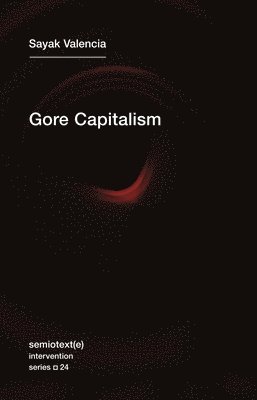
Written by the Tijuana activist intellectual Sayak Valencia, Gore Capitalism is a crucial essay that posits a decolonial, feminist philosophical approach to the outbreak of violence in Mexico and, more broadly, across the global regions of the Third World. Valencia argues that violence itself has become a product within hyper-consumerist neoliberal capitalism, and that tortured and mutilated bodies have become commodities to be traded and utilized for profit in an age of impunity and governmental austerity.
In a lucid and transgressive voice, Valencia unravels the workings of the politics of death in the context of contemporary networks of hyper-consumption, the ups and downs of capital markets, drug trafficking, narcopower, and the impunity of the neoliberal state. She looks at the global rise of authoritarian governments, the erosion of civil society, the increasing violence against women, the deterioration of human rights, and the transformation of certain cities and regions into depopulated, ghostly settings for war. She offers a trenchant critique of masculinity and gender constructions in Mexico, linking their misogynist force to the booming trade in violence.
This book is essential reading for anyone seeking to analyze the new landscapes of war. It provides novel categories that allow us to deconstruct what is happening, while proposing vital epistemological tools developed in the convulsive Third World border space of Tijuana.
147 kr
Skickas
Thirty years of “crisis,” mass unemployment, and flagging growth, and they still want us to believe in the economy... We have to see that the economy is itself the crisis. It's not that there's not enough work, it's that there is too much of it. The Coming Insurrection is an eloquent call to arms arising from the recent waves of social contestation in France and Europe. Written by the anonymous Invisible Committee in the vein of Guy Debord—and with comparable elegance—it has been proclaimed a manual for terrorism by the French government (who recently arrested its alleged authors). One of its members more adequately described the group as “the name given to a collective voice bent on denouncing contemporary cynicism and reality.” The Coming Insurrection is a strategic prescription for an emergent war-machine capable of “spreading anarchy and live communism.” Written in the wake of the riots that erupted throughout the Paris suburbs in the fall of 2005 and presaging more recent riots and general strikes in France and Greece, The Coming Insurrection articulates a rejection of the official Left and its reformist agenda, aligning itself instead with the younger, wilder forms of resistance that have emerged in Europe around recent struggles against immigration control and the “war on terror.” Hot-wired to the movement of '77 in Italy, its preferred historical reference point, The Coming Insurrection formulates an ethics that takes as its starting point theft, sabotage, the refusal to work, and the elaboration of collective, self-organized life forms. It is a philosophical statement that addresses the growing number of those—in France, in the United States, and elsewhere—who refuse the idea that theory, politics, and life are separate realms.
147 kr
Skickas
Chaos and Poetry
158 kr
Skickas
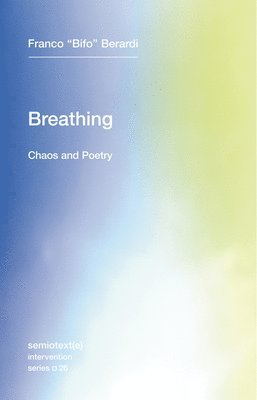
Since the hopeful days of the Occupy movement, many things have changed in the respiration of the world, and we have entered a cycle of spasm, despair, and chaos. Breathing is a book about the increasingly chaotic rhythm of our respiration, about the sense of suffocation that grows everywhere.“I can't breathe.” These words panted by Eric Garner before dying, strangled by a police officer on the streets of Staten Island, capture perfectly catching the overall sentiment of our time. In Breathing, Franco "Bifo" Berardi comes back to the subject that was the core of his 2011 book, The Uprising: the place of poetry in the relations between language, capital, and possibility. In The Uprising, he focuses on poetry as an anticipation of the trend toward abstraction that led to the present form of financial capitalism. In Breathing, he tries to envision poetry as the excess of the field of signification, as the premonition of a possible harmony inscribed in the present chaos. The Uprising was a genealogical diagnosis. Breathing is an essay on poetical therapy. How we deal with chaos, as we know that those who fight against chaos will be defeated, because chaos feeds upon war? How do we deal with suffocation? Is there a way out from the corpse of financial capitalism?
158 kr
Skickas
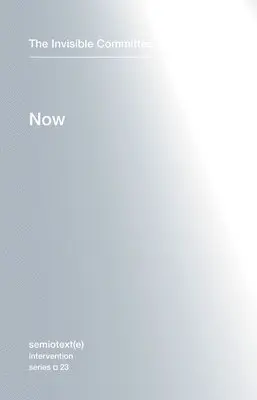
Now is the phantom chapter to the Invisible Committee's previous book, To Our Friends: a new critique from the anonymous collective that establishes their opposition to the world of capital and its law of labor, addresses current anti-terrorist rhetoric and the ferocious repression that comes with it, and clarifies the end of social democracy and the growing rumors of the need for a coming “civil war.” Now emerges at a time when the Invisible Committee's contestation has found echoes throughout the West, with a collapse of trust in the police, an inept weariness on the part of the political system, a growing urgency for opposition, a return of the theme of the Commune, a vanishing distinction between radicals and citizens, and a widespread refusal on the part of the citizen to be governed. As farcical political elections continue to unfold worldwide like a line of tumbling dominoes, and governments increasingly struggle to reclaim a legitimacy that has already slipped out of their grasp, Now clarifies the Invisible Committee's attitude toward all such elections and their outcome: one of utter indifference. Now proposes a “destituent process” that charts out a different path to be taken, a path of outright refusal that simply ignores elections altogether. It is a path that calls for taking over the world and not taking power, for exploring new forms of life and not a new constitution, and for desertion and silence as alternatives to proclamations and crashes. It is also a call for an unprecedented communism—a communism stronger than nation and country.
158 kr
Skickas
171 kr
Skickas
180 kr
Skickas
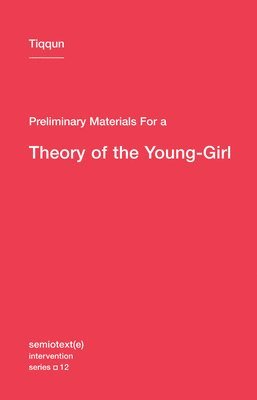
The Young-Girl is not always young; more and more frequently, she is not even female. She is the figure of total integration in a disintegrating social totality.—from Theory of the Young-Girl
First published in France in 1999, Preliminary Materials for a Theory of the Young-Girl dissects the impossibility of love under Empire. The Young-Girl is consumer society's total product and model citizen: whatever “type” of Young-Girl she may embody, whether by whim or concerted performance, she can only seduce by consuming. Filled with the language of French women's magazines, rooted in Proust's figure of Albertine and the amusing misery of (teenage) romance in Witold Gombrowicz's Ferdydurke, and informed by Pierre Klossowski's notion of “living currency” and libidinal economy, Preliminary Materials for a Theory of the Young-Girl diagnoses—and makes visible—a phenomenon that is so ubiquitous as to have become transparent.
In the years since the book's first publication in French, the worlds of fashion, shopping, seduction plans, makeover projects, and eating disorders have moved beyond the comparatively tame domain of paper magazines into the perpetual accessibility of Internet culture. Here the Young-Girl can seek her own reflection in corporate universals and social media exchanges of “personalities” within the impersonal realm of the marketplace. Tracing consumer society's colonization of youth and sexuality through the Young-Girl's “freedom” (in magazine terms) to do whatever she wants with her body, Tiqqun exposes the rapaciously competitive and psychically ruinous landscape of modern love.
340 kr
Skickas inom 7-10 vardagar
168 kr
Skickas
155 kr
Skickas
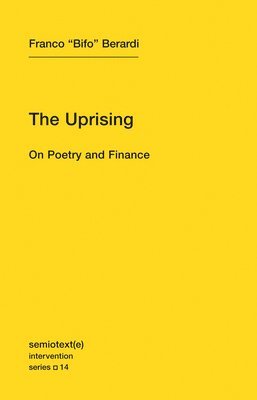
The Uprising is an Autonomist manifesto for today's precarious times, and a rallying cry in the face of the catastrophic and irreversible crisis that neoliberalism and the financial sphere have established over the globe. In his newest book, Franco “Bifo” Berardi argues that the notion of economic recovery is complete mythology. The coming years will inevitably see new surges of protest and violence, but the old models of resistance no longer apply. Society can either stick with the prescriptions and “rescues” that the economic and financial sectors have demanded at the expense of social happiness, culture, and the public good; or it can formulate an alternative. For Berardi, this alternative lies in understanding the current crisis as something more fundamental than an economic crisis: it is a crisis of the social imagination, and demands a new language by which to address it.
This is a manifesto against the idea of growth, and against the concept of debt, the financial sector's two primary linguistic means of manipulating society. It is a call for exhaustion, and for resistance to the cult of energy on which today's economic free-floating market depends. To this end, Berardi introduces an unexpected linguistic political weapon—poetry: poetry as the insolvency of language, as the sensuous birth of meaning and desire, as that which cannot be reduced to information and exchanged like currency. If the protests now stirring about the world are to take shape and direction, then the revolution will be neither peaceful nor violent—it will be linguistic, or will not be at all.
Toward a Politics of Revolutionary Love
187 kr
Skickas
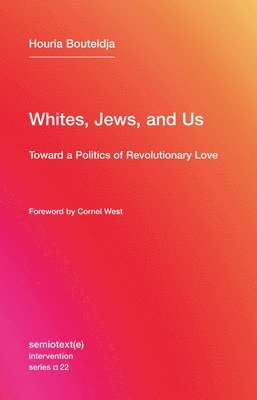
Why am I writing this book? Because I share Gramsci's anxiety: “The old are dying and the new cannot be born; in this interregnum a great variety of morbid symptoms appear.” The fascist monster, born in the entrails of Western modernity. Of course, the West is not what it used to be. Hence my question: what can we offer white people in exchange for their decline and for the wars that will ensue? There is only one answer: peace. There is only one way: revolutionary love.—from Whites, Jews, and Us
With Whites, Jews, and Us, Houria Bouteldja launches a scathing critique of the European Left from an indigenous anti-colonial perspective, reflecting on Frantz Fanon's political legacy, the republican pact, the Shoah, the creation of Israel, feminism, and the fate of postcolonial immigration in the West in the age of rising anti-immigrant populism. Drawing upon such prominent voices as James Baldwin, Malcolm X, and Jean Genet, she issues a polemical call for a militant anti-racism grounded in the concept of revolutionary love.
Such love will not come without significant discomfort for whites, and without necessary provocation. Bouteldja challenges widespread assumptions among the Left in the United States and Europe—that anti-Semitism plays any role in Arab–Israeli conflicts, for example, or that philo-Semitism doesn't in itself embody an oppressive position; that feminism or postcolonialist theory is free of colonialism; that integrationalism is a solution rather than a problem; that humanism can be against racism when its very function is to support the political-ideological apparatus that Bouteldja names the “white immune system.”
At this transitional moment in the history of the West—which is to say, at the moment of its decline—Bouteldja offers a call for political unity that demands the recognition that whiteness is not a genetic question: it is a matter of power, and it is high time to dismantle it.
This Semiotext(e)/Intervention series English-language edition includes a foreword by Cornel West.
A Concise Philosophy of the Machine as Social Movement
239 kr
Skickas inom 7-10 vardagar
205 kr
Skickas inom 3-6 vardagar
162 kr
Skickas
In Where Art Belongs, Chris Kraus examines artistic enterprises of the past decade that reclaim the use of lived time as a material in the creation of visual art. In four interlinked essays, Kraus expands the argument begun in her earlier book Video Green that “the art world is interesting only insofar as it reflects the larger world outside it.” Moving from New York to Berlin to Los Angeles to the Pueblo Nuevo barrio of Mexicali, Kraus addresses such subjects as the ubiquity of video, the legacy of the 1960s Amsterdam underground newspaper Suck, and the activities of the New York art collective Bernadette Corporation. She examines the uses of boredom, poetry, privatized prisons, community art, corporate philanthropy, vertically integrated manufacturing, and discarded utopias, revealing the surprising persistence of microcultures within the matrix. Chronicling the sometimes doomed but persistently heroic efforts of small groups of artists to reclaim public space and time, Where Art Belongs describes the trend towards collectivity manifested in the visual art world during the past decade, and the small forms of resistance to digital disembodiment and the hegemony of the entertainment/media/culture industry. For all its faults, Kraus argues, the art world remains the last frontier for the desire to live differently.
144 kr
Skickas
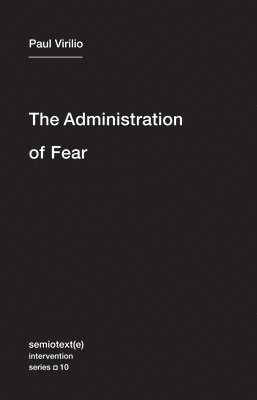
We are living under the administration of fear: fear has become an environment, an everyday landscape. There was a time when wars, famines, and epidemics were localized and limited by a certain timeframe. Today, it is the world itself that is limited, saturated, and manipulated, the world itself that seizes us and confines us with a stressful claustrophobia. Stock-market crises, undifferentiated terrorism, lightning pandemics, “professional” suicides.... Fear has become the world we live in.
The administration of fear also means that states are tempted to create policies for the orchestration and management of fear. Globalization has progressively eaten away at the traditional prerogatives of states (most notably of the welfare state), and states have to convince citizens that they can ensure their physical safety.
In this new and lengthy interview, Paul Virilio shows us how the “propaganda of progress,” the illuminism of new technologies, provide unexpected vectors for fear in the way that they manufacture frenzy and stupor. For Virilio, the economic catastrophe of 2007 was not the death knell of capitalism, as some have claimed, but just further evidence that capitalism has accelerated into turbo-capitalism, and is accelerating still. With every natural disaster, health scare, and malicious rumor now comes the inevitable “information bomb”—live feeds take over real space, and technology connects life to the immediacy of terror, the ultimate expression of speed. With the nuclear dissuasion of the Cold War behind us, we are faced with a new form of civil dissuasion: a state of fear that allows for the suspension of controversial social situations.
211 kr
Skickas inom 3-6 vardagar
157 kr
Skickas
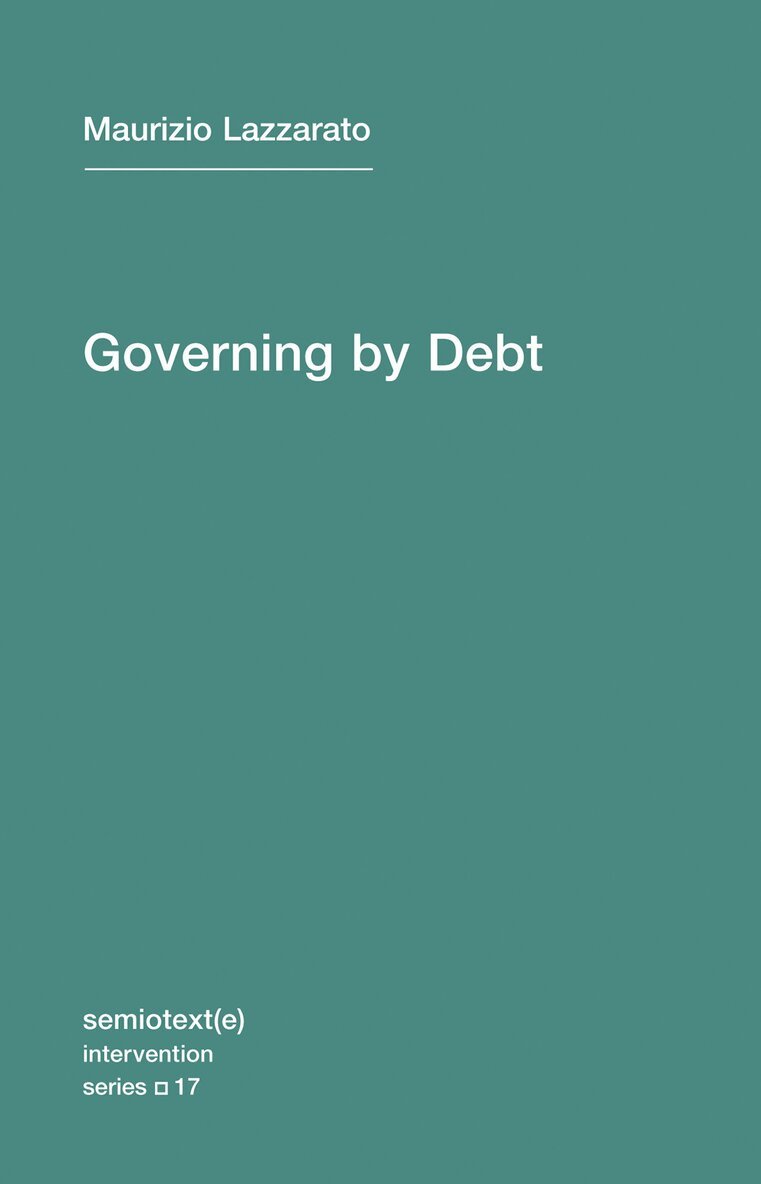
"The debtor-creditor relation, which is at the heart of this book, sharpens mechanisms of exploitation and domination indiscriminately, since, in it, there is no distinction between workers and the unemployed, consumers and producers, working and non-working populations, between retirees and welfare recipients. They are all 'debtors,' guilty and responsible in the eyes of capital, which has become the Great, the Universal, Creditor."—from The Making of the Indebted Man
Debt—both public debt and private debt—has become a major concern of economic and political leaders. In The Making of the Indebted Man, Maurizio Lazzarato shows that, far from being a threat to the capitalist economy, debt lies at the very core of the neoliberal project. Through a reading of Karl Marx's lesser-known youthful writings on John Mill, and a rereading of writings by Friedrich Nietzsche, Gilles Deleuze, Félix Guattari, and Michel Foucault, Lazzarato demonstrates that debt is above all a political construction, and that the creditor/debtor relation is the fundamental social relation of Western societies.
Debt cannot be reduced to a simple economic mechanism, for it is also a technique of “public safety” through which individual and collective subjectivities are governed and controlled. Its aim is to minimize the uncertainty of the time and behavior of the governed. We are forever sinking further into debt to the State, to private insurance, and, on a more general level, to corporations. To insure that we honor our debts, we are at once encouraged and compelled to become the “entrepreneurs” of our lives, of our “human capital.” In this way, our entire material, psychological, and affective horizon is upended and reconfigured.
How do we extricate ourselves from this impossible situation? How do we escape the neoliberal condition of the indebted man? Lazzarato argues that we will have to recognize that there is no simple technical, economic, or financial solution. We must instead radically challenge the fundamental social relation structuring capitalism: the system of debt.
158 kr
Skickas
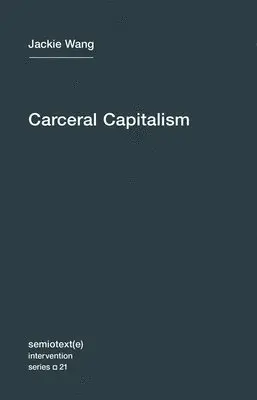
What we see happening in Ferguson and other cities around the country is not the creation of livable spaces, but the creation of living hells. When people are trapped in a cycle of debt it also can affect their subjectivity and how they temporally inhabit the world by making it difficult for them to imagine and plan for the future. What psychic toll does this have on residents? How does it feel to be routinely dehumanized and exploited by the police?—from Carceral Capitalism
In this collection of essays in Semiotext(e)'s Intervention series, Jackie Wang examines the contemporary incarceration techniques that have emerged since the 1990s. The essays illustrate various aspects of the carceral continuum, including the biopolitics of juvenile delinquency, predatory policing, the political economy of fees and fines, cybernetic governance, and algorithmic policing. Included in this volume is Wang's influential critique of liberal anti-racist politics, “Against Innocence,” as well as essays on RoboCop, techno-policing, and the aesthetic problem of making invisible forms of power legible.
Wang shows that the new racial capitalism begins with parasitic governance and predatory lending that extends credit only to dispossess later. Predatory lending has a decidedly spatial character and exists in many forms, including subprime mortgage loans, student loans for sham for-profit colleges, car loans, rent-to-own scams, payday loans, and bail bond loans. Parasitic governance, Wang argues, operates through five primary techniques: financial states of exception, automation, extraction and looting, confinement, and gratuitous violence. While these techniques of governance often involve physical confinement and the state-sanctioned execution of black Americans, new carceral modes have blurred the distinction between the inside and outside of prison. As technologies of control are perfected, carcerality tends to bleed into society.
147 kr
Skickas
166 kr
Skickas
184 kr
Kommande
159 kr
Tillfälligt slut
138 kr
Tillfälligt slut
150 kr
Tillfälligt slut
127 kr
Tillfälligt slut
127 kr
Tillfälligt slut
152 kr
Tillfälligt slut
135 kr
Tillfälligt slut