As the United States’ English Language Learner (ELL) population grows, so does the need to understand how literacy instruction truly unfolds in classrooms, especially in under-resourced and rapidly changing communities. This timely publication presents findings from three interconnected studies that explore instructional quality, professional development, and the impact of COVID-19 on ELL education across rural and urban districts in Indiana.Drawing on over 150 hours of classroom video and grounded in social constructivism, translanguaging pedagogy and Purdue English Language Development (ELD) Framework, the research offers rare, granular insights into what works, and what doesn’t, for ELLs in elementary settings. From quantifying literacy practices to evaluating year-long professional development programs and analyzing pandemic-era adaptations, this book delivers actionable strategies for educators, researchers, and policymakers.With a focus on Indiana as a lens into national challenges, English Learner Literacy in Elementary Schools showcases new methods and frameworks for equitable, culturally responsive instruction. Whether in times of stability or crisis, it equips readers with the tools to support ELLs more effectively, wherever they teach.
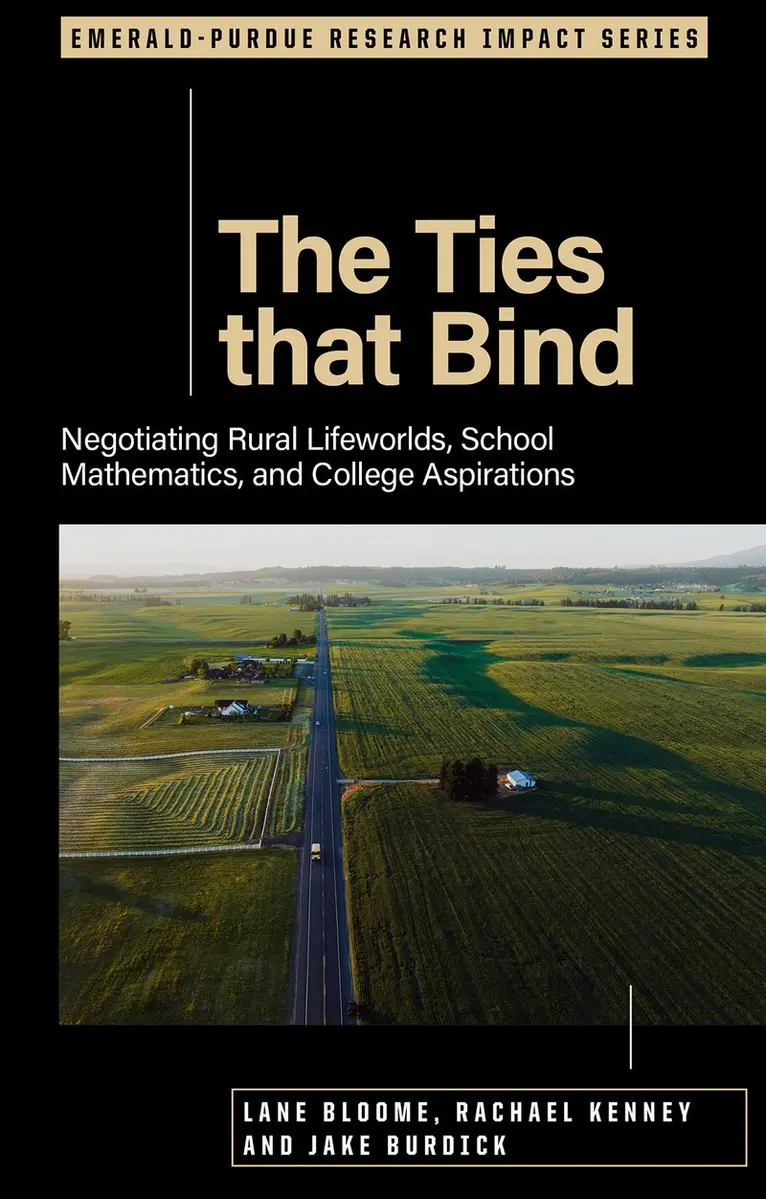
The Ties that Bind presents a narrative-driven investigation of high-achieving rural students as they engage with advanced mathematics in AP Calculus. At a time when rural education is often framed through deficit narratives, this book provides a countervailing account, showing how students draw on cultural, familial, and community resources to position themselves as capable mathematics learners. Their stories demonstrate that rigorous academic engagement is not only possible in rural contexts but deeply shaped by the social worlds students inhabit.Using interviews, classroom observations, and analyses of academic pathways, the authors apply the figured worlds framework to illuminate how students construct academic identities within intersecting contexts of school, family, and rural community life. The narratives reveal how students strategically leverage social capital and peer networks, negotiate classroom expectations, and engage with conceptual mathematical practices to advance their academic goals. Their relationships with grades, perseverance, and conceptual understanding function as tools for navigating both classroom hierarchies and broader social structures, revealing mathematics learning as a site of identity formation and aspiration.This timely work contributes a nuanced perspective to rural education research by situating mathematics learning within the broader cultural and socio-economic dynamics of rural communities. It demonstrates that conceptually rich, constructivist mathematics instruction can thrive in rural settings and serve as a meaningful pathway to postsecondary opportunity. Centering students’ voices and blending theory with empirical narrative, The Ties that Bind offers researchers, educators, and policymakers a grounded, evidence-based account of rural academic success and the possibilities it creates for students’ futures.
Access to safe drinking water remains one of the most pressing global challenges, particularly in regions where drought and chronic scarcity undermine conventional treatment systems. This timely work offers a rigorous, interdisciplinary examination of point-of-use (POU) water filtration technologies as viable solutions for vulnerable communities, with a focus on Paraguay and Ecuador.Drawing on collaboration between the Pan-American Health Organization (PAHO), Universidad San Francisco de Quito (USFQ), and Purdue University, Francisco Montalvo and Zhi Zhou integrate public health, environmental engineering, and field-based implementation. They provide a comparative analysis of activated carbon and reverse osmosis systems under real-world conditions, assessing microbial removal, metal reduction, and operational resilience in high-salinity environments. Beyond technical performance, the book addresses practical considerations such as cost, maintenance, and deployment strategies in remote health facilities.By coupling laboratory findings with field evaluations, this work closes a critical knowledge gap between theoretical efficacy and contextual applicability. It is an indispensable resource for policymakers, NGOs, health professionals, and development practitioners, as well as researchers and graduate students in global health, sustainable infrastructure, and water systems engineering.
What happens when professional chefs hang up their aprons for a life in academia? Structured as both autoethnography and critique, The Chef Professor exposes how chef pracademics (individuals who identify as both practitioners and academics) negotiate the fraught relationship between practical expertise and academic legitimacy within research-intensive universities. Following the first author’s career transition from executive chef to scholar, this book invites readers to reimagine an academic life that honors, rather than exhausts, the practitioners who bring their craft into the university.