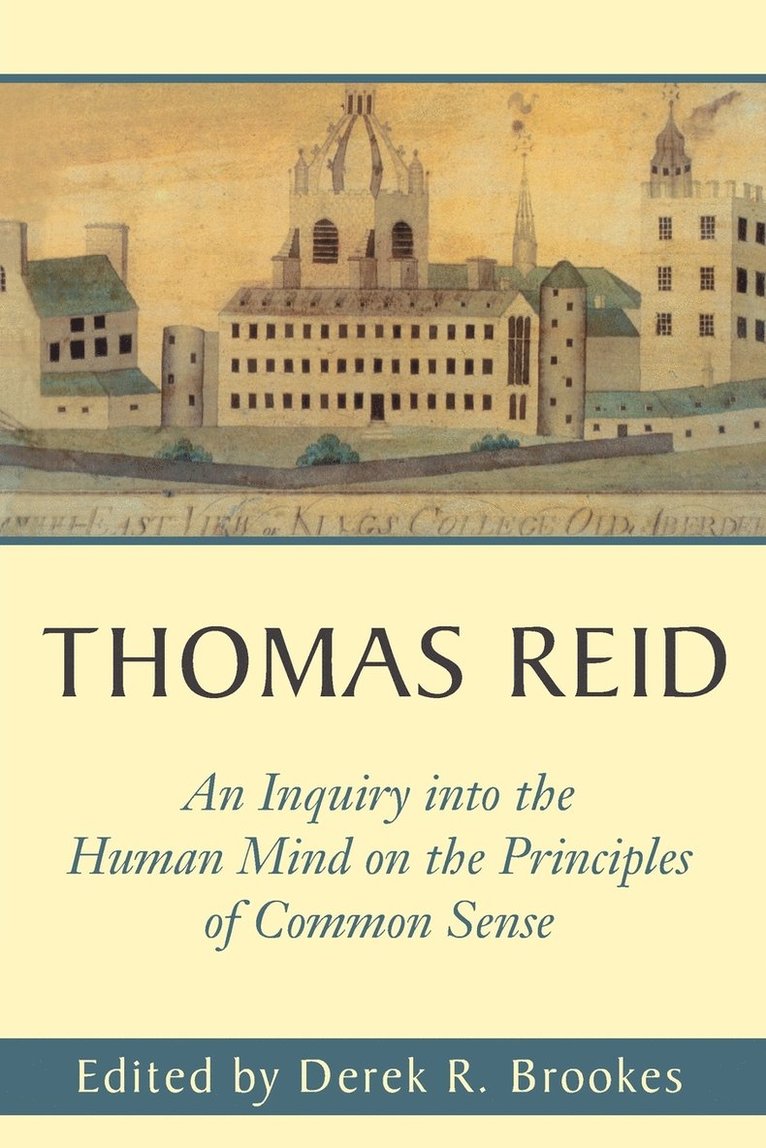
Thomas Reid (1710–1796) is now recognized as one of the towering figures of the Enlightenment. Best known for his published writings on epistemology and moral theory, he was also an accomplished mathematician and natural philosopher, as an earlier volume of his manuscripts edited by Paul Wood for the Edinburgh Reid Edition, Thomas Reid on the Animate Creation, has shown. The Correspondence of Thomas Reid collects all of the known letters to and from Reid in a fully annotated form. Letters already published by Sir William Hamilton and others have been reedited, and roughly half of the letters included appear in print for the first time.Writing in 1802, Reid's disciple and biographer Dugald Stewart doubted that Reid's correspondence "would be generally interesting." This collection proves otherwise, for the letters illuminate virtually every aspect of Reid's life and career and, in some instances, provide us with invaluable evidence about activities otherwise undocumented in his manuscripts or published works. Through his correspondence we can trace Reid's relations with contemporaries such as David Hume and his colleagues at both King's College, Aberdeen, and the University of Glasgow, as well as his engagement with the most controversial philosophical, scientific, and political issues of his day. If anything, the letters assembled here serve as the starting point for understanding Reid and his place in the Enlightenment.
Thomas Reid was an intellectual polymath whose interests encompassed all aspects of Enlightenment thought. Paul Wood reconstructs for the first time Reid's career as a mathematician and natural philosopher and shows how he grappled with various aspects of the scientific legacy of Sir Isaac Newton. This book provides the drafts and printed text of his earliest publication, 'An Essay on Quantity', along with a selection of his mathematical papers, including the significant series of manuscripts dealing with Euclid's problematic parallels postulate. Other manuscripts illustrate his skill as an observational astronomer, his work in optics dealing with the aberration of light, his speculations on electricity, and his engagement with the revolutionary chemical system of Lavoisier. Read in conjunction with Thomas Reid on the Animate Creation, this volume shows why Reid's contemporaries regarded him as an accomplished man of science.