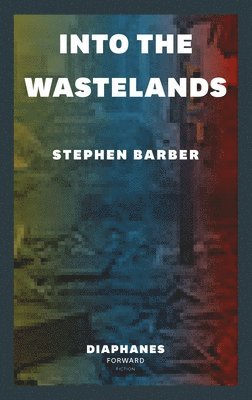
“Only the wastelands can save us now.”An urban investigator has been commissioned by a global corporation to determine how cities worldwide are being engulfed and destroyed by the wastelands that are mysteriously appearing at their heart. They are being "wastelanded," generating turmoil and catastrophic technological meltdown in every global megalopolis. Throughout his inquiries he discovers that the world’s cities are becoming apocalyptic, experiencing ecocide. The investigator himself will have to travel to the "true north" to escape that endpoint.Today, urban imaginaries and speculative fictions often depict abandoned wastelands and ruinous cities that hold the expansive potential to engulf all urban and environmental space and render it entirely apocalyptic.In his novel Into the Wastelands Stephen Barber examines urgent aspects of our wasted realities through fictional narratives: How does the figure of the proliferating, infinitely expansive wasteland enable us to understand that point of rupture for urban futures? Does the wasteland allow us to accurately assess the contemporary dynamic between the apocalyptic and the urban?
A literary tour de force through the symbolic landscapes of recent cultural history, Lookalikes is a text in which everything is as it seems and nothing is as it is.Thomas Meinecke’s lookalikes resemble many people––Marlon Brando, Shakira, Justin Timberlake, or Josephine Baker to name a few––but never themselves. Illusion is their capital; imitation is their business. They stroll through Düsseldorf's posh Königsallee, reading, quoting, and plagiarizing their way through the history of pop culture and philosophy, exploring categories of realness in parallel worlds and digital chat forums. At the same time, yet another Thomas wanders Brazil in disguise, tracing the journey of Hubert Fichte and his doppelgänger Jäcki. In this endless play of similarities, all identity is lost. Between literary and sexual genres, mimesis and authenticity, fiction and reality, these lookalikes only ever find the Other, just as Meinecke’s text duplicates itself in the furor of allusions and reference systems, constantly branching out anew, never remaining the same, always changing these so-called original signs.