1 910 kr
Skickas
1 910 kr
Skickas
1 254 kr
Skickas
“Written by three experts in the field, Deep Learning is the only comprehensive book on the subject.”—Elon Musk, cochair of OpenAI; cofounder and CEO of Tesla and SpaceX
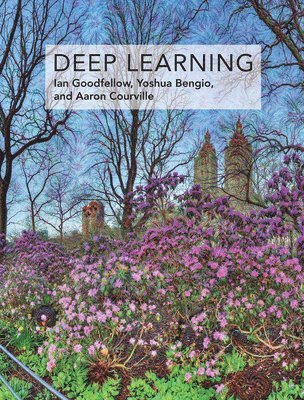
Deep learning is a form of machine learning that enables computers to learn from experience and understand the world in terms of a hierarchy of concepts. Because the computer gathers knowledge from experience, there is no need for a human computer operator to formally specify all the knowledge that the computer needs. The hierarchy of concepts allows the computer to learn complicated concepts by building them out of simpler ones; a graph of these hierarchies would be many layers deep. This book introduces a broad range of topics in deep learning.
The text offers mathematical and conceptual background, covering relevant concepts in linear algebra, probability theory and information theory, numerical computation, and machine learning. It describes deep learning techniques used by practitioners in industry, including deep feedforward networks, regularization, optimization algorithms, convolutional networks, sequence modeling, and practical methodology; and it surveys such applications as natural language processing, speech recognition, computer vision, online recommendation systems, bioinformatics, and videogames. Finally, the book offers research perspectives, covering such theoretical topics as linear factor models, autoencoders, representation learning, structured probabilistic models, Monte Carlo methods, the partition function, approximate inference, and deep generative models.
Deep Learning can be used by undergraduate or graduate students planning careers in either industry or research, and by software engineers who want to begin using deep learning in their products or platforms. A website offers supplementary material for both readers and instructors.
1 503 kr
Skickas
1 320 kr
Skickas
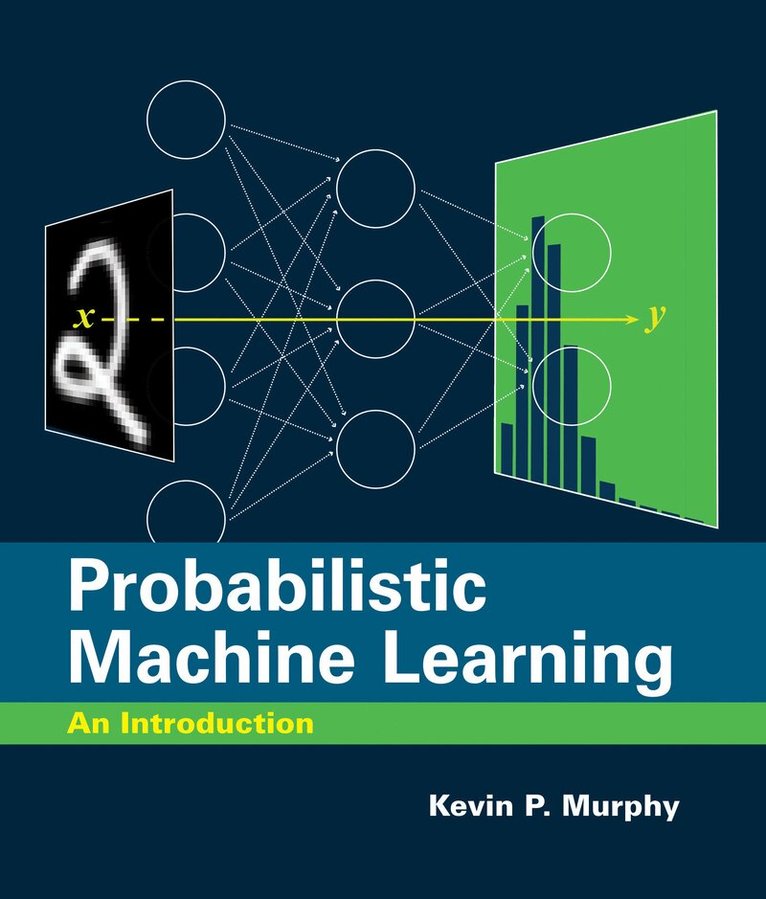
Today's Web-enabled deluge of electronic data calls for automated methods of data analysis. Machine learning provides these, developing methods that can automatically detect patterns in data and then use the uncovered patterns to predict future data. This textbook offers a comprehensive and self-contained introduction to the field of machine learning, based on a unified, probabilistic approach.
The coverage combines breadth and depth, offering necessary background material on such topics as probability, optimization, and linear algebra as well as discussion of recent developments in the field, including conditional random fields, L1 regularization, and deep learning. The book is written in an informal, accessible style, complete with pseudo-code for the most important algorithms. All topics are copiously illustrated with color images and worked examples drawn from such application domains as biology, text processing, computer vision, and robotics. Rather than providing a cookbook of different heuristic methods, the book stresses a principled model-based approach, often using the language of graphical models to specify models in a concise and intuitive way. Almost all the models described have been implemented in a MATLAB software package—PMTK (probabilistic modeling toolkit)—that is freely available online. The book is suitable for upper-level undergraduates with an introductory-level college math background and beginning graduate students.
1 569 kr
Skickas
1 477 kr
Skickas
Most tasks require a person or an automated system to reason—to reach conclusions based on available information. The framework of probabilistic graphical models, presented in this book, provides a general approach for this task. The approach is model-based, allowing interpretable models to be constructed and then manipulated by reasoning algorithms. These models can also be learned automatically from data, allowing the approach to be used in cases where manually constructing a model is difficult or even impossible. Because uncertainty is an inescapable aspect of most real-world applications, the book focuses on probabilistic models, which make the uncertainty explicit and provide models that are more faithful to reality.
Probabilistic Graphical Models discusses a variety of models, spanning Bayesian networks, undirected Markov networks, discrete and continuous models, and extensions to deal with dynamical systems and relational data. For each class of models, the text describes the three fundamental cornerstones: representation, inference, and learning, presenting both basic concepts and advanced techniques. Finally, the book considers the use of the proposed framework for causal reasoning and decision making under uncertainty. The main text in each chapter provides the detailed technical development of the key ideas. Most chapters also include boxes with additional material: skill boxes, which describe techniques; case study boxes, which discuss empirical cases related to the approach described in the text, including applications in computer vision, robotics, natural language understanding, and computational biology; and concept boxes, which present significant concepts drawn from the material in the chapter. Instructors (and readers) can group chapters in various combinations, from core topics to more technically advanced material, to suit their particular needs.
1 131 kr
Skickas
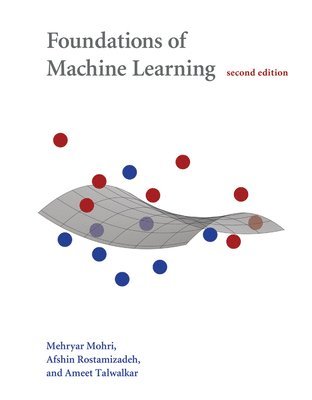
This book is a general introduction to machine learning that can serve as a textbook for graduate students and a reference for researchers. It covers fundamental modern topics in machine learning while providing the theoretical basis and conceptual tools needed for the discussion and justification of algorithms. It also describes several key aspects of the application of these algorithms. The authors aim to present novel theoretical tools and concepts while giving concise proofs even for relatively advanced topics.
Foundations of Machine Learning is unique in its focus on the analysis and theory of algorithms. The first four chapters lay the theoretical foundation for what follows; subsequent chapters are mostly self-contained. Topics covered include the Probably Approximately Correct (PAC) learning framework; generalization bounds based on Rademacher complexity and VC-dimension; Support Vector Machines (SVMs); kernel methods; boosting; on-line learning; multi-class classification; ranking; regression; algorithmic stability; dimensionality reduction; learning automata and languages; and reinforcement learning. Each chapter ends with a set of exercises. Appendixes provide additional material including concise probability review.
This second edition offers three new chapters, on model selection, maximum entropy models, and conditional entropy models. New material in the appendixes includes a major section on Fenchel duality, expanded coverage of concentration inequalities, and an entirely new entry on information theory. More than half of the exercises are new to this edition.
642 kr
Skickas
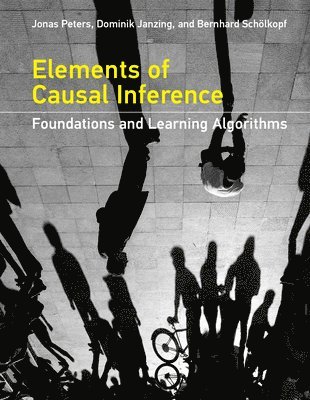
The mathematization of causality is a relatively recent development, and has become increasingly important in data science and machine learning. This book offers a self-contained and concise introduction to causal models and how to learn them from data.After explaining the need for causal models and discussing some of the principles underlying causal inference, the book teaches readers how to use causal models: how to compute intervention distributions, how to infer causal models from observational and interventional data, and how causal ideas could be exploited for classical machine learning problems. All of these topics are discussed first in terms of two variables and then in the more general multivariate case. The bivariate case turns out to be a particularly hard problem for causal learning because there are no conditional independences as used by classical methods for solving multivariate cases. The authors consider analyzing statistical asymmetries between cause and effect to be highly instructive, and they report on their decade of intensive research into this problem.
The book is accessible to readers with a background in machine learning or statistics, and can be used in graduate courses or as a reference for researchers. The text includes code snippets that can be copied and pasted, exercises, and an appendix with a summary of the most important technical concepts.
1 042 kr
Skickas
This textbook provides a technical perspective on natural language processing—methods for building computer software that understands, generates, and manipulates human language. It emphasizes contemporary data-driven approaches, focusing on techniques from supervised and unsupervised machine learning. The first section establishes a foundation in machine learning by building a set of tools that will be used throughout the book and applying them to word-based textual analysis. The second section introduces structured representations of language, including sequences, trees, and graphs. The third section explores different approaches to the representation and analysis of linguistic meaning, ranging from formal logic to neural word embeddings. The final section offers chapter-length treatments of three transformative applications of natural language processing: information extraction, machine translation, and text generation. End-of-chapter exercises include both paper-and-pencil analysis and software implementation.
The text synthesizes and distills a broad and diverse research literature, linking contemporary machine learning techniques with the field's linguistic and computational foundations. It is suitable for use in advanced undergraduate and graduate-level courses and as a reference for software engineers and data scientists. Readers should have a background in computer programming and college-level mathematics. After mastering the material presented, students will have the technical skill to build and analyze novel natural language processing systems and to understand the latest research in the field.
695 kr
Skickas
739 kr
Skickas
1 012 kr
Skickas
670 kr
Skickas
Gaussian processes (GPs) provide a principled, practical, probabilistic approach to learning in kernel machines. GPs have received increased attention in the machine-learning community over the past decade, and this book provides a long-needed systematic and unified treatment of theoretical and practical aspects of GPs in machine learning. The treatment is comprehensive and self-contained, targeted at researchers and students in machine learning and applied statistics. The book deals with the supervised-learning problem for both regression and classification, and includes detailed algorithms. A wide variety of covariance (kernel) functions are presented and their properties discussed. Model selection is discussed both from a Bayesian and a classical perspective. Many connections to other well-known techniques from machine learning and statistics are discussed, including support-vector machines, neural networks, splines, regularization networks, relevance vector machines and others. Theoretical issues including learning curves and the PAC-Bayesian framework are treated, and several approximation methods for learning with large datasets are discussed. The book contains illustrative examples and exercises, and code and datasets are available on the Web. Appendixes provide mathematical background and a discussion of Gaussian Markov processes.
759 kr
Skickas inom 7-10 vardagar
1 204 kr
Skickas inom 7-10 vardagar
1 250 kr
Skickas inom 3-6 vardagar
907 kr
Skickas inom 7-10 vardagar
907 kr
Skickas inom 7-10 vardagar
832 kr
Skickas inom 7-10 vardagar
503 kr
Tillfälligt slut
676 kr
Tillfälligt slut
629 kr
Tillfälligt slut
825 kr
Tillfälligt slut
416 kr
Tillfälligt slut
776 kr
Tillfälligt slut