371 kr
Skickas inom 7-10 vardagar
371 kr
Skickas inom 7-10 vardagar
176 kr
Skickas inom 7-10 vardagar
280 kr
Skickas inom 7-10 vardagar
310 kr
Skickas inom 7-10 vardagar
193 kr
Skickas inom 7-10 vardagar
248 kr
Skickas inom 7-10 vardagar
257 kr
Skickas inom 7-10 vardagar
359 kr
Skickas inom 5-8 vardagar
284 kr
Läs direkt efter köp
268 kr
Läs direkt efter köp
310 kr
Skickas inom 7-10 vardagar
627 kr
Skickas inom 3-6 vardagar
292 kr
Skickas inom 7-10 vardagar
315 kr
Skickas inom 7-10 vardagar
379 kr
Läs direkt efter köp
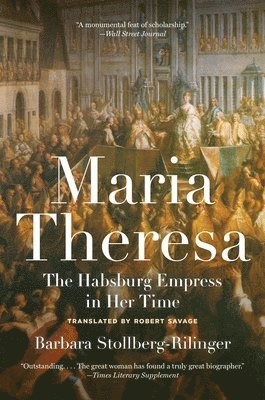
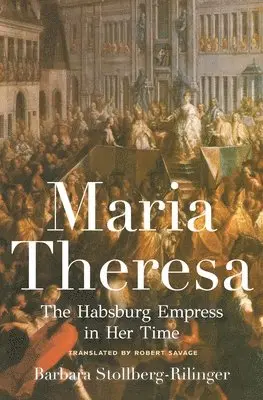
A major new biography of the iconic Austrian empress that challenges the many myths about her life and ruleMaria Theresa (1717–1780) was once the most powerful woman in Europe. At the age of twenty-three, she ascended to the throne of the Habsburg Empire, a far-flung realm composed of diverse ethnicities and languages, beset on all sides by enemies and rivals. Barbara Stollberg-Rilinger provides the definitive biography of Maria Theresa, situating this exceptional empress within her time while dispelling the myths surrounding her.Drawing on a wealth of archival evidence, Stollberg-Rilinger examines all facets of eighteenth-century society, from piety and patronage to sexuality and childcare, ceremonial life at court, diplomacy, and the everyday indignities of warfare. She challenges the idealized image of Maria Theresa as an enlightened reformer and mother of her lands who embodied both feminine beauty and virile bellicosity, showing how she despised the ideas of the Enlightenment, treated her children with relentless austerity, and mercilessly persecuted Protestants and Jews. Work, consistent physical and mental discipline, and fear of God were the principles Maria Theresa lived by, and she demanded the same from her family, her court, and her subjects.A panoramic work of scholarship that brings Europe''s age of empire spectacularly to life, Maria Theresa paints an unforgettable portrait of the uncompromising yet singularly charismatic woman who left her enduring mark on the era in which she lived and reigned.
211 kr
Läs direkt efter köp
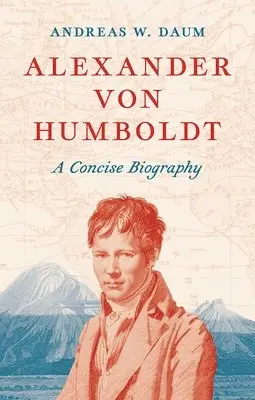
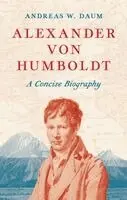
An engaging account of the life and work of the legendary polymath Alexander von HumboldtIn this lucid biography, Andreas Daum offers a succinct and novel interpretation of the life and oeuvre of Alexander von Humboldt (1769―1859). A Prussian nobleman born into the age of European Enlightenment, Humboldt was a contemporary of Napoleon, Simón Bolívar, and Charles Darwin. As a naturalist and scholar, he traveled the world, from the Americas to Central Asia, and recorded his observations in multiple volumes. Humboldt is still admired today for his interdisciplinary outreach and ecological awareness.Moving beyond the conventional views of Humboldt as either intellectual superhero or gentleman colonizer, Daum’s incisive account focuses on Humboldt in the context of the tumultuous period of history in which he lived. Humboldt embodied the contradictions that marked the age of Atlantic Revolutions. He became a critic of slavery and embraced the emerging civil society but remained close to authoritarian rulers. He dedicated his life to scientific research yet was driven by emotional impulses and pleaded for an aesthetic appreciation of nature. Daum introduces a man passionately striving to establish a “cosmic” understanding of nature while grappling with the era’s explosion of knowledge.This book provides the first concise biography of Humboldt, covering all periods of his life, exploring his personality, the vast range of his works, and his intellectual networks. Daum helps us understand Humboldt as a seminal historical figure and illuminates the role of science at the dawn of the global world.
613 kr
Skickas inom 10-15 vardagar
788 kr
Skickas inom 10-15 vardagar
1 082 kr
Skickas inom 10-15 vardagar
310 kr
Läs direkt efter köp
428 kr
Läs direkt efter köp
A groundbreaking account of how the Book of Exodus shaped fundamental aspects of Judaism, Christianity, and IslamThe Book of Exodus may be the most consequential story ever told. But its spectacular moments of heaven-sent plagues and parting seas overshadow its true significance, says Jan Assmann, a leading historian of ancient religion. The story of Moses guiding the enslaved children of Israel out of captivity to become God''s chosen people is the foundation of an entirely new idea of religion, one that lives on today in many of the world''s faiths. The Invention of Religion sheds new light on ancient scriptures to show how Exodus has shaped fundamental understandings of monotheistic practice and belief.Assmann delves into the enduring mythic power of the Exodus narrative, examining the text''s compositional history and calling attention to distinctive motifs and dichotomies: enslavement and redemption; belief and doubt; proper worship and idolatry; loyalty and betrayal. Revelation is a central theme--the revelation of God''s power in miracles, of God''s presence in the burning bush, and of God''s chosen dwelling among the Israelites in the vision of the tabernacle. Above all, it is God''s covenant with Israel—the binding obligation of the Israelites to acknowledge God as their redeemer and obey His law—that is Exodus''s most encompassing and transformative idea, one that challenged basic assumptions about humankind''s relationship to the divine in the ancient world.The Invention of Religion is a powerful account of how ideas of faith, revelation, and covenant, first introduced in Exodus, shaped Judaism and were later adopted by Christianity and Islam to form the bedrock of the world''s Abrahamic religions.
412 kr
Läs direkt efter köp
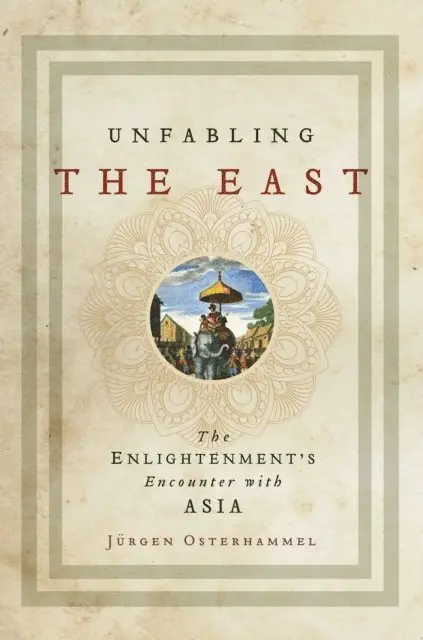
How Enlightenment Europe rediscovered its identity by measuring itself against the great civilizations of AsiaDuring the long eighteenth century, Europe''s travelers, scholars, and intellectuals looked to Asia in a spirit of puzzlement, irony, and openness. In this panoramic and colorful book, Jürgen Osterhammel tells the story of the European Enlightenment''s nuanced encounter with the great civilizations of the East, from the Ottoman Empire and India to China and Japan.Here is the acclaimed book that challenges the notion that Europe''s formative engagement with the non-European world was invariably marred by an imperial gaze and presumptions of Western superiority. Osterhammel shows how major figures such as Leibniz, Voltaire, Gibbon, and Hegel took a keen interest in Asian culture and history, and introduces lesser-known scientific travelers, colonial administrators, Jesuit missionaries, and adventurers who returned home from Asia bearing manuscripts in many exotic languages, huge collections of ethnographic data, and stories that sometimes defied belief. Osterhammel brings the sights and sounds of this tumultuous age vividly to life, from the salons of Paris and the lecture halls of Edinburgh to the deserts of Arabia, the steppes of Siberia, and the sumptuous courts of Asian princes. He demonstrates how Europe discovered its own identity anew by measuring itself against its more senior continent, and how it was only toward the end of this period that cruder forms of Eurocentrism--and condescension toward Asia—prevailed.A momentous work by one of Europe''s most eminent historians, Unfabling the East takes readers on a thrilling voyage to the farthest shores, bringing back vital insights for our own multicultural age.
283 kr
Skickas inom 10-15 vardagar
671 kr
Skickas inom 10-15 vardagar
336 kr
Läs direkt efter köp
345 kr
Skickas inom 7-10 vardagar
An investigation of a cosmic experimentIn 1851, the physicist Léon Foucault performed an unforgettable experiment. By suspending a large pendulum inside the dome of Paris’ Pantheon, Foucault provided the first simple, direct empirical evidence of the Earth's rotation—an undeniable demonstration of heliocentrism. This experiment, conducted long after the Copernican Revolution and using a laboratory apparatus rather than astronomical observation, visually confirmed what had previously been accepted as theory. The pendulum’s motion clearly illustrated the Earth's rotation. But Foucault’s experiment did not end there. It sparked a range of subsequent reenactments and interpretations, each adding new layers to its meaning. Repeated over and again, its afterlives were many as were its ramifications.
Historian Michael Hagner revisits this epoch-making experiment and its reception from the nineteenth century to the present day and follows how cosmological questions conjoined political and aesthetic judgments about the public staging and history of science. The pendulum experiment, Hagner argues, is more than just a mere scientific demonstration. It contains within it the histories of technological innovation, ideological conflicts, and the rise of popular culture and visual media. In a series of insightful studies of literary, artistic, and scientific reenactments, Hagner uses both words and images to narrate the rich and complex legacy of this experiment.Seeing Foucault's Pendulum includes among other fascinating tales, a short but stunning history of the Copernican Revolution, the paradigm-shifting work of the nineteenth-century astronomer Camille Flammarion, and the reenactments of Foucault’s experiment at the Smithsonian Institution and New York’s United Nations building. Linking nature to culture and calling for world unity, the experiment’s legacy extends beyond science. It has been reimagined in Umberto Eco’s novel Foucault’s Pendulum and in Gerhard Richter’s 2018 installation, enchantments of the postmodern world theater where the relationship between knowledge and sensory experience is problematized anew. A complex symbol in the history of ideas—challenging our assumptions, inspiring artistic expression, and prompting philosophical reflection on our place in the cosmos—Foucault’s experiment serves as a powerful reminder that both the Earth and the universe should never be reduced to a disposable mass of human hubris and of irresponsible manipulation.