136 kr
Skickas inom 7-10 vardagar
136 kr
Skickas inom 7-10 vardagar
178 kr
Skickas
157 kr
Skickas
297 kr
Skickas
331 kr
Skickas
Digital Prospects
177 kr
Skickas
The World before 600
434 kr
Skickas inom 7-10 vardagar
290 kr
Läs direkt efter köp
An examination of the narrative strategies employed in the most dangerous book of the twentieth century and a reflection on totalitarian literature.
Hitler''s Mein Kampf was banned in Germany for almost seventy years, kept from being reprinted by the accidental copyright holder, the Bavarian Ministry of Finance. In December 2015, the first German edition of Mein Kampf since 1946 appeared, with Hitler''s text surrounded by scholarly commentary apparently meant to act as a kind of cordon sanitaire. And yet the dominant critical assessment (in Germany and elsewhere) of the most dangerous book of the twentieth century is that it is boring, unoriginal, jargon-laden, badly written, embarrassingly rabid, and altogether ludicrous. (Even in the 1920s, the consensus was that the author of such a book had no future in politics.) How did the unreadable Mein Kampf manage to become so historically significant? In this book, German literary scholar Albrecht Koschorke attempts to explain the power of Hitler''s book by examining its narrative strategies.
Koschorke argues that Mein Kampf cannot be reduced to an ideological message directed to all readers. By examining the text and the signals that it sends, he shows that we can discover for whom Hitler strikes his propagandistic poses and who is excluded. Koschorke parses the borrowings from the right-wing press, the autobiographical details concocted to make political points, the attack on the Social Democrats that bleeds into an anti-Semitic conspiracy theory, the contempt for science, and the conscious attempt to trigger outrage.
A close reading of National Socialism''s definitive text, Koschorke concludes, can shed light on the dynamics of fanaticism. This lesson of Mein Kampf still needs to be learned.
223 kr
Skickas inom 7-10 vardagar
173 kr
Läs direkt efter köp
A prominent German thinker argues that—contrary to “Twitter Revolution” cheerleading—digital communication is destroying political discourse and political action.
The shitstorm represents an authentic phenomenon of digital communication.—from In the Swarm
Digital communication and social media have taken over our lives. In this contrarian reflection on digitized life, Byung-Chul Han counters the cheerleaders for Twitter revolutions and Facebook activism by arguing that digital communication is in fact responsible for the disintegration of community and public space and is slowly eroding any possibility for real political action and meaningful political discourse. In the predigital, analog era, by the time an angry letter to the editor had been composed, mailed, and received, the immediate agitation had passed. Today, digital communication enables instantaneous, impulsive reaction, meant to express and stir up outrage on the spot. “The shitstorm,” writes Han, ”represents an authentic phenomenon of digital communication.”
Meanwhile, the public, the senders and receivers of these communications have become a digital swarm—not a mass, or a crowd, or Negri and Hardt''s antiquated notion of a “multitude,” but a set of isolated individuals incapable of forming a “we,” incapable of calling dominant power relations into question, incapable of formulating a future because of an obsession with the present. The digital swarm is a fragmented entity that can focus on individual persons only in order to make them an object of scandal.
Han, one of the most widely read philosophers in Europe today, describes a society in which information has overrun thought, in which the same algorithms are employed by Facebook, the stock market, and the intelligence services. Democracy is under threat because digital communication has made freedom and control indistinguishable. Big Brother has been succeeded by Big Data.

197 kr
Skickas inom 7-10 vardagar
268 kr
Skickas inom 3-6 vardagar
400 kr
Skickas inom 7-10 vardagar
293 kr
Skickas
244 kr
Läs direkt efter köp
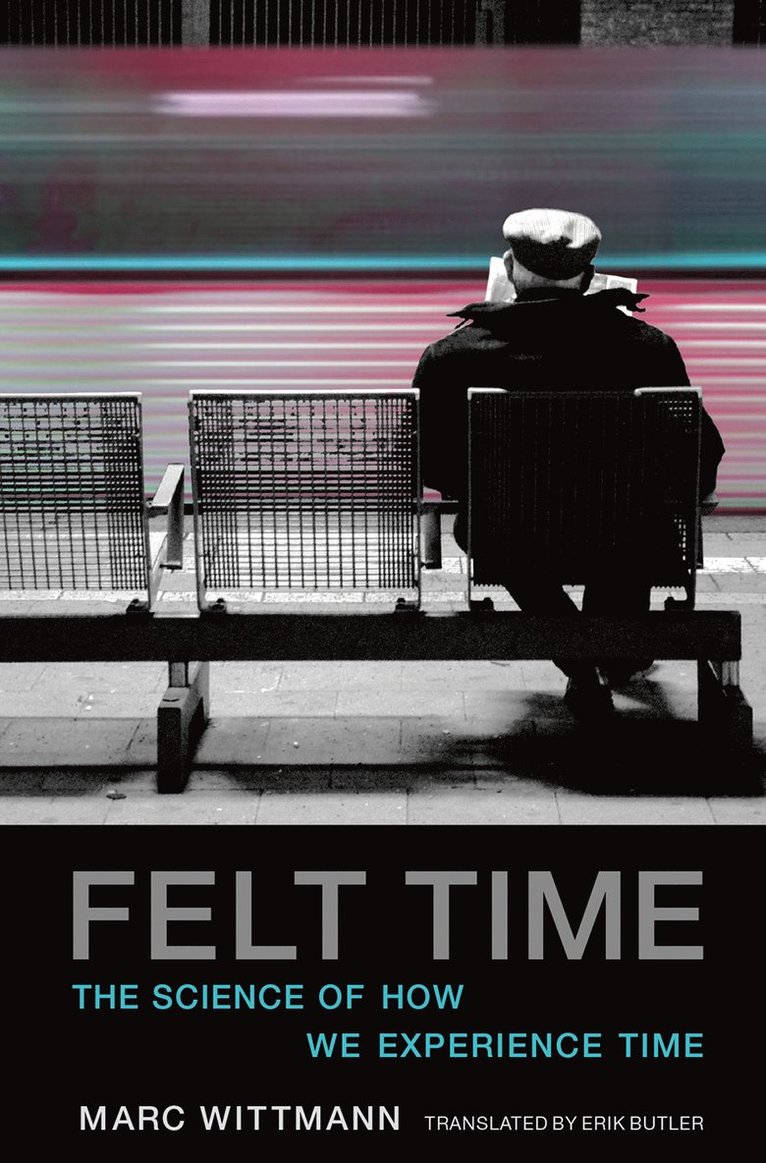
An expert explores the riddle of subjective time, from why time speeds up as we grow older to the connection between time and consciousness.
We have widely varying perceptions of time. Children have trouble waiting for anything. (“Are we there yet?”) Boredom is often connected to our sense of time passing (or not passing). As people grow older, time seems to speed up, the years flitting by without a pause. How does our sense of time come about? In Felt Time, Marc Wittmann explores the riddle of subjective time, explaining our perception of time—whether moment by moment, or in terms of life as a whole. Drawing on the latest insights from psychology and neuroscience, Wittmann offers a new answer to the question of how we experience time.
Wittmann explains, among other things, how we choose between savoring the moment and deferring gratification; why impulsive people are bored easily, and why their boredom is often a matter of time; whether each person possesses a personal speed, a particular brain rhythm distinguishing quick people from slow people; and why the feeling of duration can serve as an “error signal,” letting us know when it is taking too long for dinner to be ready or for the bus to come. He considers the practice of mindfulness, and whether it can reduce the speed of life and help us gain more time, and he describes how, as we grow older, subjective time accelerates as routine increases; a fulfilled and varied life is a long life. Evidence shows that bodily processes—especially the heartbeat—underlie our feeling of time and act as an internal clock for our sense of time. And Wittmann points to recent research that connects time to consciousness; ongoing studies of time consciousness, he tells us, will help us to understand the conscious self.
150 kr
Läs direkt efter köp
Why 1 = presence and 0 = absence and the digital world formula is x = xn: an exploration of meaning in a universe of infinite replication.
In the beginning was the Zero, and the Zero was with God, and God was the One.—All and Nothing
In 1854, the British mathematician George Boole presented the idea of a universe the elements of which could be understood in terms of the logic of absence and presence: 0 and 1, all and nothing—the foundation of binary code. The Boolean digits 0 and 1 do not designate a quantity. In the Boolean world, x times x always equals x; all and nothing meet in the formula x = xn. As everything becomes digitized, God the clockmaker is replaced by God the programmer. This book–described by its authors as “a theology for the digital world”—explores meaning in a digital age of infinite replication, in a world that has dissolved into information and achieved immortality by turning into a pure sign.
All and Nothing compares information that spreads without restraint to a hydra—the mythological monster that grew two heads for every one that was cut off. Information is thousand-headed and thousand-eyed because Hydra''s tracks cannot be deleted. It shows that when we sit in front of a screen, we are actually on the other side, looking at the world as an uncanny reminder of the nondigitized. It compares our personal data to our shadows and our souls, envisioning the subconscious laid out on a digital bier like a corpse.
The digital world, the authors explain, summons forth fantasies of a chiliastic or apocalyptic nature. The goal of removing the representative from mathematics has now been achieved on a greater scale than Boole could have imagined.
301 kr
Läs direkt efter köp
Explaining the science contained in a simple assembly of grains—the most abundant form of matter present on Earth.
Granular media—composed of vast amounts of grains, consolidated or not—constitute the most abundant form of solid matter on Earth. Granular materials assemble in disordered configurations scientists often liken to a bag of marbles. Made of macroscopic particles rather than molecules, they defy the standard scheme of classification in terms of solid, liquid, and gas. Granular materials provide a model relevant to various domains of research, including engineering, physics, and biology. William Blake famously wished “To See a World in a Grain of Sand”; in this book, pioneering researchers in granular matter explain the science hidden behind simple grains, shedding light on collective behavior in disordered settings in general.
The authors begin by describing the single grain with its different origins, shapes, and sizes, then examine grains in piled or stacked form. They explain the packing fraction of granular media, a crucial issue that bears on the properties displayed in practical applications; explore small-scale deformations in piles of disordered grains, with particular attention to friction; and present theories of various modes of disorder. Along the way, they discuss such concepts as force chains, arching effects, wet grains, sticky contacts, and inertial effects. Drawing on recent numerical simulations as well as classical concepts developed in physics and mechanics, the book offers an accessible introduction to a rapidly developing field.
286 kr
Läs direkt efter köp
386 kr
Läs direkt efter köp
433 kr
Läs direkt efter köp
369 kr
Skickas inom 7-10 vardagar
430 kr
Skickas inom 7-10 vardagar
375 kr
Skickas
253 kr
Skickas inom 3-6 vardagar
1 233 kr
Skickas inom 7-10 vardagar
295 kr
Skickas inom 7-10 vardagar
356 kr
Läs direkt efter köp
1 464 kr
Skickas inom 7-10 vardagar
343 kr
Skickas inom 10-15 vardagar
361 kr
Läs direkt efter köp