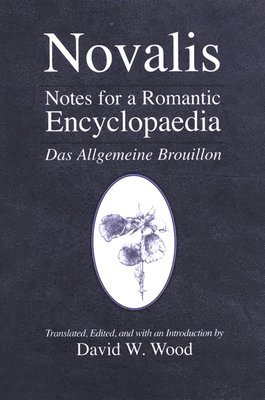
The first English translation of Novalis's unfinished notes for a universal science, Das Allgemeine Brouillon.Novalis is best known in history as the poet of early German Romanticism. However, this translation of Das Allgemeine Brouillon, or "Universal Notebook," finally introduces him to the English-speaking world as an extraordinarily gifted philosopher in his own right and shatters the myth of him as a mere daydreaming and irrational poet. Composed of more than 1,100 notebook entries, this is easily Novalis's largest theoretical work and certainly one of the most remarkable and audacious undertakings of the "Golden Age" of German philosophy. In it, Novalis reflects on numerous aspects of human culture, including philosophy, poetry, the natural sciences, the fine arts, mathematics, mineralogy, history, and religion, and brings them all together into what he calls a "Romantic Encyclopaedia" or "Scientific Bible."Novalis's Romantic Encyclopaedia fully embodies the author's own personal brand of philosophy, "Magical Idealism." With meditations on mankind and nature, the possible future development of our faculties of reason, imagination, and the senses, and the unification of the different sciences, these notes contain a veritable treasure trove of richly poetic and philosophic thoughts.
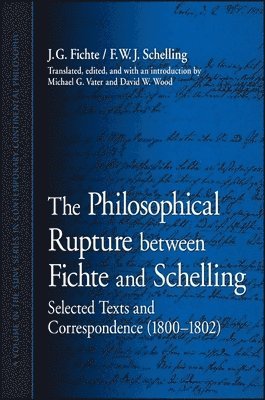
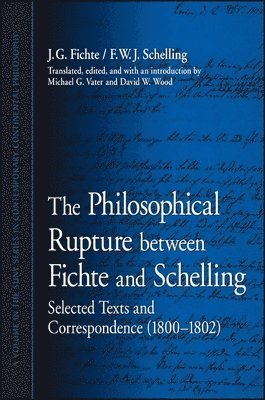
Correspondence and texts by Fichte and Schelling illuminate their thought and the trajectory of their philosophical falling out.The disputes of philosophers provide a place to view their positions and arguments in a tightly focused way, and also in a manner that is infused with human temperaments and passions. Fichte and Schelling had been perceived as "partners" in the cause of Criticism or transcendental idealism since 1794, but upon Fichte's departure from Jena in 1799, each began to perceive a drift in their fundamental interests and allegiances. Schelling's philosophy of nature seemed to move him toward a realistic philosophy, while Fichte's interests in the origin of personal consciousness, intersubjectivity, and the ultimate determination of the agent's moral will moved him to explore what he called "faith" in one popular text, or a theory of an intelligible world. This volume brings together the letters the two philosophers exchanged between 1800 and 1802 and the texts that each penned with the other in mind.
Correspondence and texts by Fichte and Schelling illuminate their thought and the trajectory of their philosophical falling out.The disputes of philosophers provide a place to view their positions and arguments in a tightly focused way, and also in a manner that is infused with human temperaments and passions. Fichte and Schelling had been perceived as "partners" in the cause of Criticism or transcendental idealism since 1794, but upon Fichte's departure from Jena in 1799, each began to perceive a drift in their fundamental interests and allegiances. Schelling's philosophy of nature seemed to move him toward a realistic philosophy, while Fichte's interests in the origin of personal consciousness, intersubjectivity, and the ultimate determination of the agent's moral will moved him to explore what he called "faith" in one popular text, or a theory of an intelligible world. This volume brings together the letters the two philosophers exchanged between 1800 and 1802 and the texts that each penned with the other in mind.