177 kr
Skickas inom 7-10 vardagar
177 kr
Skickas inom 7-10 vardagar
329 kr
Skickas inom 7-10 vardagar
443 kr
Skickas inom 7-10 vardagar
243 kr
Skickas inom 7-10 vardagar
234 kr
Läs direkt efter köp
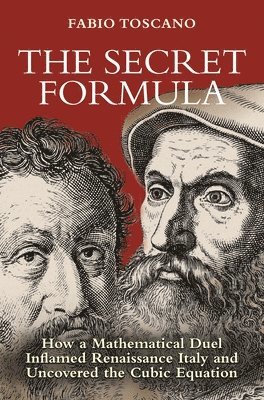
The legendary Renaissance math duel that ushered in the modern age of algebraThe Secret Formula tells the story of two Renaissance mathematicians whose jealousies, intrigues, and contentious debates led to the discovery of a formula for the solution of the cubic equation. Niccolò Tartaglia was a talented and ambitious teacher who possessed a secret formula—the key to unlocking a seemingly unsolvable, two-thousand-year-old mathematical problem. He wrote it down in the form of a poem to prevent other mathematicians from stealing it. Gerolamo Cardano was a physician, gifted scholar, and notorious gambler who would not hesitate to use flattery and even trickery to learn Tartaglia''s secret.Set against the backdrop of sixteenth-century Italy, The Secret Formula provides new and compelling insights into the peculiarities of Renaissance mathematics while bringing a turbulent and culturally vibrant age to life. It was an era when mathematicians challenged each other in intellectual duels held outdoors before enthusiastic crowds. Success not only enhanced the winner''s reputation, but could result in prize money and professional acclaim. After hearing of Tartaglia''s spectacular victory in one such contest in Venice, Cardano invited him to Milan, determined to obtain his secret by whatever means necessary. Cardano''s intrigues paid off. In 1545, he was the first to publish a general solution of the cubic equation. Tartaglia, eager to take his revenge by establishing his superiority as the most brilliant mathematician of the age, challenged Cardano to the ultimate mathematical duel.A lively account of genius, betrayal, and all-too-human failings, The Secret Formula reveals the epic rivalry behind one of the fundamental ideas of modern algebra.
599 kr
Läs direkt efter köp
In this magisterial work, Roland Omnès takes us from the academies of ancient Greece to the laboratories of modern science as he seeks to do no less than rebuild the foundations of the philosophy of knowledge. One of the world''s leading quantum physicists, Omnès reviews the history and recent development of mathematics, logic, and the physical sciences to show that current work in quantum theory offers new answers to questions that have puzzled philosophers for centuries: Is the world ultimately intelligible? Are all events caused? Do objects have definitive locations? Omnès addresses these profound questions with vigorous arguments and clear, colorful writing, aiming not just to advance scholarship but to enlighten readers with no background in science or philosophy. The book opens with an insightful and sweeping account of the main developments in science and the philosophy of knowledge from the pre-Socratic era to the nineteenth century. Omnès then traces the emergence in modern thought of a fracture between our intuitive, commonsense views of the world and the abstract and--for most people--incomprehensible world portrayed by advanced physics, math, and logic. He argues that the fracture appeared because the insights of Einstein and Bohr, the logical advances of Frege, Russell, and Gödel, and the necessary mathematics of infinity of Cantor and Hilbert cannot be fully expressed by words or images only. Quantum mechanics played an important role in this development, as it seemed to undermine intuitive notions of intelligibility, locality, and causality. However, Omnès argues that common sense and quantum mechanics are not as incompatible as many have thought. In fact, he makes the provocative argument that the "consistent-histories" approach to quantum mechanics, developed over the past fifteen years, places common sense (slightly reappraised and circumscribed) on a firm scientific and philosophical footing for the first time. In doing so, it provides what philosophers have sought through the ages: a sure foundation for human knowledge. Quantum Philosophy is a profound work of contemporary science and philosophy and an eloquent history of the long struggle to understand the nature of the world and of knowledge itself.