154 kr
Skickas
154 kr
Skickas
274 kr
Skickas inom 3-6 vardagar
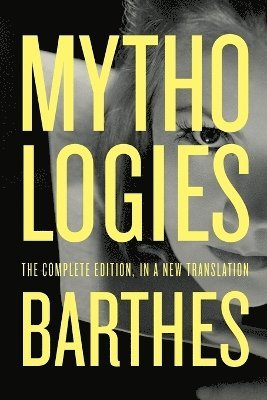
"No denunciation without its proper instrument of close analysis," Roland Barthes wrote in his preface to Mythologies. There is no more proper instrument of analysis of our contemporary myths than this book-one of the most significant works in French theory, and one that has transformed the way readers and philosophers view the world around them.Our age is a triumph of codification. We own devices that bring the world to the command of our fingertips. We have access to boundless information and prodigious quantities of stuff. We decide to like or not, to believe or not, to buy or not. We pick and choose. We think we are free. Yet all around us, in pop culture, politics, mainstream media, and advertising, there are codes and symbols that govern our choices. They are the fabrications of consumer society. They express myths of success, well-being, or happiness. As Barthes sees it, these myths must be carefully deciphered, and debunked.What Barthes discerned in mass media, the fashion of plastic, and the politics of postcolonial France applies with equal force to today's social networks, the iPhone, and the images of 9/11. This new edition of Mythologies, complete and beautifully rendered by the Pulitzer Prize-winning poet, critic, and translator Richard Howard, is a consecration of Barthes's classic-a lesson in clairvoyance that is more relevant now than ever.

256 kr
Skickas inom 3-6 vardagar
Is there any such thing as revolutionary literature? Can literature, in fact, be political at all? These are the questions Roland Barthes addresses in Writing Degree Zero, his first published book and a landmark in his oeuvre. The debate had engaged the European literary community since the 1930s; with this fierce manifesto, Barthes challenged the notion of literature's obligation to be socially committed. Yes, Barthes allows, the writer has a political and ethical responsibility. But the history of French literature shows that the writer has often failed to meet it-and from Barthes's perspective, literature is committed to little more than the myth of itself. Expert and uncompromising, Writing Degree Zero introduced the themes that would soon establish Barthes as one of the leading voices in literary criticism.
154 kr
Skickas
179 kr
Tillfälligt slut
"In his Course in General Linguistics, first published in 1916, Saussure postulated the existence of a general science of signs, or Semiology, of which linguistics would form only one part. Semiology, therefore aims to take in any system of signs, whatever their substance and limits; images, gestures, musical sounds, objects, and the complex associations of all these, which form the content of ritual, convention or public entertainment: these constitute, if not languages, at least systems of signification . . . The Elements here presented have as their sole aim the extraction from linguistics of analytical concepts which we think a priori to be sufficiently general to start semiological research on its way. In assembling them, it is not presupposed that they will remain intact during the course of research; nor that semiology will always be forced to follow the linguistic model closely. We are merely suggesting and elucidating a terminology in the hope that it may enable an initial (albeit provisional) order to be introduced into the heterogeneous mass of significant facts. In fact what we purport to do is furnish a principle of classification of the questions. These elements of semiology will therefore be grouped under four main headings borrowed from structural linguistics: I. Language and Speech; II. Signified and Signifier; III. Syntagm and System; IV. Denotation and Connotation."--Roland Barthes, from his Introduction