2 628 kr
Skickas inom 10-15 vardagar
2 628 kr
Skickas inom 10-15 vardagar
714 kr
Skickas inom 10-15 vardagar
830 kr
Skickas inom 10-15 vardagar
2 628 kr
Skickas inom 10-15 vardagar
2 872 kr
Skickas inom 10-15 vardagar
2 232 kr
Skickas inom 10-15 vardagar
784 kr
Skickas inom 10-15 vardagar
2 232 kr
Skickas inom 10-15 vardagar
2 628 kr
Skickas inom 10-15 vardagar
830 kr
Skickas inom 10-15 vardagar
2 552 kr
Skickas inom 10-15 vardagar
2 865 kr
Skickas inom 10-15 vardagar
1 912 kr
Skickas inom 10-15 vardagar
403 kr
Skickas inom 10-15 vardagar
1 140 kr
Skickas inom 10-15 vardagar
1 707 kr
Skickas inom 10-15 vardagar
Biology, Chemistry, Bioinformatics, and Drug Design
2 273 kr
Skickas inom 10-15 vardagar
1 707 kr
Skickas inom 10-15 vardagar
3 913 kr
Skickas inom 7-10 vardagar
1 043 kr
Skickas inom 10-15 vardagar
655 kr
Läs direkt efter köp
The U.S. healthcare system is in "complete chaos-disarray." Medical costs have increased significantly over the past 6 years with 70% increase for deductibles and 24% or more for health insurance premiums. All the while, workers earnings have either not increased or if they did, the pay raises were for less than the increase in the cost of medical care. The situation is unsustainable and the public wants the system fixed. This book offers ways of fixing the problems in healthcare.
HEALTHCARE''s OUT SICK - PREDICTING A CURE - Solutions that WORK !!!! first defines the "healthcare in crisis" problem. Through real patient experiences, the book describes the difficulties of getting through the maze of complexity among the plethora of "silo providers" which make up the industry. The heart of the book provides readers with a comprehensive solution that can work, a disruption that is necessary to provide Americans the medical care they need without the US public and healthcare providers and payors going into bankruptcy, insolvency or closure.
This book delves into digitized medicine, payor and provider reimbursement models, and value-based healthcare delivery. It also includes a philosophy or mode of thinking and operation for the solutions that are needed for diagnosis-effective, cost-effective, and time-efficient healthcare delivery, of which digitized medicine, value-based care, and payor reimbursement modes are just some of the factors. The authors propose that the real solution involves having the patient at the center of the issues and changing from an archaic gold standard way of thinking to a "Predictive Analytic thinking" where one gets at the real truth by doing "real science" that in the end becomes effective not only for the population but for the individual person. This all leads to real person-centered and person-directed medicine and healthcare delivery.
641 kr
Läs direkt efter köp
The U.S. healthcare system is in "complete chaos-disarray." Medical costs have increased significantly over the past 6 years with 70% increase for deductibles and 24% or more for health insurance premiums. All the while, workers earnings have either not increased or if they did, the pay raises were for less than the increase in the cost of medical care. The situation is unsustainable and the public wants the system fixed. This book offers ways of fixing the problems in healthcare.
HEALTHCARE''s OUT SICK - PREDICTING A CURE - Solutions that WORK !!!! first defines the "healthcare in crisis" problem. Through real patient experiences, the book describes the difficulties of getting through the maze of complexity among the plethora of "silo providers" which make up the industry. The heart of the book provides readers with a comprehensive solution that can work, a disruption that is necessary to provide Americans the medical care they need without the US public and healthcare providers and payors going into bankruptcy, insolvency or closure.
This book delves into digitized medicine, payor and provider reimbursement models, and value-based healthcare delivery. It also includes a philosophy or mode of thinking and operation for the solutions that are needed for diagnosis-effective, cost-effective, and time-efficient healthcare delivery, of which digitized medicine, value-based care, and payor reimbursement modes are just some of the factors. The authors propose that the real solution involves having the patient at the center of the issues and changing from an archaic gold standard way of thinking to a "Predictive Analytic thinking" where one gets at the real truth by doing "real science" that in the end becomes effective not only for the population but for the individual person. This all leads to real person-centered and person-directed medicine and healthcare delivery.
956 kr
Läs direkt efter köp
This new book educates readers about new technologies before they appear in hospitals, enabling medical physicists and clinicians to prepare for new technologies thoroughly and proactively, and provide better patient care once new equipment becomes available. Emerging technologies in imaging, treatment planning, treatment delivery, dosimetry and informatics are all discussed. The book is divided into three parts: recently developed technologies available for practice; technologies under development nearing completion; and technologies in an early stage of development that could have potential radiotherapy applications.
Features:
Introduces emerging technologies in imaging, treatment planning, treatment delivery, dosimetry and informatics The advantages and limitations of each technology in clinical settings are discussed, and recommendations on how to adopt the technologies are provided Critiques and improvement points are provided for researchers, in addition to suggestions on how to prepare quality assurance are provided as needed942 kr
Läs direkt efter köp
This new book educates readers about new technologies before they appear in hospitals, enabling medical physicists and clinicians to prepare for new technologies thoroughly and proactively, and provide better patient care once new equipment becomes available. Emerging technologies in imaging, treatment planning, treatment delivery, dosimetry and informatics are all discussed. The book is divided into three parts: recently developed technologies available for practice; technologies under development nearing completion; and technologies in an early stage of development that could have potential radiotherapy applications.
Features:
Introduces emerging technologies in imaging, treatment planning, treatment delivery, dosimetry and informatics The advantages and limitations of each technology in clinical settings are discussed, and recommendations on how to adopt the technologies are provided Critiques and improvement points are provided for researchers, in addition to suggestions on how to prepare quality assurance are provided as needed927 kr
Läs direkt efter köp
Electronic Health Record (EHR) systems today provide increasing levels of clinical decision support and are the fulcrum for change for value-based healthcare delivery. Billions of dollars of government and insurer payments are dependent on evidence-based workflow design and quality report. In this context, quality measurement is no longer a retrospective exercise, but an essential prospective process embedded in clinical operations. Population health tools in the EHR enhance the efficiency and effectiveness of interventions thus improving the quality of care at lower cost. Population health methods are effective in ensuring that the right patient receives the right care at the right time.
This book provides a clear framework for design, implementation, and monitoring of innovative population health tools to accelerate measurable improvements in care delivery. Key benefits for readers include conceptual framework, team approach, and technical insights that result in improved patient care, improved performance on quality measures and increased revenue from quality performance incentives and risk-based contracts. This is also a practice guide to the healthcare professionals many roles who are eager to build or improve population health programs with the goal of delivering high quality value-based care.
927 kr
Läs direkt efter köp
Electronic Health Record (EHR) systems today provide increasing levels of clinical decision support and are the fulcrum for change for value-based healthcare delivery. Billions of dollars of government and insurer payments are dependent on evidence-based workflow design and quality report. In this context, quality measurement is no longer a retrospective exercise, but an essential prospective process embedded in clinical operations. Population health tools in the EHR enhance the efficiency and effectiveness of interventions thus improving the quality of care at lower cost. Population health methods are effective in ensuring that the right patient receives the right care at the right time.
This book provides a clear framework for design, implementation, and monitoring of innovative population health tools to accelerate measurable improvements in care delivery. Key benefits for readers include conceptual framework, team approach, and technical insights that result in improved patient care, improved performance on quality measures and increased revenue from quality performance incentives and risk-based contracts. This is also a practice guide to the healthcare professionals many roles who are eager to build or improve population health programs with the goal of delivering high quality value-based care.
1 052 kr
Läs direkt efter köp
Modern medicine is undergoing a paradigm shift from a "one-size-fits-all" strategy to a more precise patient-customized therapy and medication plan. While the success of precision medicine relies on the level of pharmacogenomic knowledge, dissecting the genetic mechanisms of drug response in a sufficient detail requires powerful computational tools. Quantitative Methods for Precision Medicine: Pharmacogenomics in Action presents the advanced statistical methods for mapping pharmacogenetic control by integrating pharmacokinetic and pharmacodynamic principles of drug-body interactions. Beyond traditional reductionist-based statistical genetic approaches, statistical formulization in this book synthesizes elements of multiple disciplines to infer, visualize, and track how pharmacogenes interact together as an intricate but well-coordinated system to mediate patient-specific drug response.
Features:
Functional and systems mapping models to characterize the genetic architecture of multiple medication processes Statistical methods for analyzing informative missing data in pharmacogenetic association studies Functional graph theory of inferring genetic interaction networks from association data Leveraging the concept of epistasis to capture its bidirectional, signed and weighted properties Modeling gene-induced cell-cell crosstalk and its impact on drug response A graph model of drug-drug interactions in combination therapies Critical methodological issues to improve pharmacogenomic research as the cornerstone of precision medicineThis book is suitable for graduate students and researchers in the fields of biology, medicine, bioinformatics and drug design and delivery who are interested in statistical and computational modelling of biological processes and systems. It may also serve as a major reference for applied mathematicians, computer scientists, and statisticians who attempt to develop algorithmic tools for genetic mapping, systems pharmacogenomics and systems biology. It can be used as both a textbook and research reference. Professionals in pharmaceutical sectors who design drugs and clinical doctors who deliver drugs will also find it useful.
3 134 kr
Läs direkt efter köp
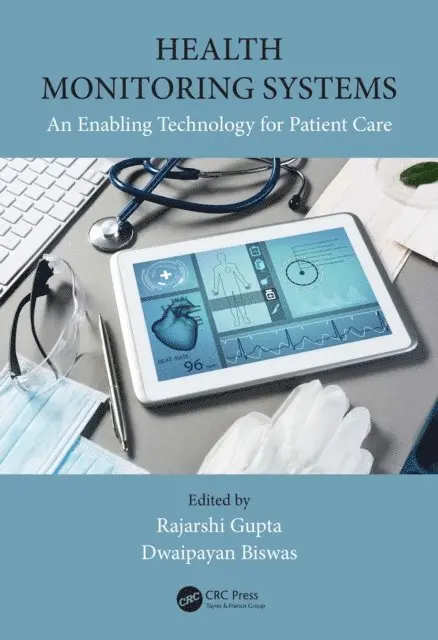
Remote health monitoring using wearable sensors is an important research area involving several key steps: physiological parameter sensing and data acquisition, data analysis, data security, data transmission to caregivers, and clinical intervention, all of which play a significant role to form a closed loop system. Subject-specific behavioral and clinical traits, coupled with individual physiological differences, necessitate a personalized healthcare delivery model for around-the-clock monitoring within the home environment. Cardiovascular disease monitoring is an illustrative application domain where research has been instrumental in enabling a personalized closed-loop monitoring system, which has been showcased in this book.
Health Monitoring Systems: An Enabling Technology for Patient Care provides a holistic overview of state-of-the-art monitoring systems facilitated by Internet of Things (IoT) technology. The book lists out the details on biomedical signal acquisition, processing, and data security, the fundamental building blocks towards an ambulatory health monitoring infrastructure. The fundamentals have been complimented with other relevant topics including applications which provide an in-depth view on remote health monitoring systems.
Key Features:
Presents examples of state-of-the-art health monitoring systems using IoT infrastructure
Covers the full spectrum of physiological sensing, data acquisition, processing, and data security
Provides relevant example applications demonstrating the benefits of technological advancements aiding disease prognosis
This book serves as a beginner’s guide for engineering students of electrical and computer science, practicing engineers, researchers, and scientists who are interested in having an overview of pervasive health monitoring systems using body-worn sensors operating outside the hospital environment. It could also be recommended as a reference for a graduate or master’s level course on biomedical instrumentation and signal processing.
823 kr
Läs direkt efter köp
731 kr
Läs direkt efter köp
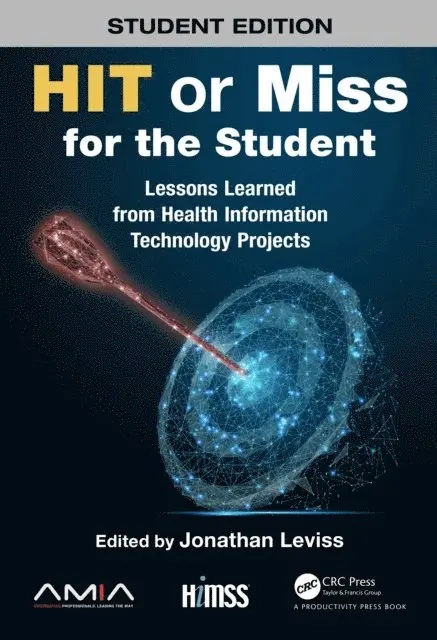
HIT or Miss for Student: Lessons Learned from Health Information Technology Projects presents and dissects a wide variety of HIT failures so that the students can understand in each case what went wrong and why and how to avoid such problems, without focusing on the involvement of specific people, organizations, or vendors. The lessons may be applied to future and existing projects, or used to understand why a previous project failed. The student also learns how common causes of failure affect different kinds of HIT projects and with different results.
Cases are organized by the type of focus (hospital care, ambulatory care, and community). Each case provides analysis by an author who was involved in the project plus the insight of an HIT expert. This book presents a model to discuss HIT failures in a safe and protected manner, providing an opportunity to focus on the lessons offered by a failed initiative as opposed to worrying about potential retribution for exposing a project as having failed. Access expert insight into key obstacles that must be overcome to leverage IT and transform healthcare.
Each de-identified case study includes an analysis by a group of industry experts along with a counter analysis. Cases include a list of key words and are categorized by project (e.g. CPOE, business intelligence). Each chapter or case contains test questions and study suggestions for the student. Answers are provided as an appendix to the book. Whether you’re a graduate student in a health administration or health IT program or attending training sessions sponsored by their healthcare organization, this valuable resource for all who want to understand the dynamics of HIT projects and why some fail and others succeed.