331 kr
Läs direkt efter köp
331 kr
Läs direkt efter köp
602 kr
Läs direkt efter köp
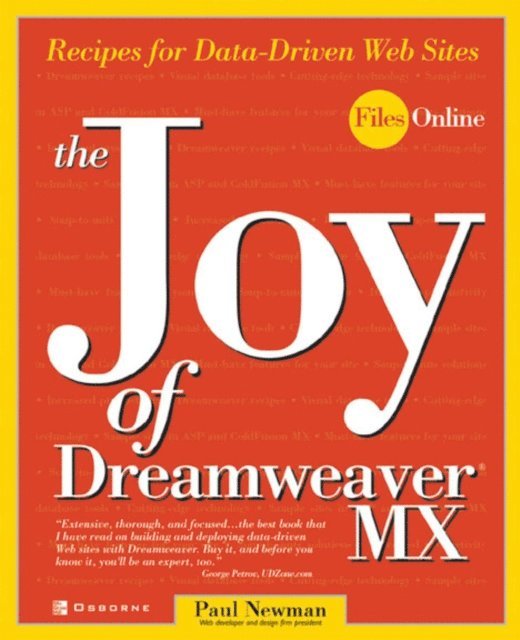
Get cookin’ with Dreamweaver MX using this unique and compelling cookbook filled with ready-to-use Web solutions. Featuring a full menu of extensions, commands, and applications -- including ASP and ColdFusion -- this book will help you deploy dynamic and sophisticated Web applications instantly and expertly.
602 kr
Läs direkt efter köp
614 kr
Läs direkt efter köp
220 kr
Skickas inom 7-10 vardagar
455 kr
Läs direkt efter köp
294 kr
Skickas inom 7-10 vardagar
209 kr
Läs direkt efter köp
Here is a full-color, fast reference to the most popular electronic document exchange program--Adobe Acrobat. Release 7 is a major upgrade with new features that include enhanced PDF creation, watermarks, improved collaboration functions, digital signature capability, and more. All these and more features are covered in the book. Color screenshots with callouts show and explain exactly what you''ll see on your computer screen while you''re doing a task. The lengthwise layout of the book provides a more open, visual display and allows the book to lie flat for easy reference. Learn to:
Create, view, and edit PDFsUse distillerCreate interactive formsAdd links and multimediaEstablish document security560 kr
Läs direkt efter köp
405 kr
Läs direkt efter köp
Get the most out of Photoshop Elements with help from this easy-to-use, full-color guide. Learn to fix images, remove red-eye and other flaws, restore photographs, use layers, create photo collages, work with filters, add type, and more. Plus, get tips for printing your images and posting them to the Internet.
653 kr
Skickas inom 11-20 vardagar
As the visual effects industry has diversified, so too have the books written to serve the needs of this industry. Today there are hundreds of highly specialized titles focusing on particular aspects of film and broadcast animation, computer graphics, stage photography, miniature photography, color theory, and many others.
Visual Effects in a Digital World offers a much-needed reconsolidation of this knowledge. All of the industry's workers frequently need to understand concepts from other specialties, and this book-the only one of its kind-lets them look up and grasp the basics of any visual effects concept in a matter of seconds. It's a great way for everyone, regardless of experience, to find their way through the jargon and learn what they need to know.
Authoritative coverage from a winner visual effects expert-winner of a British Academy Award and two Emmys Covers topics such as computer graphics, digital compositing, live action, stage, and miniature photography, and a wide range of computer and Internet concepts Offers job descriptions for positions found throughout the industry Demystifies the jargon used by practitioners in every subspecialtyPearson Education
178 kr
Skickas
386 kr
Läs direkt efter köp
386 kr
Läs direkt efter köp
3 134 kr
Läs direkt efter köp
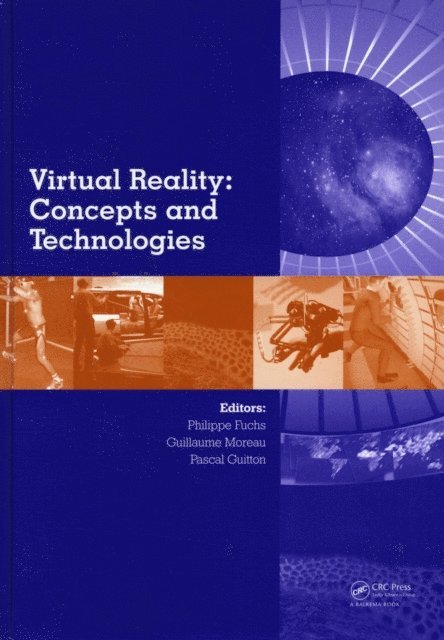
A manual for both designers and users, comprehensively presenting the current state of experts'' knowledge on virtual reality (VR) in computer science, mechanics, optics, acoustics, physiology, psychology, ergonomics, ethics, and related area. Designed as a reference book and design guide to help the reader develop a VR project, it presents the reader with the importance of the user’s needs and various aspects of the human computer interface (HCI). It further treats technical aspects of VR, hardware and software implementations, and details on the sensory and psycho-sensory interfaces. Providing various concepts and technologies, including mathematics and modelling techniques, it allows the reader to formalize, conceptualize and construct a virtual reality project from original thought to application. This book is intended for engineers, computer scientists and computer game developers working on various VR applications. It can further serve as an educational tool in Virtual Reality courses for senior graduate and postgraduate students.
291 kr
Skickas inom 7-10 vardagar
631 kr
Skickas inom 10-15 vardagar
569 kr
Skickas
677 kr
Skickas inom 10-15 vardagar
555 kr
Skickas inom 10-15 vardagar
124 kr
Skickas
85 kr
Läs direkt efter köp
1 012 kr
Skickas
506 kr
Läs direkt efter köp
How the simulation and visualization technologies so pervasive in science, engineering, and design have changed our way of seeing the world.
Over the past twenty years, the technologies of simulation and visualization have changed our ways of looking at the world. In Simulation and Its Discontents, Sherry Turkle examines the now dominant medium of our working lives and finds that simulation has become its own sensibility. We hear it in Turkle''s description of architecture students who no longer design with a pencil, of science and engineering students who admit that computer models seem more “real” than experiments in physical laboratories.
Echoing architect Louis Kahn''s famous question, “What does a brick want?”, Turkle asks, “What does simulation want?” Simulations want, even demand, immersion, and the benefits are clear. Architects create buildings unimaginable before virtual design; scientists determine the structure of molecules by manipulating them in virtual space; physicians practice anatomy on digitized humans. But immersed in simulation, we are vulnerable. There are losses as well as gains. Older scientists describe a younger generation as “drunk with code.” Young scientists, engineers, and designers, full citizens of the virtual, scramble to capture their mentors'' tacit knowledge of buildings and bodies. From both sides of a generational divide, there is anxiety that in simulation, something important is slipping away. Turkle''s examination of simulation over the past twenty years is followed by four in-depth investigations of contemporary simulation culture: space exploration, oceanography, architecture, and biology.
550 kr
Läs direkt efter köp
An exploration of what experimental literature in both print and programmable media tells us about the act of reading.
In Scripting Reading Motions, Manuel Portela explores the expressive use of book forms and programmable media in experimental works of both print and electronic literature and finds a self-conscious play with the dynamics of reading and writing. Portela examines a series of print and digital works by Johanna Drucker, Mark Z. Danielewski, Rui Torres, Jim Andrews, and others, for the insights they yield about the semiotic and interpretive actions through which readers produce meaning when interacting with codes. Analyzing these works as embodiments and simulations of the motions of reading, Portela pays particular attention to the ways in which awareness of eye movements and haptic interactions in both print and electronic media feeds back onto the material and semantic layers of the works. These feedbacks, he argues, sustain self-reflexive loops that link the body of the reader to the embodied work. Readers'' haptic actions and eye movements coinstantiate the object that they are reading.
Portela discusses typographic and graphic marks as choreographic notations for reading movements; examines digital recreations of experimental print literary artifacts; considers reading motions in kinetic and generated texts; analyzes the relationship of bibliographic, linguistic, and narrative coding in Danielewski''s novel-poem, Only Revolutions; and describes emergent meanings in interactive textual instruments. The expressive use of print and programmable media, Portela shows, offers a powerful model of the semiotic, interpretive, and affective operations embodied in reading processes.
Important Notice: The digital edition of this book is missing some of the images found in the physical edition.
310 kr
Läs direkt efter köp
A theoretical and practical guide to integrating human values into the conception and design of digital games.
All games express and embody human values, providing a compelling arena in which we play out beliefs and ideas. “Big ideas” such as justice, equity, honesty, and cooperation—as well as other kinds of ideas, including violence, exploitation, and greed—may emerge in games whether designers intend them or not. In this book, Mary Flanagan and Helen Nissenbaum present Values at Play, a theoretical and practical framework for identifying socially recognized moral and political values in digital games. Values at Play can also serve as a guide to designers who seek to implement values in the conception and design of their games.
After developing a theoretical foundation for their proposal, Flanagan and Nissenbaum provide detailed examinations of selected games, demonstrating the many ways in which values are embedded in them. They introduce the Values at Play heuristic, a systematic approach for incorporating values into the game design process. Interspersed among the book''s chapters are texts by designers who have put Values at Play into practice by accepting values as a design constraint like any other, offering a real-world perspective on the design challenges involved.
506 kr
Läs direkt efter köp
How the S-C 4020—a mainframe peripheral intended to produce scientific visualizations—shaped a series of early computer art projects that emerged from Bell Labs.
In 1959, the electronics manufacturer Stromberg-Carlson produced the S-C 4020, a device that allowed mainframe computers to present and preserve images. In the mainframe era, the output of text and image was quite literally peripheral; the S-C 4020—a strange and elaborate apparatus, with a cathode ray screen, a tape deck, a buffer unit, a film camera, and a photo-paper camera—produced most of the computer graphics of the late 1950s and early 1960s. At Bell Laboratories in Murray Hill, New Jersey, the S-C 4020 became a crucial part of ongoing encounters among art, science, and technology. In this book, Zabet Patterson examines the extraordinary uses to which the Bell Labs SC-2040 was put between 1961 and 1972, exploring a series of early computer art projects shaped by the special computational affordances of the S-C 4020.
The S-C 4020 produced tabular data, graph plotting and design drawings, grid projections, and drawings of axes and vectors; it made previously impossible visualizations possible. Among the works Patterson describes are E. E. Zajac''s short film of an orbiting satellite, which drew on the machine''s graphic capacities as well as the mainframe''s calculations; a groundbreaking exhibit of “computer generated pictures” by Béla Julesz and Michael Noll, two scientists interested in visualization; animations by Kenneth Knowlton and the Bell Labs artist-in-residence Stan VanDerBeek; and Lillian Schwartz''s “cybernetic” film Pixillation.
Arguing for the centrality of a peripheral, Patterson makes a case for considering computational systems not simply as machines but in their cultural and historical context.

629 kr
Läs direkt efter köp
How the archive evolved to include new technologies, practices, and media, and how it became the apparatus through which we map the everyday.
In Archive Everything, Gabriella Giannachi traces the evolution of the archive into the apparatus through which we map the everyday. The archive, traditionally a body of documents or a site for the preservation of documents, changed over the centuries to encompass, often concurrently, a broad but interrelated number of practices not traditionally considered as archival. Archives now consist of not only documents and sites but also artworks, installations, museums, social media platforms, and mediated and mixed reality environments. Giannachi tracks the evolution of these diverse archival practices across the centuries.
Archives today offer a multiplicity of viewing platforms to replay the past, capture the present, and map our presence. Giannachi uses archaeological practices to explore all the layers of the archive, analyzing Lynn Hershman Leeson''s !Women Art Revolution project, a digital archive of feminist artists. She considers the archive as a memory laboratory, with case studies that include visitors'' encounters with archival materials in the Jewish Museum in Berlin. She discusses the importance of participatory archiving, examining the “multimedia roadshow” Digital Diaspora Family Reunion as an example. She explores the use of the archive in works that express the relationship between ourselves and our environment, citing Andy Warhol and Ant Farm, among others. And she looks at the transmission of the archive through the body in performance, bioart, and database artworks, closing with a detailed analysis of Lynn Hershman Leeson''s Infinity Engine.
436 kr
Läs direkt efter köp
A new approach to interaction design that moves beyond representation and metaphor to focus on the material manifestations of interaction.
Smart watches, smart cars, the Internet of things, 3D printing: all signal a trend toward combining digital and analog materials in design. Interaction with these new hybrid forms is increasingly mediated through physical materials, and therefore interaction design is increasingly a material concern. In this book, Mikael Wiberg describes the shift in interaction design toward material interactions. He argues that the “material turn” in human-computer interaction has moved beyond a representation-driven paradigm, and he proposes “material-centered interaction design” as a new approach to interaction design and its materials. He calls for interaction design to abandon its narrow focus on what the computer can do and embrace a broader view of interaction design as a practice of imagining and designing interaction through material manifestations. A material-centered approach to interaction design enables a fundamental design method for working across digital, physical, and even immaterial materials in interaction design projects.
Wiberg looks at the history of material configurations in computing and traces the shift from metaphors in the design of graphical user interfaces to materiality in tangible user interfaces. He examines interaction through a material lens; suggests a new method and foundation for interaction design that accepts the digital as a design material and focuses on interaction itself as the form being designed; considers design across substrates; introduces the idea of “interactive compositions”; and argues that the focus on materiality transcends any distinction between the physical and digital.
610 kr
Skickas inom 7-10 vardagar