722 kr
Skickas inom 10-15 vardagar
722 kr
Skickas inom 10-15 vardagar
844 kr
Skickas inom 10-15 vardagar
859 kr
Skickas inom 10-15 vardagar
676 kr
Skickas inom 10-15 vardagar
889 kr
Skickas inom 10-15 vardagar
844 kr
Skickas inom 10-15 vardagar
631 kr
Skickas inom 10-15 vardagar
676 kr
Skickas inom 10-15 vardagar
844 kr
Skickas inom 10-15 vardagar
844 kr
Skickas inom 10-15 vardagar
1 057 kr
Skickas inom 10-15 vardagar
616 kr
Skickas inom 10-15 vardagar
238 kr
Skickas
798 kr
Skickas inom 10-15 vardagar
646 kr
Skickas inom 10-15 vardagar
830 kr
Skickas inom 3-6 vardagar
768 kr
Skickas inom 10-15 vardagar
1 290 kr
Skickas inom 3-6 vardagar
506 kr
Läs direkt efter köp
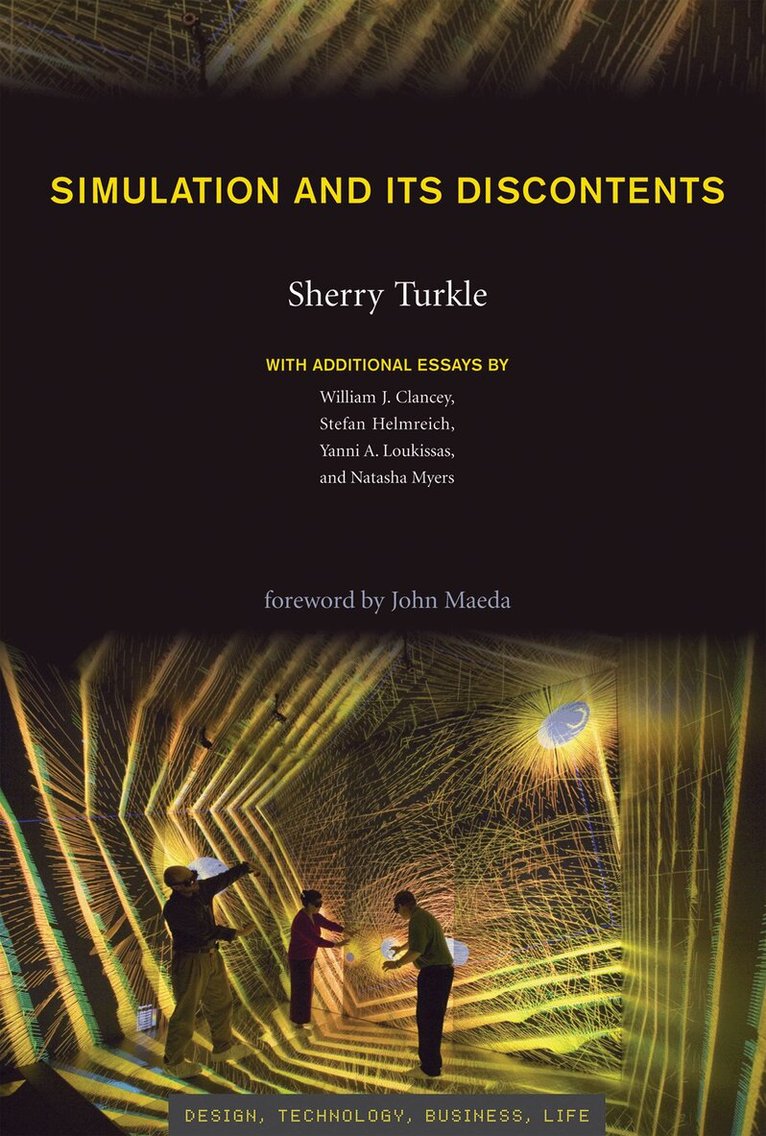
How the simulation and visualization technologies so pervasive in science, engineering, and design have changed our way of seeing the world.
Over the past twenty years, the technologies of simulation and visualization have changed our ways of looking at the world. In Simulation and Its Discontents, Sherry Turkle examines the now dominant medium of our working lives and finds that simulation has become its own sensibility. We hear it in Turkle''s description of architecture students who no longer design with a pencil, of science and engineering students who admit that computer models seem more “real” than experiments in physical laboratories.
Echoing architect Louis Kahn''s famous question, “What does a brick want?”, Turkle asks, “What does simulation want?” Simulations want, even demand, immersion, and the benefits are clear. Architects create buildings unimaginable before virtual design; scientists determine the structure of molecules by manipulating them in virtual space; physicians practice anatomy on digitized humans. But immersed in simulation, we are vulnerable. There are losses as well as gains. Older scientists describe a younger generation as “drunk with code.” Young scientists, engineers, and designers, full citizens of the virtual, scramble to capture their mentors'' tacit knowledge of buildings and bodies. From both sides of a generational divide, there is anxiety that in simulation, something important is slipping away. Turkle''s examination of simulation over the past twenty years is followed by four in-depth investigations of contemporary simulation culture: space exploration, oceanography, architecture, and biology.

1 139 kr
Läs direkt efter köp
A new conceptualization of the relationship between the systemic and the iconic in real-time simulations that distinguishes among four levels of forming.
Computer simulations conceive objects and situations dynamically, in their changes and progressions. In The Systemic Image, Inge Hinterwaldner considers not only the technical components of dynamic computer simulations but also the sensory aspects of the realization. Examining the optic, the acoustic, the tactile, and the sensorimotor impressions that interactive real-time simulations provide, she finds that iconicity plays a dominant yet unexpected role. Based on this, and close readings of a series of example works, Hinterwaldner offers a new conceptualization of the relationship between systemic configuration and the iconic aspects in these calculated complexes.
Hinterwaldner discusses specifications of sensorialization, necessary to make the simulation dynamic perceivable. Interweaving iconicity with simulation, she explores the expressive possibilities that can be achieved under the condition of continuously calculated explicit changes. She distinguishes among four levels of forming: the systems perspective, as a process and schema that establishes the most general framework of simulations; the mathematical model, which marks off the boundaries of the simulation''s actualization; the iconization and its orientation toward the user; and interaction design, necessary for the full unfolding of the simulation. The user makes manifest what is initially latent. Viewing the simulation as an interface, Hinterwaldner argues that not only does the sensorially designed aspect of the simulation seduce the user but the user also makes an impact on the simulation—on the dynamic and perhaps on the iconization, although not on the perspectivation. The influence is reciprocal.
875 kr
Skickas inom 7-10 vardagar
982 kr
Skickas
The book is divided into three parts. Part I discusses the relationship between sensory stimuli and neural responses, focusing on the representation of information by the spiking activity of neurons. Part II discusses the modeling of neurons and neural circuits on the basis of cellular and synaptic biophysics. Part III analyzes the role of plasticity in development and learning. An appendix covers the mathematical methods used, and exercises are available on the book's Web site.
606 kr
Skickas inom 7-10 vardagar
690 kr
Skickas inom 7-10 vardagar
534 kr
Skickas inom 3-6 vardagar
3 303 kr
Skickas inom 10-15 vardagar
3 303 kr
Skickas inom 10-15 vardagar
1 704 kr
Skickas inom 10-15 vardagar
2 270 kr
Skickas inom 10-15 vardagar
556 kr
Skickas inom 10-15 vardagar