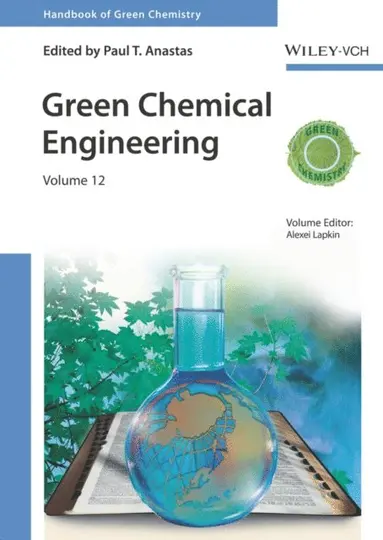
Green Chemical Engineering, Volume 12
Del i serien Handbook of Green Chemistry
1 763 kr
Tillfälligt slut. Bevaka för att få ett mejl när produkten kan beställas.
Fler format och utgåvor
Beskrivning
Produktinformation
- Utgivningsdatum:2018-08-01
- Mått:170 x 241 x 25 mm
- Vikt:930 g
- Format:Inbunden
- Språk:Engelska
- Serie:Handbook of Green Chemistry
- Antal sidor:396
- Förlag:Wiley-VCH Verlag GmbH
- Medarbetare:Alexei Lapkin
- ISBN:9783527326433
Utforska kategorier
Mer om författaren
Paul T. Anastas joined Yale University as Professor and serves as the Director of the Center for Green Chemistry and Green Engineering at Yale. From 2004-2006, Paul Anastas has been the Director of the Green Chemistry Institute in Washington, D.C. Until June of 2004 he served as Assistant Director for Environment at e White House Office of Science and Technology Policy where his responsibilities included a wide range of environmental science issues including furthering international public-private cooperation in areas of Science for Sustainability such as Green Chemistry. In 1991, he established the industry-government-university partnership Green Chemistry Program, which was expanded to include basic research, and the Presidential Green Chemistry Challenge Awards. He has published and edited several books in the field of Green Chemistry and one of the inventors of the 12 principles of Green Chemistry. Alexei Lapkin is Professor of Sustainable Reaction Engineering at the Univeristy of Cambridge. He received his PhD in Chemical Engineering at the University of Bath in 2000 and held a Lecturer position until 2009. He then moved to University of Warwick, School of Engineering, to help to develop their research programme in Chemical Engineering. In 2013 he took over his position in Cambridge.
Innehållsförteckning
- About the Editors XIIIList of Contributors XVPreface XIX1 Chemical Engineering Science and Green Chemistry – The Challenge of Sustainability 1Alexei A. Lapkin1.1 Sustainability Challenge for the Chemical Industry 11.2 From Green to Sustainable Chemistry 51.3 Chemical Engineering Science for Sustainability 71.4 Trends in Chemical Engineering Science 91.5 Topics Covered in This Book 11Acknowledgment 13References 13Part One: Molecular Engineering of Materials, Reactions, and Processes 172 Recent Advances in the Molecular Engineering of Solvents for Reactions 19Eirini Siougkrou, Amparo Galindo, and Claire S. Adjiman2.1 Introduction 192.2 Solvent Effects on Reactions 222.3 Design or Selection of Solvents for Chemical Reactions 262.3.1 Model-Based Screening Methods 272.3.2 Generate-and-Test Methods 282.3.3 Optimization-Based Methods 302.3.4 Discussion 342.4 A Case Study 352.5 Conclusions 38Acknowledgments 38References 393 Hierarchically Structured Pt and Non-Pt-Based Electrocatalysts for PEM Fuel Cells 47Panagiotis Trogadas and Marc-Olivier Coppens3.1 Introduction 473.2 Pure Hollow Pt Nanoparticles 493.3 Hollow Pt Metal Alloys 513.3.1 PtAu 523.3.2 PtAg 533.3.3 PtCo 563.3.4 PtNi 583.3.5 PtRu 593.3.6 PtPd 613.3.7 PtCu 623.4 Non-Pt Alloy Nanostructures 633.5 Conclusions and Outlook 64Acknowledgment 65References 654 New Frontiers in Biocatalysis 73John M. Woodley and Nicholas J. Turner4.1 Introduction 734.2 Recent Advances in Biocatalysis 744.3 Biocatalytic Retrosynthesis 754.4 Process-Driven Protein Engineering 804.5 Process Developments 834.5.1 Continuous Processes 834.5.2 Kinetic Analysis 844.6 Future Perspectives 84References 85Part Two: Innovations in Design, Unit Operations, and Manufacturing 875 Conceptual Process Design and Process Optimization 89Alexander Mitsos, Ung Lee, Sebastian Recker, and Mirko Skiborowski5.1 Introduction 895.2 Mathematical Background 895.2.1 System of Nonlinear Equations 905.2.2 Nonlinear Programming (NLP) 905.2.3 Mixed Integer Programming 925.3 Synthesis 935.3.1 Reactor Networks 935.3.2 Separation Systems 955.3.3 Overall Flowsheets 975.4 Superstructure-Based Techniques 1015.4.1 Heat Exchange Networks 1015.4.2 Process Flowsheet Optimization 1035.5 Integrated Process Design, Operation, and Control 1055.6 Water and Energy Processes 1055.7 Conclusions and Outlook 107References 1076 Development of Novel Multiphase Microreactors: Recent Developments and Future Challenges 115Evgeny Rebrov6.1 Principles and Features 1156.1.1 Continuous Phase Multiphase Microreactors 1156.1.1.1 Falling Film Microreactor 1156.1.1.2 Mesh Contactor 1166.1.2 Dispersed Phase Multiphase Microreactors 1166.1.2.1 Segmented Flow Microreactors 1166.1.2.2 Microstructured Packed Beds 1176.1.2.3 Prestructured Microreactors 1186.1.2.4 Foam Microreactors 1206.1.2.5 Microreactors with Fibrous Internal Structures 1206.2 Experimental Practice 1216.2.1 Flow Regimes 1216.2.1.1 Capillary Microreactors 1216.2.1.2 Structured Packed Beds 1226.2.2 Dispersion and Holdup in Microstructured Packed Bed Reactors 1236.2.2.1 Liquid Holdup 1236.2.2.2 Hydrodynamic Dispersion 1246.3 Modeling Features 1256.3.1 Hydrodynamics 1256.3.1.1 Falling Films Microreactors 1256.3.2 Pressure Drop in Capillary Microreactors 1276.3.2.1 Gas–Liquid Microreactors 1276.3.2.2 Liquid–Liquid Microreactors 1306.3.3 Mass Transfer 1316.3.3.1 Capillary Microreactors 1316.3.3.2 Falling Film Microreactors 1336.3.4 Two-Phase Flow Distribution 1336.4 Applications 1366.4.1 Falling Film Microreactors 1366.4.2 Capillary Microreactors 1376.4.2.1 Wall Coated Catalytic Microreactors 1376.4.2.2 Phase Transfer Catalysis in Microreactors 1396.4.2.3 Microstructured Packed Bed Reactors 1426.5 Conclusions and Outlook 144References 1447 Process Intensification through Continuous Manufacturing: Implications for Unit Operation and Process Design 153Sebastian Falß, Nicolai Kloye, Manuel Holtkamp, Angelina Prokofyeva, Thomas Bieringer, and Norbert Kockmann7.1 Continuous Processes as a Means of Process Intensification 1537.2 Equipment for Continuous Processes 1587.2.1 Upstream Equipment 1597.2.1.1 Reactors without Active Mixing 1597.2.1.2 Reactors with Dynamic Mixing 1617.2.2 Downstream Equipment 1637.2.3 Process Integration 1657.2.4 Continuous Equipment as Enabling Technology 1667.3 Process Development and Implementation for Continuous Processes 1687.3.1 Process Development and Scale-Up 1687.3.2 Flexible Implementation of Continuous Processes 1727.4 Selected Case Studies 1747.5 Conclusion and Outlook 180References 1828 How Technical Innovation in Manufacturing Is Fostered through Business Innovation 191Nicolas Eghbali, Marianne Hoppenbrouwers, Steven Lemain, Gert De Bruyn, and Bart Vander Velpen8.1 General Introduction 1918.2 Concept of Chemical Leasing and Take Back Chemicals 1928.2.1 The Concept of Take Back Chemicals 1948.2.2 Advantages and Challenges of the Take Back Chemicals Model 1958.2.2.1 What Are the Advantages of Implementing TaBaChem 1968.2.2.2 What Are the Impediments in Implementing the New Business Models? 1978.3 General Economic, Technical, and Management Aspects 1988.3.1 Economic Aspects 1988.3.1.1 Direct Gains, Indirect Gains, and Investments 1988.3.1.2 Pricing 1998.3.1.3 Conclusion on the Economic Aspects 2008.3.2 Technical Aspects 2018.3.2.1 Reuse of Chemicals 2018.3.2.2 Process Optimization 2018.3.2.3 Conclusion on the Technical Aspects 2018.3.3 Organizational/Managerial Aspects 2028.3.3.1 Sales 2028.3.3.2 Quality Assurance 2028.3.3.3 Tendering and Rewarding 2028.3.3.4 Knowledge Sharing 2028.3.3.5 Logistics 2038.3.3.6 Conclusion on the Organizational/Managerial Aspects 2038.4 Compatibility of the Service Model with the Actual Legislation: Some Important Aspects 2038.4.1 Transition from Sales to Providing a Service to the Customer 2048.4.1.1 The Supplier Retains Ownership of the Chemical 2048.4.1.2 Result-Oriented Services Lead to Different Pricing of a Chemical 2048.4.1.3 A Transparent and Elaborated Contract Is Necessary 2058.4.2 Closing the Life Cycle and Preventing Waste 2058.4.3 Business Confidentiality and the Protection of Competition 2088.4.3.1 Intellectual Property Rights 2088.4.3.2 Competition 2088.5 General Conclusion 211References 2119 Applications of 3D Printing in Synthetic Process and Analytical Chemistry 215Victor Sans, Vincenza Dragone, and Leroy Cronin9.1 Introduction 2159.1.1 Polymerization-Based Additive Manufacturing (AM) 2169.1.1.1 Stereolithography (SLA) 2179.1.1.2 Photopolymer Jetting (PJ) 2179.1.1.3 Physical Binding 2179.1.2 Melting-Based Techniques 2189.1.2.1 Selective Laser Melting (SLM) 2189.1.2.2 Electron Beam Melting (EBM) 2189.1.2.3 Fused Deposition Modeling (FDM) 2199.1.2.4 Laser Sintering (LS) 2199.1.2.5 Material Jetting (MJ) 2199.2 Chemical Reactors Manufacturing by Additive Manufacturing Techniques 2209.2.1 3D Printing Technologies in Chemistry 2209.3 3D Printing Applied to Flow Chemistry 2269.3.1 Mesoscale Reactors 2269.3.2 3D Printed Membranes 2359.4 Applications of 3D Printed Flow Devices in Analytical Chemistry 2399.4.1 3D Printing of Valves, Pumps and Actuators 2399.4.2 Modular Devices Based on SL 2429.5 Future Trends 2489.5.1 Ultrafast Printing 2499.5.2 Smart Materials through 4D Printing 2509.6 Conclusions 251References 252Part Three: Enabling Technologies 25710 Process Analytical Chemistry and Nondestructive Analytical Methods: The Green Chemistry Approach for Reaction Monitoring, Control, and Analysis 259Miriam Fontalvo Gómez, Boris Johnson Restrepo, Torsten Stelzer, and Rodolfo J. Romañach10.1 Green Chemistry and Chemical Analysis in Manufacturing 25910.2 Process Analytical Chemistry: Concept and Objectives 26010.3 Vibrational Spectroscopy 26410.4 Challenges to Overcome 26810.5 Applications of Process Analytical Chemistry and Nondestructive Analyses 27010.5.1 Dairy Industry 27010.5.2 Synthesis of Active Pharmaceutical Ingredients 27110.5.3 Preparation of Polymeric Strip Film Unit Dosage Forms 27310.5.4 Polymer Industry 27410.5.5 Process Analytical Chemistry for Biodiesel Production 27610.6 Future Trends in PAC 279Acknowledgments 281References 28111 NMR Spectroscopy and Microscopy in Reaction Engineering and Catalysis 289Carmine D’Agostino, Mick D. Mantle, and Andrew J. Sederman11.1 Introduction 28911.2 Basic Principles of NMR 29011.2.1 Nuclear Spins and Bulk Magnetization 29011.2.2 NMR Spectroscopy of Liquids 29311.2.3 NMR Relaxation 29511.2.3.1 Spin–Lattice Relaxation 29511.2.3.2 Spin–Spin Relaxation 29611.2.4 Pulsed Field Gradient NMR 29711.3 The NMR Toolkit in Reaction Engineering and Catalysis 29911.3.1 NMR Spectroscopy in Catalysis and Reaction Engineering 30011.3.2 Diffusion of Fluids Confined in Porous Catalysts 30611.3.2.1 Catalyst Deactivation Studies Using PFG NMR 31111.3.3 NMR Relaxation Time Analysis in Porous Catalytic Materials 31411.3.4 Combining NMR Spectroscopy withMagnetic Resonance Imaging 31911.4 Summary 324References 32412 An Introduction to Closed-Loop Process Optimization and Online Analysis 329Christopher S. Horbaczewskyj, Charlotte E. Willans, Alexei A. Lapkin, and Richard A. Bourne12.1 Introduction 32912.2 Principles of Self-Optimization and Requirements for Experimental Systems 33012.3 Analytical Techniques for Closed-Loop Optimization 33212.4 Decision Algorithms in Closed-Loop Optimization 33412.4.1 Algorithms for Discovery 33512.4.2 Algorithms for Developing Process Understanding 33712.4.3 Algorithms for Automated Process Optimization 33812.5 Application Examples of Closed-Loop Discovery and Optimization 34112.5.1 Discovery in Closed-Loop Self-Optimization 34112.5.2 High-Throughput Screening 34212.5.3 Examples of One-Variable-at-a-Time Reaction Optimization 34412.5.4 Examples of Application of Design of Experiments 34612.5.5 Rate-Based/Physical Organic Approaches 35012.5.6 Examples of Algorithm-Based Self-Optimization 36412.6 Conclusions and Future Directions 368Acknowledgments 369References 369Index 375
Du kanske också är intresserad av
- -52%
Pixi adventskalender 2025 : Med böcker av Maria Trolle, Maria Nilsson Thore, Johan Anderblad, Filippa Widlund, Mårten Melin Elsa Beskow, Lotta Olsson mfl
Flera Författare
Häftad, 2025
129 kr269 kr