Coral Reefs of Cuba
3 087 kr
Beställningsvara. Skickas inom 10-15 vardagar. Fri frakt över 249 kr.
Fler format och utgåvor
Beskrivning
Produktinformation
- Utgivningsdatum:2024-12-28
- Mått:210 x 279 x 25 mm
- Vikt:1 093 g
- Format:Häftad
- Språk:Engelska
- Serie:Coral Reefs of the World
- Antal sidor:438
- Förlag:Springer International Publishing AG
- ISBN:9783031367212
Utforska kategorier
Mer om författaren
Dr. Vassil N. Zlatarski was born in Sofia, Bulgaria in 1936. He holds a Ph.D. in Geology from the Bulgarian Academy of Sciences of Sofia and a D.Sc. in Biology from Russian Academy of Sciences of Moscow. He Studied fossil and modern corals and reefs in Bulgaria, France, Cuba, Mozambique, Mexico, Panama, and USA. He worked as a University Professor in Mexico, USA and Cuba. The monograph “The Scleractinians of Cuba” written by Dr. Zlatarski and Nereida Martínez Estalella was published in Russian in 1980, French in 1982, and Spanish in 2018. Dr. Zlatarski is now retired and a self-employed scientist.Prof. John K. Reed was born in Middletown, Ohio in 1948, and is a recently retired Research Professor at Harbor Branch Oceanographic Institute (HBOI), Florida Atlantic University, USA. John’s research on discovery and conservation of mesophotic and deep-water reefs began 47 years ago when he started at HBOI. He has >100 publications and reports on worldwide research expeditions, deep-sea coral reef research, and biomedical research. John received his B.S. from the University of Miami and M.S., specializing in marine ecology, from Florida Atlantic University in 1975.Dr. Shirley A. Pomponi is a Research Professor at Harbor Branch Oceanographic Institute – Florida Atlantic University. She earned her Ph.D. in Biological Oceanography from the University of Miami, Rosenstiel School of Marine and Atmospheric Science. An ocean explorer and marine biotechnologist, her research focuses on marine sponges, and in particular, the development of sustainable methods for production of sponge-derived chemicals with human health applications. Her research group developed the first marine invertebrate (sponge) cell line in 2019. The has participated in or led dozens of research expeditions worldwide and has made more than 300 dives in the Johnson-Sea-Link submersibles. She has authored or co-authored more than 100 peer-reviewed scientific publications and is co-inventor on several patents. In June 2022, she received a Lifetime Achievement Award from the Society for In Vitro Biology.Dr. Sandra Brooke was born just west of London. After completing her undergraduate and M.Sc degrees in England, she worked in mosquito control in the Cayman Islands, where she learned to dive and discovered marine biology. She then obtained an M.A in Marine Biology from the Virginia Institute of Marine Science, and a Ph.D (2002) from the Southampton Oceanography Center, UK.Her research focuses primarily on coral reefs in both shallow and deep waters, specifically understanding their distribution, abundance, and life histories, as well as how they are affected by anthropogenic impacts. Dr. Brooke has worked in the Aleutian Islands of Alaska, Norwegian Fjords, South Atlantic Bight, Gulf of Mexico, and Mid-Atlantic canyons, and her research uses submersibles, Remotely Operated Vehicles, benthic landers and in situ experimentation to enhance our understanding of deep-sea coral biology, ecology and vulnerability to disturbance.Stephanie Farrington graduated with her Master’s in Marine Biology in 2008 from Nova Southeastern University, working under Dr. Charles Messing on the Biogeography of the Straits of Florida. After graduation she started her career working under John Reed at Harbor Branch Oceanographic Institute at Florida Atlantic University until John’s retirement in 2022. At HBOI, she was a Research Biologist concentrating on deep-sea and mesophotic habitats around the SE US, Gulf of Mexico and Cuba.Stephanie is now a Fisheries Scientist III NOAA Contractor at the Panama City Fisheries Lab working on the Mesophotic and Deep Benthic Communities (MDBC) program in the northern Gulf of Mexico. She is focused on coral reef restoration and exploration centeredaround the aftermath of the Deep-Water Horizon oil spill.
Innehållsförteckning
- Part I. Introduction.- Chapter 1. Insights from Cuban Coral Reefs.- Part II. History.- Chapter 2. Research History of Corals and Coral Reefs in Cuba.- Part III. Description.- Chapter 3. Physical-Geographic Characteristics of Cuban Reefs.- Chapter 4. Outline of the Geology, Geomorphology and Evolution of the Late Qua-ternary Shelf and Uplifted Marine Terraces of Cuba; Tectonic and Sea Level Control of Present Day Coral Reef Distribution.- Chapter 5. A Remote Sensing Appraisal of the Extent and Geomorphological Diversity of the Coral Reefs of Cuba.- Part IV. Biota.- Chapter 6. Macrophytes Associated with Cuban Coral Reefs.- Chapter 7. Sponges: Conspicuous Inhabitants of the Cuban Coral Reefs and Their Potential as Bioindicators of Contamination.- Chapter 8. Species List of Cuban Stony Corals: Class Anthozoa, Order Scleractinia; Class Hydrozoa, Suborders Capitata and Filifera.- Chapter 9. Octocoral Forests: Distribution, Abundance, and Species Richness in Cuban Coral Reefs.- Chapter 10. Current State of Knowledge of Reef Mollusks in Cuba.- Chapter 11. Herbivory on Cuban Coral Reefs.- Chapter 12. Chronology of the Lionfish Invasion in Cuba and Evaluation of Impacts on Native Reef Fishes.- Chapter 13. Sharks and Rays in Cuban Coral Reefs: Ecology, Fisheries, and Conservation.- Chapter 14. Mesophotic Coral Ecosystems of Cuba.- Part V. Ecology, Conservation and Management.- Chapter 15. Status of Cuban Coral Reefs.- Chapter 16. Population Genetics of Cuba’s Scleractinian Corals.- Chapter 17. Multiple Cumulative Effects on Coral Reefs of the Northwestern Cuban Region.- Chapter 18. Guanahacabibes National Park: Research, Monitoring and Man-Agement for the Conservation of Coral Reefs.- Chapter 19. Ciénaga de Zapata Biosphere Reserve: Integrating Science with the Management of Coral Reefs.- Chapter 20. Coral Reefs in Cuban Marine Protected Areas.- Part VI. Economic Valuation.- Chapter 21. Economic Valuation of the Coral Reefs of Jardines de la Reina and Punta Francés National Parks, Cuba.- Chapter 22. The Economic Value of Coral Reefs in the Context of Marine Protected Areas: Experiences of the South Cuban Archipelago Project.- Chapter 23. Fish Can Be More Valuable Alive Than Dead.
Mer från samma serie
Coral Reefs of the Western Pacific Ocean in a Changing Anthropocene
Jing Zhang, Thamasak Yeemin, R. John Morrison, Gi Hoon Hong
Inbunden, 2022
1 657 kr
Coral Reefs of the Western Pacific Ocean in a Changing Anthropocene
Jing Zhang, Thamasak Yeemin, R. John Morrison, Gi Hoon Hong
Häftad, 2023
1 657 kr
Coral Reef Conservation and Restoration in the Omics Age
Madeleine J. H. van Oppen, Manuel Aranda Lastra
Inbunden, 2022
1 657 kr
Coral Reef Conservation and Restoration in the Omics Age
Madeleine J. H. van Oppen, Manuel Aranda Lastra
Häftad, 2023
1 040 kr
Coral Reefs of Eastern Asia under Anthropogenic Impacts
Ichiro Takeuchi, Hideyuki Yamashiro
Inbunden, 2023
2 427 kr
Du kanske också är intresserad av
- -15% på allt
Coral Reefs of Cuba
Vassil N. Zlatarski, John K. Reed, Shirley A. Pomponi, Sandra Brooke, Stephanie Farrington
Inbunden, 2023
3 087 kr
Coral Reefs of Cuba
Stephanie Farrington, Sandra Brooke, Shirley A. Pomponi, John K. Reed, Vassil N. Zlatarski
4 038 kr
Mediterranean Cold-Water Corals: Past, Present and Future
Covadonga Orejas, Carlos Jiménez
Inbunden, 2019
3 087 kr
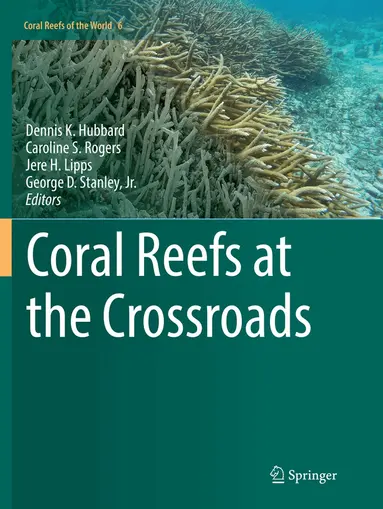
Coral Reefs at the Crossroads
Dennis K. Hubbard, Caroline S. Rogers, Jere H. Lipps, George D. Stanley, Jr.
Häftad, 2018
1 327 kr
Coral Reefs of Eastern Asia under Anthropogenic Impacts
Ichiro Takeuchi, Hideyuki Yamashiro
Inbunden, 2023
2 427 kr