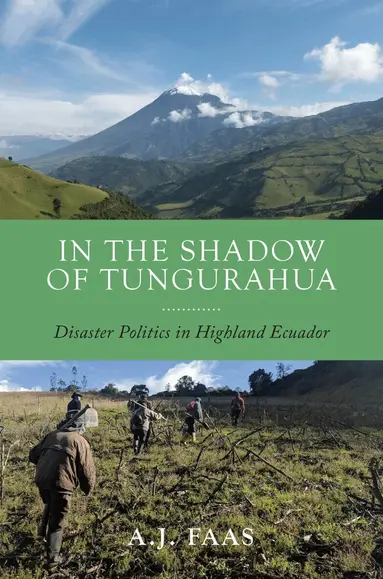
"In the Shadow of Tungurahua is a powerful reminder of ethnography's analytical and methodological value in the anthropological study of disasters. Weaving theoretical reflections with ethnographic storytelling, Faas examines the ways people work tirelessly to make meaningful lives in catastrophe's aftermath and how disaster affected communities are often haunted by colonial and post-colonial political ecological processes that engender disasters. Books like this are few and far between."— Roberto E. Barrios, author of Governing Affect: Neoliberalism and Disaster Reconstruction"Tungurahua is a volcano that erupted ten years before Faas completed his fieldwork in Penipe...[L]ike the volcano, Faas's In the Shadow of Tungurahua is similarly potent due to the scope of its scholarly interventions, for how it brings together the anthropologies of work, risk, and disaster. It is also potent for how it keeps the ethnographic encounter front and center, which breathes life into the text."— Exertions, the Journal of the Society for the Anthropology of Work"In the Shadow of Tungurahua, by A.J. Faas, is a frame story, a structure that allows a rich tapestry of place-based stories to unfold...Faas understands the present situation of people responding to disaster not as an unexpected development but a manifestation of centuries of social and political activity in a place permanently plagued by conquest and resistance – but it is anything but simplistic."— Disaster Prevention and Management"A. J. Faas masterfully presents the stories of residents who were affected by the 1999 and 2006 volcanic eruptions of Tungurahua in the Sierra of central Ecuador [and] provides valuable insight into the politics of disasters. The accounts and experiences of the people of Penipe following the eruption and during their resettlement are powerful, and readerswill quickly feel transported to the streets, porches, agricultural fields, and communal buildings where these events unfolded."— Journal of Latin American Geography"This book demonstrates how deeply an anthropological eye can probe when guided by solid theory, methodology, and long and careful fieldwork. A.J. Faas makes a transformative contribution to the study of disasters and politics in Ecuador, Latin America, and the Global South. It's a delightful read, rich in ethnographic detail and engaging prose, and a testament to the value of anthropological approaches to the study of disaster."— Virginia García-Acosta, editor of The Anthropology of Disasters in Latin America: State of the Art"An extensive, on-the-ground and people-centered look at ordinary, 'bare life' living of the campesinos living on the Tungurahua volcano's mountainside. . . . This scholarly contribution would appeal to any disaster scholar in any discipline who grapples with concepts of belonging, attachment to space, agency, and human–nature relationships."— Journal of Disaster Studies"In the Shadow of Tungurahua is a powerful reminder of ethnography's analytical and methodological value in the anthropological study of disasters. Weaving theoretical reflections with ethnographic storytelling, Faas examines the ways people work tirelessly to make meaningful lives in catastrophe's aftermath and how disaster affected communities are often haunted by colonial and post-colonial political ecological processes that engender disasters. Books like this are few and far between."— Roberto E. Barrios, author of Governing Affect: Neoliberalism and Disaster Reconstruction"Tungurahua is a volcano that erupted ten years before Faas completed his fieldwork in Penipe...[L]ike the volcano, Faas's In the Shadow of Tungurahua is similarly potent due to the scope of its scholarly interventions, for how it brings together the anthropologies of work, risk, and disaster. It is also potent for how it keeps the ethnographic encounter front and center, which breathes life into the text."— Exertions, the Journal of the Society for the Anthropology of Work"In the Shadow of Tungurahua, by A.J. Faas, is a frame story, a structure that allows a rich tapestry of place-based stories to unfold...Faas understands the present situation of people responding to disaster not as an unexpected development but a manifestation of centuries of social and political activity in a place permanently plagued by conquest and resistance – but it is anything but simplistic."— Disaster Prevention and Management"A. J. Faas masterfully presents the stories of residents who were affected by the 1999 and 2006 volcanic eruptions of Tungurahua in the Sierra of central Ecuador [and] provides valuable insight into the politics of disasters. The accounts and experiences of the people of Penipe following the eruption and during their resettlement are powerful, and readerswill quickly feel transported to the streets, porches, agricultural fields, and communal buildings where these events unfolded."— Journal of Latin American Geography"This book demonstrates how deeply an anthropological eye can probe when guided by solid theory, methodology, and long and careful fieldwork. A.J. Faas makes a transformative contribution to the study of disasters and politics in Ecuador, Latin America, and the Global South. It's a delightful read, rich in ethnographic detail and engaging prose, and a testament to the value of anthropological approaches to the study of disaster."— Virginia García-Acosta, editor of The Anthropology of Disasters in Latin America: State of the Art