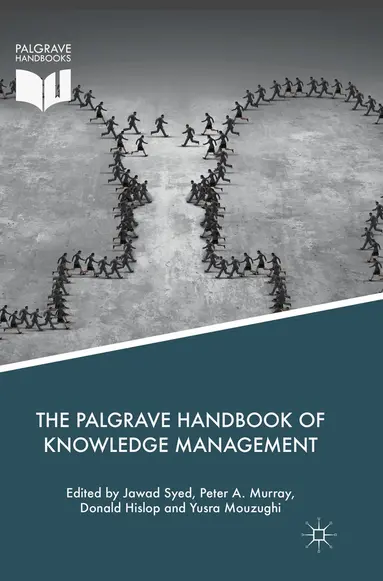
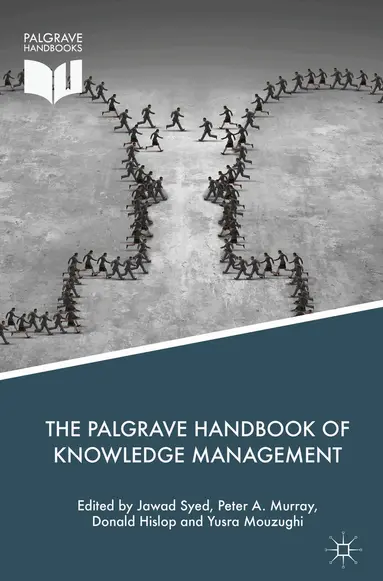
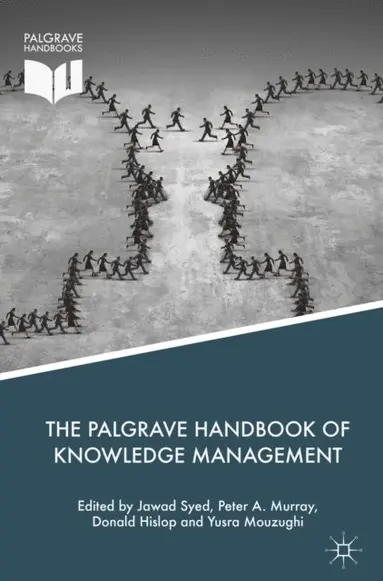
The Palgrave Handbook of Knowledge Management
Jawad Syed, Peter A. Murray, Donald Hislop, Yusra Mouzughi
Häftad, 2018
1 741 kr
410 kr
Tillfälligt slut. Bevaka för att få ett mejl när produkten kan beställas.
Peter Murray teaches Sociology at NUI Maynooth. His research for this book was supported by the Irish Research Council for the Humanities and Social Sciences.
'Murray has produced an important historical account that all students of the economic development of modern Ireland will have to take account of in the future.' Irish Studies Review, August 2010 "This book might be a rejoinder to Fosters as it shows that the economic development of the Republic and its prosperity up to the current recession were the product of decades of policy and planning. Murray shows how the stagnation of the Republic in the 1950s and mass emigration led to a radical rethink in the state's economic policies. Joining the European Economic Community was seen as the best means to ensure economic prosperity. To do that meant ditching inefficient domestic industries, modernising the industrial sector and supporting innovation. To achieve this Ireland accepted US aid under the Marshall Plan which enabled schemes to improve industrial technology and productivity. Murray follows this through showing the long-term impact of these policies and charting the rise in Irish industrial visibility and how all this fitted into the plans to join the EEC." Books Ireland September 2009 'Murray, who teaches Sociology at the National University of Ireland, Maynooth, presents a policy and institutional analysis of a critical period for the Irish Republic. Caught amid the economic promise of Europe and the US-promoted Cold War vision of global capitalism, Ireland recognised that its future would rest in best taking advantage of its hard-won independence to transform itself. Distancing Ireland from continued overreliance on trade relations with the UK, the republic tried to leverage both the US and Europe to set it own course to economic independence. While examining the importance of education, labour, management and government, Murray explicates the very complicated role of government policy and the bewildering variety of acronymic government bureaus. To no one's surprise, the author reveals the very uneven accomplishments of policy initiatives over the period studied. To answer the title's eponymous question, Murray would respond with the qualified 'maybe'. Recommended to undergraduates and above.' Choice August 2010 Vol. 47 No. 11 'Peter Murray's deftly researched and well-argued book is an important addition to the scholarly literature probing the actual working and influence of the E.R.P. (European Recovery program). One of a growing number of country-specific studies, Murray's work reveals an important dimension of the relationship between Marshall Aid, European business recovery and local challenges posed by American post-war economic dominance: he shows how Marshall Aid largesse often acted as a double-edged sword, carrying both the hopeful promise of economic rehabilitation, but, with it, the heavy cost of reforming indigenous business practices in line with American managerial models.Murray's work illuminates the historic persistence of Ireland's long, frustrating struggle to achieve full economic independence.' Irish Historical Studies 37 (146) 2010
Jawad Syed, Peter A. Murray, Donald Hislop, Yusra Mouzughi
Häftad, 2018
1 741 kr
Jawad Syed, Peter A. Murray, Donald Hislop, Yusra Mouzughi
Inbunden, 2018
2 479 kr
Yusra Mouzughi, Donald Hislop, Peter A. Murray, Jawad Syed
2 194 kr

Yusra Mouzughi, Donald Hislop, Peter A. Murray, Jawad Syed
2 194 kr
Jawad Syed, Peter A. Murray, Donald Hislop, Yusra Mouzughi
Inbunden, 2018
2 479 kr
Jawad Syed, Peter A. Murray, Donald Hislop, Yusra Mouzughi
Häftad, 2018
1 741 kr

Vendela Wikström
Kartonnage, 2026
259 kr
Marcus Frank
Inbunden, 2026
269 kr