
- Nyhet
Harness Engineering
Design Patterns for Securing Long-Horizon Multi-Agent AI Systems
Häftad, Engelska, 2026
715 kr
Beställningsvara. Skickas inom 7-10 vardagar. Fri frakt över 249 kr.
Beskrivning
Build a secure control plane for agentic AI with design patterns for bounded autonomy, least privilege identity, trusted context, governed memory, and runtime recoveryKey FeaturesDesign a security control plane for long running agents and delegated multi-agent workContain prompt injection and memory poisoning through enforceable trust boundariesUse HarnessLab scenarios to connect design patterns with observable control decisionsBook DescriptionLong-running AI agents need controls that hold across tool calls, delegated tasks, and persistent memory. Harness Engineering presents design patterns for securing long-horizon multi-agent AI systems through a control plane that governs autonomy, identity, intent, context, and memory. Learn to scope agent permissions, contain prompt injection, detect goal drift, and place human oversight where consequential actions require it.Through architectural diagrams and HarnessLab scenarios, explore decision tracing, evaluation gates, runtime intervention, recovery, fleet coordination, and data governance. Build the engineering judgment to make agent behavior observable, authority accountable, and improvement measurable, so you can move from promising prototypes to controlled production operations.What you will learnSet autonomy budgets and risk based human approval gatesScope agent identities, credentials, and delegation chainsBind tool authority to intent and detect goal driftContain prompt injection and govern persistent memoryUse decision traces and evals to govern agent improvementSteer live runs and enforce fleet and data boundariesWho this book is forFor AI engineers, security architects, platform teams, and technical leaders designing or governing long running agentic AI systems. Researchers and graduate students will also benefit from its pattern based treatment of agent security and control. Familiarity with LLM applications, tool calling, access control, and distributed systems is recommended. The book supports readers moving from agent prototypes to accountable enterprise operations.
Produktinformation
Utforska kategorier
Mer om författaren
Innehållsförteckning

Hoppa över listan

Du kanske också är intresserad av
Del 13
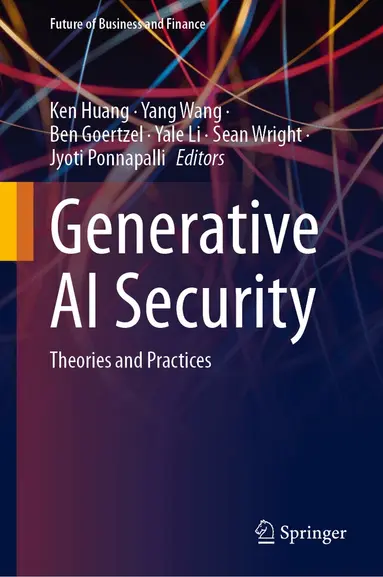
Generative AI Security
Ken Huang, Yang Wang, Ben Goertzel, Yale Li, Sean Wright, Jyoti Ponnapalli
Inbunden, 2024
1 234 kr
- Nyhet